
Booting children off YouTube so they can spend more time watching the BBC sounds wonderfully wholesome to a generation of adults with fond memories of Play School, Jackanory and Blue Peter. But in 2026, children’s television is not so innocent.
Can’t children’s television programmes just be entertaining and informative?
Like literature, education, clubs such as the Scouts and Guides, libraries, art galleries, museums, and just about anything else children might encounter, television is now political. So it is hardly a surprise to learn that CBBC producers have been lobbied by charities and campaigning organisations that are keen to get their message across in output aimed at primary school-aged children. These groups boast of having influenced programme-makers on pro-migrant storylines, according to an investigation this week in the Daily Telegraph.
They have good reason to show off. Heard, a charity that works ‘with people and the media to inspire content that changes hearts and minds’, appears to be particularly successful. Its website features a brief clip of Prince William, suggesting, if not royal endorsement, then certainly influence at the very highest levels. Netflix, the BBC, ITV, Sky, Channel 4: Heard seems to have worked with just about every major media outlet going. And this pays: Heard has received more than £4.5 million in grant funding since its inception in 2021.
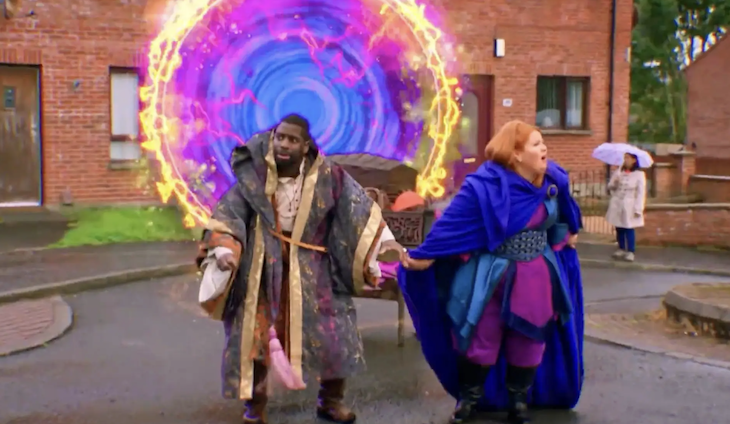
In its bid to ‘tell stories that create change’, Heard experts met with the producers of ‘Pickle Storm’ as they set about creating the second series of the hit CBBC comedy, before its release last year. For the uninitiated, ‘Pickle’ is a young alien who, having experienced persecution on her home planet, seeks refuge in a British town. Hilarity ensues as Pickle and her family meet the locals and ‘try to fit in’. The baddies, of course, are those who make life difficult for the aliens, while the goodies quickly learn to be inclusive.
Worried this allegory might be too subtle for tiny tots? Fear not. Pickle and her father, the heroes of this tale, are played by people of colour, while the actors cast as ‘unwelcoming teacher’ and ‘stupid supermarket employee’ are white men. Of course.
The BBC claims that Heard – which aims to ‘tell stories that create change’ – had no power to influence editing or production, and that consultation with experts is common practice. It said that decisions on using material were signed off by news editors.
But this begs more questions. Why these particular experts? And, even if script-writing is not outsourced to campaigners, why is there a perceived need to hit children over the head with such blunt political messaging? Can’t children’s television programmes just be entertaining and informative?
Pickle Storm is not the first CBBC programme to be accused of pushing a political agenda. Arguably, Grange Hill got there first with its gritty portrayal of a London comprehensive school complete with racial tensions and its 1986 ‘Just Say No’ anti-drugs message. Blue Peter’s Janet Ellis got into trouble the following year after announcing her pregnancy live on air – just weeks after having split from her husband. But such controversies seem either well-intentioned or just plain naive compared to more recent concerted efforts to incorporate political messages into children’s programmes.
In 2022, Horrible Histories tried to present British history as multicultural with its inane song, Been Here From The Start, which includes the jaunty lyric: ‘Before these isles were British, Black people played their part.’ Another episode featured Queen Victoria being taught that ‘British things’, including tea, sugar and cotton, are not British at all. And then there are CBBC series such as ‘First Day’ which feature transgender characters and normalise the idea that sex is not something you are born with, but something that can be changed.
It is easy to see why political activists seek to influence the children’s books, films and television programmes. After all, children are too young to have developed their own opinions and too ignorant to challenge the politics to which they are being subjected. The BBC suggests consulting experts is routine practice; but there is nothing neutral or objective about promoting a pro-migrant message at a time when migration is one of the most contentious issues in the country.
Bringing politics into children’s television programmes breaches the trust of parents who assume that the BBC can be safely relied upon to entertain and educate young children. Parents not only have to put up with programming that might ride roughshod over their own political views but, to add insult to injury, they are expected to pay for the privilege through the licence fee. Enough is enough. If the government is determined to keep kids off social media, it needs to ensure that other sources of entertainment and education are not just of the highest quality but also politically neutral.

Comments