
When the Artemis II mission eventually blasts off, it will take humans back to the Moon for the first time in more than 50 years. Americans Reid Wiseman, Victor Glover, Christina Koch and Canadian Jeremy Hansen will travel further out into space than anyone before when they loop 4,700 miles beyond the Moon, seeing parts of it never before glimpsed by human eyes.
The flight is designed to put the powerful Space Launch System rocket and the Orion capsule, with its European-made Service Module, through their paces. Three hours after launch, the crew will monitor a procedure not performed since 1972, so-called TLI – Trans-Lunar Injection. Only five of the 24 astronauts who have experienced that are still with us. Artemis II will not technically orbit the Moon but perform high-looping trajectories around it. The flight forms part of a what will culminate in a lunar landing mission sometime in the next few years – if Elon Musk’s contribution to it can get its act together in time to beat the Chinese to the next lunar footprint.
It has been a mirror to the world, a stopping place for the souls of the dead, the ruler of tides and temptress of time
While at their furthest from the Earth, one of the astronauts’ duties will be to take pictures of the globes of the Moon and the Earth from their unique vantage point. It will show these two very different worlds alongside each other and perhaps give an inkling of how much they need one another.
Behind the technical accomplishments of the mission and the drama of exploration lies our most ancient companion. You can gather all the facts about the Moon, its size, structure and history. You can map its craters, its vast plains and determine its composition, but the facts alone will never let you know the real Moon. You cannot strip it of its myth and mystery and say it is just a ball of rock. It is far more precious than that. It has a unique place inside us. In a way Leonardo da Vinci was wrong when he wrote it was a mirror to the Earth. It is a mirror, but not of the Earth, but of the hopes and fears of the human soul.

Every creature that has ever lived has done so under the light and influence of the Moon. It was here long before we arrived and may be here long after we have gone. It has been the Earth’s companion since the chaotic birth of the sun and its planets and there are some who believe that, without it, the Earth would not be the bountiful world it is. Throughout the ages it has been praised and feared, but never underestimated.
It has been a mirror to the world, a stopping place for the souls of the dead, the ruler of the tides and the temptress of time. All ancient calendars were lunar calendars. The practice of starting a month by the first sighting of a crescent was observed by the Babylonians and the Hebrews as well as the Germans and the Celts.
It has had many names. In Mesopotamia it was Sin or Ishtar; in Egypt, Hathor; for the Greeks the triple deity Artemis, Selene and Hecate; to the Romans it was Diana; to the Chinese, Guanyin; to the Hindus it was Shiva, unstable and as mysterious as madness; and to the Alaskan Inuit it was Igaluk, the supreme being of the universe.
The Pythagoreans called the Moon the counter-Earth and believed it to be inhabited by animals and plants, like those on our Earth, only greater and more beautiful. Some believed that the Moon was the place souls passed through on the way to the paradise fields of the stars. Greeks located the Elysian Fields, home of the blessed dead, in the Moon, and the shoes of senators were sometimes decorated with ivory crescents to show that after death they would inhabit it.
Later, Rome would teach “the souls of the just are purified in the Moon.” Whatever it was, for Pythagoras and many others who followed him for 2,000 years the Moon marked a fundamental boundary in the cosmos. All things below it were subject to change and decay, while from the Moon upwards there was only eternal perfection.
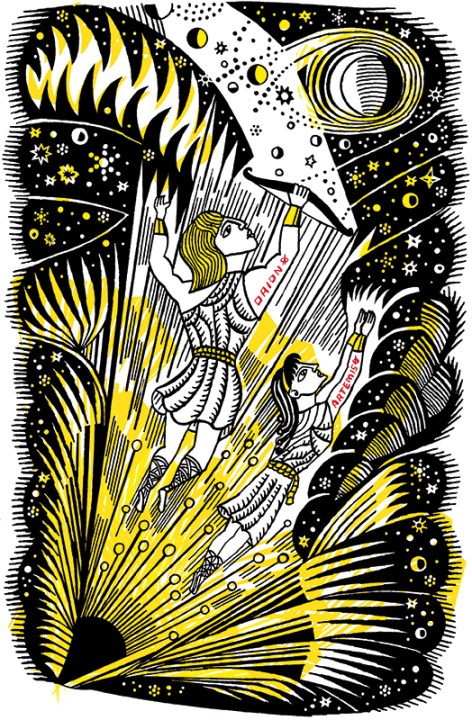
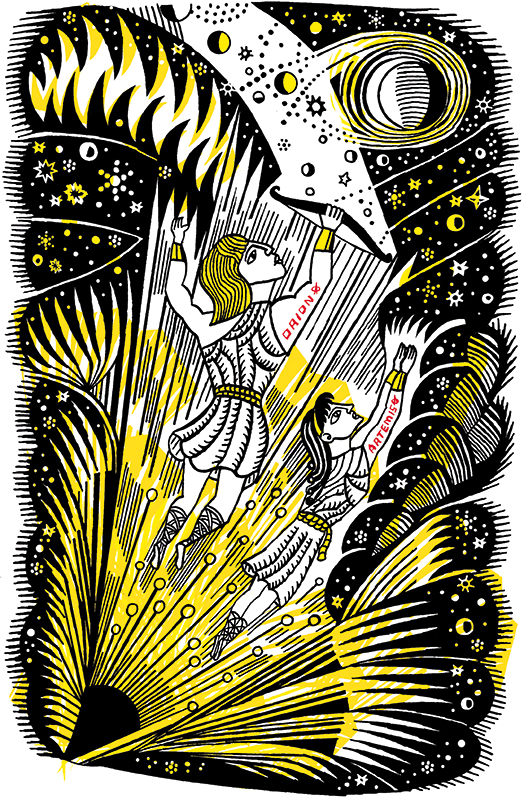
For the Greeks, the Moon was a holy trinity. When growing in the sky she was Artemis, after whom the new mission is named. She was goddess of the hunter and friend to mortals. When full, she was beautiful Selene, from the word selas, meaning “light,” sister to Eos the dawn, known for her love affairs and the three daughters she had by Zeus. But when waning she was the mysterious and brooding Hecate, meaning “influence from afar,” in later years said to be the daughter of Zeus and Hera. She dwelled in the underworld but had power everywhere. The Greeks regarded her as supreme, both in Heaven and Hell, and the owl flying through the moonlit sky is her messenger. Let us hope the Artemis crew do not encounter her.
All the ancients knew there was something hidden, almost sinister, about the Moon’s changing phases and its relationships with water and fertility. Its influence was beneficial yet unsettling, an unseen power that was darker and more mysterious than the unsubtle sun.

Its life in nighttime skies meant that it was not just an observer of human affairs but a participant in them as well as an accomplice to the strange forces of the night. “What is there in thee, Moon! That thou shouldst move my heart so potently,” wrote John Keats in 1818. “This is the light of the mind, cold and planetary,” added Sylvia Plath more recently.
Even today – especially today – the Moon’s influence is pervasive and unappreciated. Few realize that so many of our words and customs stem from the Moon. Sabah is an early word for the Moon; Sabattu was the full-moon day from which we get the word Sabbath. There are some linguists who believe the origin of the word “men” comes from an earlier word for moon.
The familiar nursery rhyme of Jack and Jill (and their going up the hill to fetch a pail of water) is a modification of a far more ancient Norse tale of Hjúki and Bil, who represent the waxing and waning of the Moon. So many legends say that without the Moon, man would be nothing.
Neither would woman. It is not a coincidence that the lunation and the menstrual cycle last the same length of time. The sometimes dim-red light of the lunar eclipse was said to be symbolic of when the Mesopotamian goddess Ishtar, who represents love, sexuality, fertility and war, menstruated. Fertility is the Moon’s gift. In France some women who wish to become pregnant gather at a prehistoric stone and lift their skirts to the Moon; in South America mothers take their children out under the Moon and give thanks.
The Moon in the water is a favorite Zen metaphor for human life, suggesting that it is our senses that mediate between the internal and the external world, like ripples in the reflection of the Moon. In China, during the Han dynasty, the emperor Wu-ti (140-87 BC) had a terrace built overlooking a royal park. It was called fou-yue-t’ai, which means “for viewing the Moon from below.” To do this he added a lake. There is something stirring about drawing down the Moon in water.
In every civilization and every age, mankind has looked up at the moon
In every civilization and every age, mankind has looked up at the Moon. Some 4,000 years ago, huge stones were moved to mark its motions; 400 years ago, crude telescopes were turned toward it. And just a short time ago, in comparison, man walked upon the surface of the silver shrine of Hecate. Now in a new geopolitical age, in the time of social media and AI, we are returning. It is not far away. For some ancient Greeks it was just beyond a spear’s reach or the wings of Icarus. It is only four days by the Artemis II spaceship.
The Moon is mysterious when it rises above some ancient stone structure. Perhaps when the Artemis crew see it from a new angle, they will feel its mystique, realizing it is no “lesser light made to rule the night.” Neil Armstrong, the first man to walk on the Moon, said: “There are secrets on the Moon, there are things to see beyond belief.” So, for a while, think of the Moon and pay no worship to the garish Sun.

Comments