London

Taking on the Cornish culinary mafia: Four Boys reviewed

From our UK edition

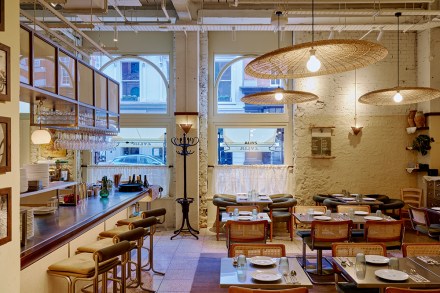
‘Expect David Cameron to be there.’ This was the main thing I had been told before I went to Four Boys in Rock, Cornwall. As I arrive, it makes sense. This is a Cameron-y sort of place and not just because every man in here looks a bit like David Cameron. Why? Well, Cameron’s big idea as leader of the Conservative party was to modernise it. ‘We’ll get elected if we hug hoodies and manage to not pull a face when we see an avocado.’ Four Boys, with its awareness of fashion, is doing something similar. I notice something at the top of the menu when I sit down. ‘We recommend sharing our food.’ What? Small plates?! Sharing?! I’m trying to get away from east London! Yet all has been done judiciously.
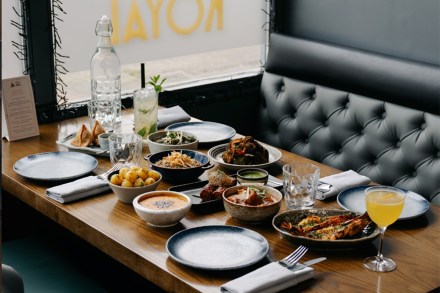
‘If you’re a lamb chop ultra, then start your car’: Koyal reviewed

From our UK edition

One of the things I find most confusing is the practice of going for a curry when you’re hammered. Having tried this with friends a couple of times, I have concluded that anyone who likes the pints-then-curry act is a liar or feels so awful regularly that the feeling afterwards is nothing abnormal. There is no type of food I dislike more than bad Indian: the places where a vindaloo means three scoops of curry powder and a rogan josh means two; where onion is undetectable in the sunflower oil bhaji.

Do we really want to live in a world where we’re perpetually spied on?

From our UK edition

Some people think that the United Kingdom ranks as an unusually surveillance-heavy society, what with all the CCTV installations, doorbell cameras and automatic number plate recognition systems that have proliferated in the public sphere – but they would be wrong. In fact, according to Ruben Andersson’s Age of Security, the whole world is sliding towards a state of perpetual surveillance, where everybody is spied on all the time, by cameras and communications interceptions and data capture, without debate or accountability or even much public reflection on what is happening. Do we actually want to live in this state of heightened supervision, looked over by what we are told are ‘machines of loving grace’ (as the novelist Richard Brautigan once wrote)? Does it matter?

Together and apart: How to Make a Woman, by Marie Darrieussecq, reviewed

From our UK edition

Two girls in Basque south-west France in the 1980s have been best friends since early childhood. Rose is the good one, studious and kind, with a sweetheart she plans to marry. Solange is the wild child: rebellious, dishonest and pregnant at 15. How to Make a Woman might sound like a Gallic take on Elena Ferrante territory, but it’s much more than that. Visceral and cerebral, with echoes of Simone de Beauvoir, it describes what it means to live in a world apparently created by and for men. The novel unfolds as a triptych: Part One ‘According to Rose’; Part Two ‘As told by Solange’; and, finally, ‘Together’. Typically, while Rose goes on a school trip to Madrid, Solange survives a horrific birth, described in unflinching detail.

There’s no excuse for a plastic plant

Monstera deliciosa, otherwise known as the Swiss cheese plant, is perhaps the most popular houseplant of them all, probably because it’s so easy to care for. In normal circumstances, you almost have to try to mess it up. A heatwave, however, can put a monstera under stress. Subject one to warm weather for too long and you’ll find its poor leaves scorched, its roots damaged and its stems desperately dehydrated. For this reason, you might feel the temptation to turn to a shockingly popular alternative: the plastic plant. It should be resisted at all costs. A potted history takes us back to the 1950s, when a postwar manufacturing boom saw the mass production of cheap polyvinyl chloride and polyethylene.

plastic plant

What ‘London-style’ pizzerias could learn from America

“London-style pizza.” People think there is such a thing. Somewhere over the past three years, the pizza hype in Britain’s capital city has gotten out of control. Our economy is struggling and chefs have turned to the food that literally nobody dislikes. Loads of new places have opened: we’ve had Vincenzo’s, Carmy’s, Breadstall, Gracy’s, Lenny’s, Dough Hands, etc. Can’t you tell they’re all incredibly different? All of them really (although they would quibble) have been putting out the exact same style of pizza. The problem is: what do you call it? It’s hard to describe. Critics say it’s “burnt.” There’s some truth to that.

london-style pizzerias

‘Thank goodness it’s not going for a star’: Rosina reviewed

From our UK edition

The worst areas to eat in London are the best places to live. Hampstead, Chelsea, Chiswick, St John’s Wood: all would be lucky to have even one restaurant that would be an 8/10 in Hackney. This is disappointing because Hackney is annoying, but, hey, hipsters make good restaurants. I wonder why these areas are so lacking. Is it because St John’s Wood Man has an underpaid cook on speed dial? Is it because Belgravian Influencer orders a shawarma every night? Is it because Hampstead Family don’t eat where they sh– hmm, yes... A little bruschetta of chopped rabbit livers comes next, visible through a translucent sheet of lardo Whatever the explanation, the exception to this rule is Wandsworth Common.

Dear Mary: how should I have dealt with a seat thief?

Q. When guests are leaving our house they sometimes ask: “Would you like me to strip my bed?” The truthful answer is often: “No, because you are very clean and only stayed one night and I may decide to reuse your bed for one of the hulking slob friends of my son who stay.” But if I say this, the guest might wonder if they went into “pre-used” sheets. Worst-case scenario, they do not ask and turn up downstairs with an armful of bedding. What should I do? – C.W., Stoke Abbott, Dorset A. When asked by a guest if they should strip the sheets, reply: “Please don’t. Our daily has such little self-esteem as it is, she would really mind if you cheated her of the whole job.” Q.

seat
plane

Trapped with the plane passengers from Hell

Under late June’s ferocious heat dome, during what turned out to be an almost eight-hour drive to join Martin Vander Weyer and his guests for three nights in the Dordogne, my car was telling me it wouldn’t start due to a recurring AdBlue emissions fault. And my old phone was pegging out. At home I hadn’t had hot water – or cold – for five days because the boiler was broken. There was also a leak. I had to turn the water on and off at the mains when I needed it. Life was turning out to be more troglodyte than I bargained for. Although the water, when it ran, was chilly, my brain was overheating even before the temperature hit 111 degrees in the Dordogne. Like in the UK, I don’t have enough income or savings to cover all my bills.

ballet

Three cheers for Britain’s most unabashedly elitist school

As we ponder the ups and downs of the UK’s sporting record this summer, it might be worth noting their unquestioned prowess when it comes to the demands of classically based dancing. The Royal Ballet is consistently more than a match for any comparable company in the world, and its chief feeder, the Royal Ballet School, currently celebrating its centenary, is similarly and solidly rated as one of the two or three best of its kind anywhere. Both these institutions are deeply beholden to tradition, and the RBS might well be the most unabashedly elitist educational establishment in the country. It receives globally more than 2,500 applications a year. All these will lead to an audition, the number finally whittled down to 30-odd offers of a full-time place.

How has Tower Hamlets really spent my council tax?

How does Tower Hamlets spend my council tax? I’ve been shovelling cash at them for 19 years so I strolled along to the new town hall to find out where the money goes. The new town hall cost a packet, clearly. Carved out of the Royal London Hospital, the spacious lobby looks cool, stylish and reassuringly anonymous, like a private bank in Zurich. Glass doors swish apart and I enter the debating chamber where the councillors sit at a curved mono-desk opposite the public gallery. Everything is slick and hyper-modern. The pristine floor glows beneath the recessed lights. I had expected an ordinary meeting but I seem to have stumbled on an important debate.

Long live the working lunch

From our UK edition

Every time statistics are released about our lunching habits, I become ever more depressed. Apparently, as many as seven in ten of us fail to leave our desks during so-called ‘lunch hour’, miserably chomping on our identikit meal deal or Pret sandwiches. And, of course, very few of us ever manage to take anything like the amount of time we’re supposedly due for our lunches. A recent survey revealed that the median amount of time that we have as our midday breaks is a trifling 34 minutes. But, from a legal perspective, this is more than our due. Government guidelines declare: ‘Workers have the right to one uninterrupted 20-minute rest break during their working day, if they work more than six hours a day. This could be a tea or lunch break.

‘A contradiction in terms’: Zylia reviewed

From our UK edition

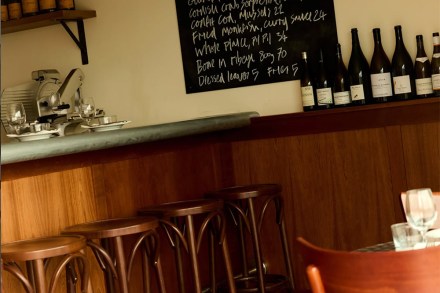
Can there be, in Britain, such a thing as a destination Greek taverna? There are some cases where proximity is the most important thing: gyms, cafés, defibrillators. A Greek taverna falls into this category. All you need is harmless food and ambient fake vines for a catch-up with your relatives. But I’m in need of a new one. Lemonia in north London was a good option until halfway through my final meal there. A bit of lamb kleftiko decided it wanted to remain in the entrance to my father’s trachea. Choking, mouth frothing, screaming for help, oh thank God there’s a nurse over there, Heimlich, hospital, then, seven hours later, home.

The £10 pint explains the rise of Reform

I bought my first pint of bitter, in a pub in Slough, in 1972. It cost 12 pence. The Bank of England inflation calculator tells me that is the equivalent of £1.45 today. Yet a pint now sells for £10 in London. What went wrong? Many factors, of which the first was Britain’s entry into the EEC on January 1, 1973. We were eventually made to "harmonize" our alcohol duties with our partners, leading to a drop in the duty on wine and a rise in that on beer, to reflect French cultural preferences. The most recent shock has been Rachel Reeves’s attack on small businesses with employer NI rises, punitive workers’ rights, ever-higher minimum wage etc. In the 1970s, the price of a pint, like the cost of a packet of cigarettes, was a major issue of concern in each year’s Budget.

pint

‘It feels subversive to eat so much carbohydrate in Mayfair’: Claridge’s ArtSpace Café and Bakery reviewed

From our UK edition

Claridge’s grew nine storeys in the last decade: it’s a metaphor. The ornamental 1897 castle on Brook Street has expanded to fit the available space. Though it grew by half, it never closed, and workmen dug out the basement by hand. In one room, Claridge’s was a building site: in another, a dream world. We are trekking through metaphors now. We are up to our necks. The children eating the Nutella, banana and whipped cream crêpes look deranged Hotels are like buses: they have infinite possibilities. That is what they are for. To not be home. Like Alec Guinness, who lived in the Connaught with his share of the profits of Star Wars, which shamed him (the Connaught is the anti-Tatooine), I would like to live in a hotel.

The Spectator’s caught in the EU crosshairs

From our UK edition

Is the flotation of Elon Musk’s SpaceX venture on the US Nasdaq exchange a beacon for the future of earthly capital markets and interplanetary relations, or just bonkers? The answer is it’s both, as well as being a stratospheric ego trip for Musk himself, who according to the prospectus will not only retain 85 per cent of the company’s voting rights but will also be awarded an extra billion shares if it succeeds in establishing ‘a permanent human colony on Mars’. In every sense, like Star Trek’s USS Enterprise, this spaceship is heading where no man has gone before. On the positive side, SpaceX’s Starlink satellite internet constellation, with ten million subscribers, is already profitable.

Did ‘millions’ attend Tommy Robinson’s Unite the Kingdom rally?

The Metropolitan Police were braced for one of the "busiest days for policing in London in recent years" on Saturday, with both a Unite the Kingdom rally organized by Tommy Robinson and a pro-Palestinian Nakba day rally taking place. Some 4,000 officers were deployed, along with helicopters, drones, Sandcat armored vehicles, dogs, horses and live facial recognition systems. The last Unite the Kingdom rally, in September, drew a crowd of 150,000 according to the police, three times what the Met expected – and organizers said this one would be "the biggest patriotic rally to grace this planet." Addressing the crowd at the event, Robinson said "we are here in our millions" and that attendees were at the "biggest event in British history.

rally

Letters: it’s hard to undo dumbing down

From our UK edition

Tales from the City Sir: Simon Jenkins’s article on Liverpool Street Station (‘Horror storeys’, 9 May) is inaccurate, and an insult to every councillor on the City of London planning committee, whose professionalism I defend. Saying the committee was ‘clearly going to approve’ the application amounts to an allegation of predetermination. That is a serious charge against every councillor present. It is also untrue: 22 members heard the case and three voted against. Sir Simon writes that ‘both schemes were presented to a packed City planning committee’. This is also untrue. There was one planning application before the committee that day.

The Golders Green atrocity is the final straw

It is undeniable now: war has been declared on British Jews. A fascistic crusade is being waged against our Jewish compatriots. The anti-Semitic atrocity in Golders Green today is further brutish proof of this unsettling fact. We’ve had fire bombings at synagogues, the murder of Jews in Manchester on Yom Kippur, and now this frenzied knifing of Jews in London. There can be no more equivocating – this is a moral emergency. The most sickening thing about today’s knife pogrom is that it was entirely predictable The scenes from Golders Green are truly grim. Video clips show the suspect wielding his knife with demented fury at two visibly Jewish men.

golders green

‘A constant good in this world’: Simpson’s in the Strand reviewed

From our UK edition

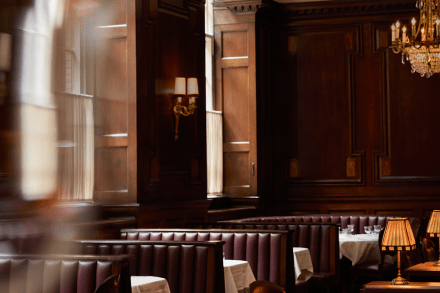
Simpson’s in the Strand is a dream palace, and its fortunes are as tidal as the river. It is on the site of John of Gaunt’s Savoy Palace, destroyed in the Peasants’ Revolt. It began as a cigar divan and chess club, was subsumed into the Savoy Hotel, built with the profits from The Mikado, and was beloved by Churchill and Wodehouse, who described it as an Elysium where you were ‘at liberty to eat till you were helpless, if you felt so disposed’. It then decayed. I’ve come here for 30 years and, grand as it was, Simpson’s smelt of beef and the 1922 committee by the end. No restaurant can live on that indefinitely, and it closed in 2020. I did not enjoy my last meal here, but I took part of its myth: when it sold off its crockery in 2023 I bought what I think is a milk jug.