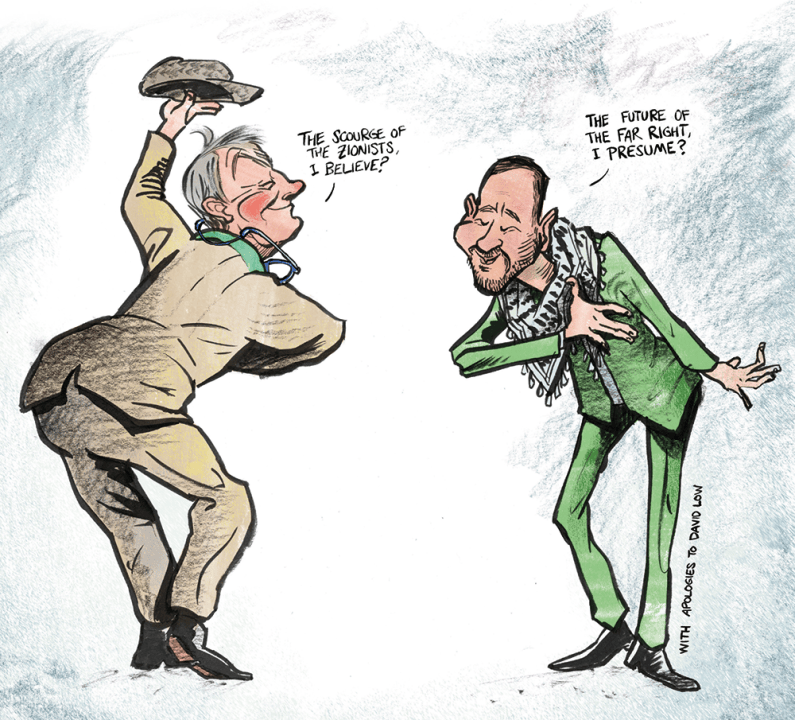


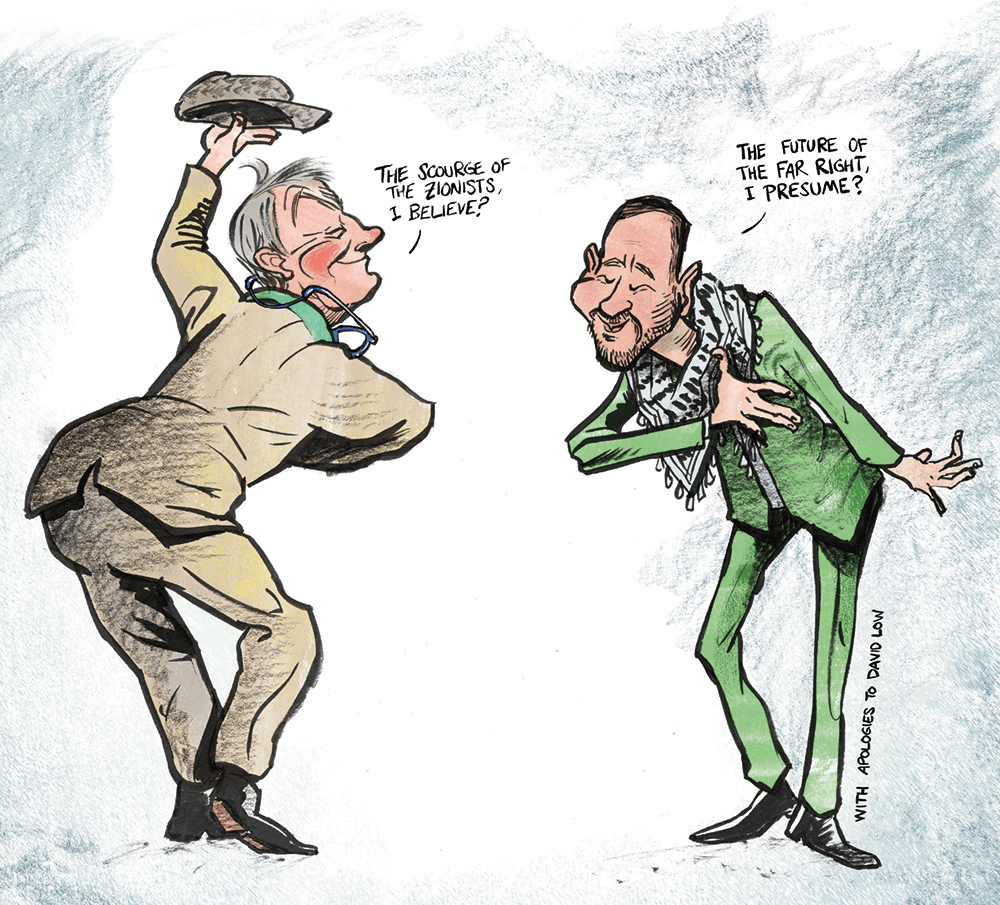
Johann von Leers was one of Goebbels’s most industrious propagandists: 27 books in 12 years, among them Jews Are Looking at You and Jewry and Knavery. After the war he slipped away to Peron’s Argentina and then to Nasser’s Egypt, where he put his skills to work against Israel. ‘Israel is abnormal,’ he said. ‘It must go. It causes trouble.’ All von Leers did was change his vocabulary – ‘Jew’ became ‘Zionist’ and race science gave way to the language of anti-colonialism and anti-imperialism, with the same ideas finding a new audience in the Arab world.
Von Leers converted to Islam and became Omar Amin, reportedly in honour of Haj Amin al-Husseini, the Grand Mufti of Jerusalem and a wartime ally of the Nazis. He revived medieval libels and modern conspiracies, influencing the Muslim Brotherhood. Von Leers’s story is worth retelling because it runs through every strand of modern anti-Semitism: an alliance of the far right, the progressive left and Islamist extremists. Since 7 October 2023 that convergence has become unignorable in Britain.
It has been a year since Jihad Al-Shamie took his version of anti-Semitism, along with a knife, to attack Heaton Park synagogue in Manchester on Yom Kippur, the holiest day in the Jewish calendar. Melvin Cravitz and Adrian Daulby were killed. Since then, Jewish-owned ambulances have been torched, synagogues in London set alight, terror plans in Greater Manchester foiled and two Jewish men stabbed in Golders Green. These are the extreme examples. Most British Jews will mention quieter changes: people afraid to wear Jewish symbols in public, students hiding their faith at university, families changing their names to sound less Jewish. The many bodies representing British Jews can seldom agree on anything, let alone an approach to combatting this movement, which makes it all the odder that anti-Semites are so sure that Jews act as one, according to some grand plan.
Members of the Green party and Restore Britain have more in common than either would like
Members of the Green party and Restore Britain would loathe being put in the same sentence, but in blurring the difference between anti-Zionism and anti-Semitism, and in the ease with which they make a scapegoat of the Jewish community, the two parties have more in common than either would like. At the Green conference in Brighton last weekend, members committed the party to ‘a single democratic Palestinian state in all of historic Palestine’ and to the view that the struggle to get there ‘by all available means under international law is legitimate’. Greens For Palestine, the pressure group behind the motion, explained this includes ‘armed struggle’. This means the Greens now take a more extreme position on Israel than the Palestinian Authority, which last year signed a memorandum with the British government committing it to a two-state solution.
The motion declared that ‘Zionism is racism’. The phrase has a pedigree. After the Six-Day War in 1967, when the attempt to defeat Israel by force had failed, the Soviet Union and its Arab and Palestinian allies turned to ‘Zionology’, which cast Zionism as racism, imperialism and fascism. Poland’s communist leader, Wladyslaw Gomulka, warned of a Zionist ‘fifth column’ and sorted Polish Jews into the loyal, the tolerable and the Zionists, emotionally tied to Israel, who would have to leave the country. More than 100,000 meetings in factories, offices and even sports clubs passed anti-Zionist resolutions. An eye clinic in Lodz asked its doctors for baptism certificates. Around 15,000 Jews left, from a community of perhaps 30,000. Nobody needed to say ‘Jew’; attacking the belief in a Jewish right to self-determination was enough.
In 1975 a United Nations resolution, the product of the Zionology alliance, declared that Zionism was ‘a form of racism and racial discrimination’. Within two years, students’ unions at York, Salford, Warwick and Lancaster expelled their Jewish societies as ‘Zionist and therefore racist’. By the 1980s the National Front had borrowed the idea, railing against ‘international Zionism’ to dress up its anti-Semitism. The UN resolution was annulled 16 years later but the phrase outlived it.

The Greens had a chance to show they knew this history. Instead, an amendment to protect Jewish members who attend a Zionist synagogue failed by a wider margin than ‘Zionism is racism’ passed. So a Jewish Green, even an anti-Zionist one, who worships at a synagogue that prays for Israel could be targeted for falling foul of the party’s own definition of racism. The motion’s proposer and co-author, Lubna Speitan, told a meeting two months ago that synagogues should be ‘confronted’. What makes a synagogue Zionist? Some of the Haredim of Stamford Hill have little time for the Israeli state, but they still face Jerusalem when they pray. Their council is now run by the Greens. Will it call them racist for being Jewish? Speitan herself is almost a perfect example of the convenient alliance between extremists and progressives. The Jewish Chronicle revealed that she is friends with al Qaeda terrorist Minh Quang Pham, who plotted to blow up passengers landing at Heathrow airport from Israel. She was even happy to testify in his defence.
The usual defence is that anti-Zionism is not anti-Semitism and that the Greens have a Jewish leader. But when party members voted on whether Zionism is racism, Zack Polanski was not in the hall: a dereliction of leadership which should surprise nobody. When it emerged that his co-deputy Mothin Ali had responded to 7 October attacks by suggesting that Hamas fighters were ‘indigenous people defending themselves’, Polanski stood by him.
Polanski has said he is ‘really aware’ of Bundism, the Jewish socialist movement of prewar Poland. The Bundists were anti-Zionists too, believing in doikayt, ‘hereness’: that Jews should build their lives in the country they were in, alongside their fellow workers, and not go looking for a state of their own. It was a noble idea, but it did not survive the century. Hitler murdered its members; Stalin had its leaders killed. A Jew turned out to be a Jew, whatever their workers’ allegiances. After the war, hearing that some comrades wanted to revive the movement, one veteran is said to have replied: ‘Enough splashing around in piss!’ Polanski is now drowning in it, deluded if he thinks eco-credentials, LGBT status or avowed anti-Zionism will protect him from his Jewishness in the face of anti-Semites.
Restore Britain is a different beast: smaller, newer and without motions being passed by members. The language differs, but some ideas sound familiar. Frank Wright, a Restore campaigner, tells his followers in an ‘ABC of Zionism’ that ‘Israeli agents were suspiciously prevalent around 9/11’ and that the ‘Zionist lobby’ is ‘the most powerful force in the world’. Rupert Lowe, the party’s leader, calls him a ‘good man’.
Harrison Pitt, on being given a ‘senior fellow’ position in Restore, hosted a podcast with Martin Sellner, who has links to neo-Nazism, and asked whether we are living through an overcorrection to Nazism. The two men quickly agreed that we are. Charlie Downes, the 25-year-old co-founder of Restore, enthusiastically backs Lowe’s pledge to ‘ban kosher slaughter’ on ‘day one’ if Restore entered government. And when Nigel Farage said, during a row over donations, that he couldn’t be bought, Downes shared a photograph of him at a Reform Jewish Alliance event in front of a Star of David. The party has said ‘We are not going to police our membership’ and that concern about anti-Semitism was a ‘minoritarian moral fetish’.
Some British far-right activists have been guests on Blood Brothers, the podcast of the Islamic outlet 5Pillars, where host and guest agree that the Jews tricked them into hating one another. Von Leers would have felt quite at home.
What makes the present iteration of anti-Semitism so powerful is that it contains nearly all the earlier versions
These groups form under different guises but arrive in the same place: the Jew as a suspect presence, an alien force, the best available scapegoat. What makes the present iteration of anti-Semitism so powerful is that it contains nearly all the earlier versions. At the bottom is the medieval layer of blood libel. On top of that sits the 19th-century kind, the Jew as capitalist, and then the racial kind, the Jew as vermin. Now a fourth has been added: the Jew as racist.
Restore and the Greens are no longer fringe groups. The Greens are on around 11 per cent in the polls, Restore on 4 per cent. That means roughly one British voter in seven intends to support a party that is, at the very least, comfortable with anti-Semitism. Many have no idea. They are voting for the environment, or for deportations, or because, as one frustrated German was reported as saying in this magazine in 1930: ‘Everyone else has deceived us; now let us see what Hitler can do.’
Britain in 2026 is not Germany in 1933. The scale is not comparable, nor is the violence, but the route is familiar. Millions have lost faith in liberal democracy and are looking to movements where the more radical you are, the better. Reform is no longer radical enough for some, so now there is Restore. The mainstream parties treat their cranks as the mad old uncle in the corner, but in the Greens and Restore the cranks can take over.
First past the post has held them back. But put today’s polls through the proportional system (which Andy Burnham supports) and see what comes out: to govern, the left would need the Greens and the right would need Restore. The choice could be between a government propped up by a party that thinks armed struggle against the Jewish state is legitimate and one that needs the votes of a party which will not police its membership for Hitler sympathisers. Those who promise that PR would bring a kinder politics might like to look at the arithmetic.
Historically, the countries where Jews have felt safest were, at that moment, the freest in the world: the Dutch Republic, Edwardian England, 20th-century America. Those where they have felt most imperilled, from the Spain of the Inquisition to Lueger’s Vienna to Germany in the 1930s, had something else going wrong. What starts with the Jews never ends with the Jews. Before Al-Shamie went to Heaton Park, he and a friend had planned to attack the Defence Academy at Shrivenham. Palestine Action says it is disrupting arms for Israel, but the factories it smashes and the police it attacks are Britain’s. Iran, which almost certainly directed the synagogue arsons, is thought to have had a hand in the terror plot at RAF Fairford. There are other motivations at play.
There are remedies. Disrupt the extremists, including the Iranian ones too long indulged here. Find out what works in schools to counter conspiracy theories, instead of funding what we think ought to work. And draw a firm line on what requires action. After 7 October there were anti-Semitic sermons in British mosques, and what happened? Nothing but a warning.
There is an old Jewish joke which I last heard Simon Schama tell. What is the difference between a Jewish pessimist and a Jewish optimist? The pessimist says: ‘It can’t possibly get any worse.’ The optimist says: ‘I’m sure it can!’ One in seven of us seems minded to prove the optimist right.



Comments