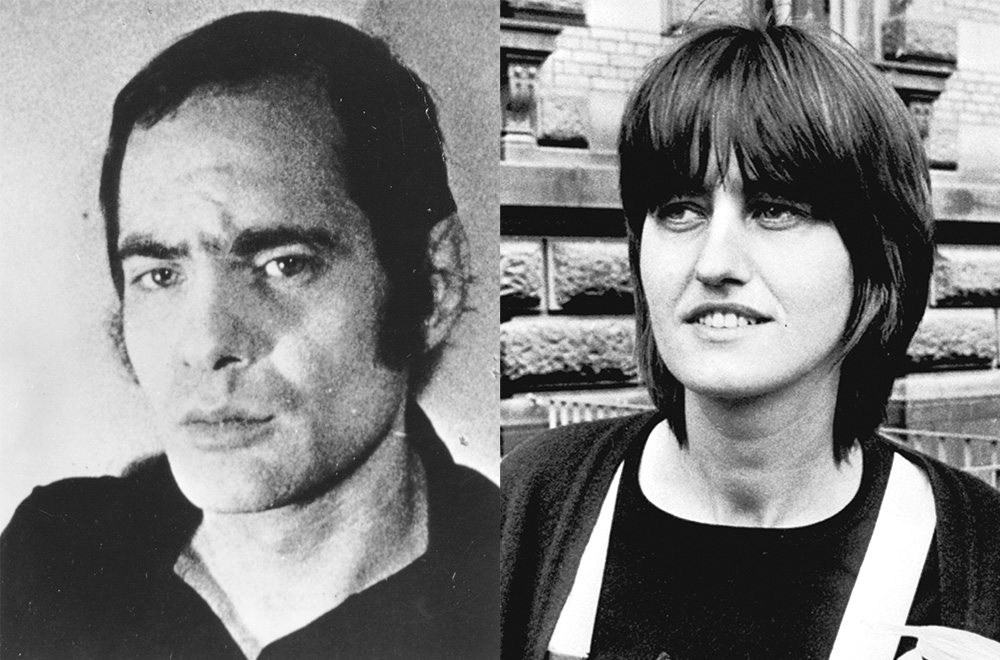
In the summer of 1970, a group of West German radical activists flew from Berlin to the Middle East. They wanted to acquire the necessary skills to launch a campaign of urban warfare against what they considered to be the fascist regime in their homeland. This would be their contribution to the global struggle against imperialism and capitalism that they believed was under way worldwide.
Thousands of western European left-wing activists travelled to the Middle East out of sympathy with the Palestinian nationalist cause in the late 1960s. Most returned after a few weeks with suntans, a keffiyeh and a book of poetry, in the words of one jaded foreign correspondent; but a minority convinced their hosts to upgrade the standard tour of refugee camps, clinics and schools to include actual military training. The West Germans fell into the latter category and spent six weeks or so in a training camp in Jordan, just north of Amman. This was run by Fatah, the biggest militant Palestinian group at the time, and dedicated to the ‘armed struggle’ against Israel.
Astrid Proll, then 23, was one of the travellers to Jordan. In Storm and Silence, she describes the many miscommunications and culture clashes that marred relations with their hosts. On arrival, Andreas Baader, whose arrogance infuriated almost everyone, vetoed the segregation of men and women as was customary in the socially conservative environment of even the relatively secular camps run by Fatah. He demanded extra ammunition, which was expensive, after the West Germans had shot off their entire allocation with abandon; dismissed as useless the rigorous physical drills that were routine for trainees; and refused early morning exercise.
The spartan conditions were onerous, too, and the visitors’ desire for comfortable beds and fresh fruit, both notably absent, grew. They also argued among themselves, though Proll does not mention the incident which convinced their hosts to send them home: an effort to persuade the Palestinians that one of their number was an Israeli spy, who should be executed.
Back in West Germany, the group’s primary propagandist, Ulrike Meinhof, a former high-profile radical journalist of significant intellect and profound commitment, sat at a typewriter in a safehouse and, fuelled by cigarettes and coffee, tapped out the manifesto of the new group – now called the Red Army Faction (RAF).
The campaign that the group then launched was squalid and shortlived. It started with a series of bank robberies. At a push, these could be understood to be attacks on capitalism, Proll writes, but were, she admits, really motivated by pragmatic considerations. Clandestine life was expensive, especially if you wanted luxuries. Gudrun Ensslin, the clever, capable, dogmatic co-founder of the RAF, took her lover Baader shopping at ‘bourgeois’ stores, and the shirts she bought him to be dry-cleaned.
Proll’s account of her life in the RAF is artless and somewhat fragmentary. She was an early recruit and present at many important moments. On the whole, she appears an honest narrator, which makes her story a valuable addition to the already extensive literature on West German extremism in the 1970s. But it is frustrating that, when it comes to some of the most interesting and important episodes that she witnessed, or indeed may have played a key role in, she retreats into a discussion of secondary sources.
She was caught in May 1971, recognised by a sharp-eyed garage attendant who had clearly been carefully scrutinising the wanted posters that had gone up all over West Germany bearing mugshots of fugitive RAF members. In this book she admits that a stolen silver-grey Alfa Romeo Giulia might not have been the best choice of vehicle for a clandestine ‘urban guerrilla’. Baader was caught the following year after driving an aubergine Porsche Targa the wrong way down a one-way street at 4 a.m. The arrest of Meinhof and Ensslin followed.
Proll admits that a stolen silver-grey Alfa Romeo Giulia may not have been the ideal car for an urban guerrilla
The RAF was eventually responsible for 34 deaths, with most coming as the group sought to free its incarcerated leaders. The violence peaked in 1977, when a series of spectacular attacks failed, leading Ensslin and Baader to commit suicide in their cells. Proll remembers little debate about the rights and wrongs of murder. This may have been true when she was active, but there are other accounts which give detailed descriptions of bitter arguments over exactly this issue. At the end of the book, she admits that the RAF’s ‘methods were not the right ones’ and calls for ‘new forms of resistance’.
Perhaps the most enjoyable pages are those describing Proll’s time in London, where she arrived in 1974 after absconding when a West German judge ordered her temporary release on grounds of ill-health during her trial for attempted murder. She ended up working as a car mechanic in Hackney, where she felt ‘at home in that desolate backdrop of a slowly fading city’. This allows the reader a glimpse of a much-parodied world of political activism, alternative lifestyles and experimentation. Proll remembers: ‘In the 1970s it was very much the vogue to leave your husband and get into a lesbian relationship as an act of deepened feminist radicalisation.’
Though awkward questions were usually deflected by her false marriage to Robin Puttick and the ‘reserved politeness’ of the British, Proll’s past eventually caught up with her and, despite a vociferous campaign by supporters, she was extradited back to West Germany in 1979. Times had changed. The RAF had become ‘a fashion item, a symbol of radical chic’, rather than an existential threat, and she served out a relatively short sentence uneventfully before release and rehabilitation. ‘I was incredibly lucky,’ she writes.



Comments