
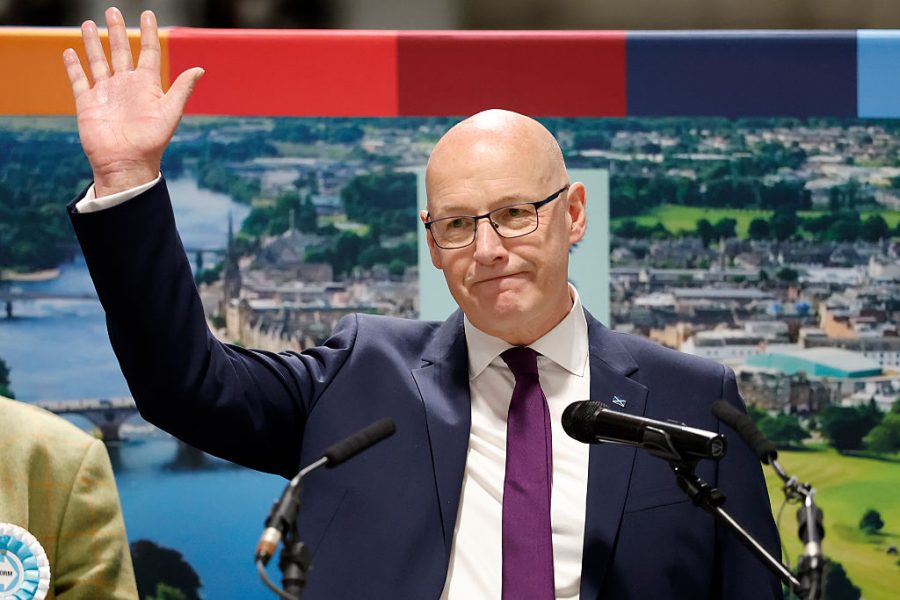
Yesterday was the news that Keir Starmer has agreed to have a face-to-face meeting with John Swinney, Scotland’s first minister, following the SNP’s strong performance in the local elections. Swinney said that Starmer had agreed over the phone that they would discuss holding another referendum on independence. No. 10 has a slightly different recollection of the call – saying that Starmer made it clear that he would not support another referendum.
Nonetheless it would seem that a narrative has arisen that, as Swinney puts it, ‘the momentum is building behind Scotland’s right to decide’. ‘Plaid Cymru and SNP wins leave the UK under threat,’ says GB News. ‘Wales and Scotland turn to independence parties,’ says the Financial Times. It is not just the SNP who are seeking to make capital from these gains. Sinn Féin’s Michelle O’Neill said:
The Labour party has simply collapsed in Wales and Scotland as it has in England
I don’t think there can be any clearer sign that Westminster’s time is coming to an end for the people here and the people in Scotland and Wales.
It is true that the nationalist parties such as the SNP and Plaid have performed well in the local elections this year. We can now expect Scotland, Wales and Northern Ireland to be led by nominal independence parties. Nevertheless, a closer look at the data suggests that – in Scotland at least – the ongoing electoral success of the SNP is not necessarily correlated with surging support for independence. YouGov polling from March, for example, shows independence as a sixth-level issue, far behind the economy, health and immigration – and below even education.
Crucially, using YouGov’s data, we can see that Scottish voters are becoming less and less interested in independence as time goes on. At the end of 2022, it was the third most important issue. The number of respondents putting independence in their top three has fallen by around half.
Crucially, there has been very little change in support for independence across the country over the last five years, with both ‘Yes’ and ‘No’ sitting at 45 per cent. So while party allegiances may be changing constantly, especially with the abrupt rise of the Reform and the Greens in England, the underlying support for either option has remained broadly the same.
Why are the nationalist parties still performing well when the data suggests the union is becoming less controversial? There is obviously the impact of Brexit, which has made it much less plausible for a country to leave the UK and rejoin the EU from a constitutional perspective, but there is also the fact that parties like the SNP have now held substantial power in local government for well over a decade.
In that time, they have won concessions from Westminster, such as free prescriptions (in 2011), while remaining within the devolution settlement. Their aggressive lobbying on behalf of Scottish voters means that it could be logical to vote SNP while being sceptical about national independence.
Then there is the fact that the Labour party has simply collapsed in Wales and Scotland as it has in England. Voters who want a centre-left party which is not contaminated with the brand problems that Labour now has, have an obvious alternative with Plaid or the SNP. These floating voters will not necessarily vote in favour of independence if the question is put to them in a referendum – and neither Plaid nor the SNP would attempt to leave the Union without one.
Whatever reasons voters had for choosing the SNP, the party only managed to win 38.2 per cent of the constituency vote. When combined with their Green allies, this means that the incumbent government received just over 40 per cent of the vote. John Swinney’s party has dropped 9.5 per cent since the last Scottish parliament election in 2021. Overall turnout at the election was also down to only 53.2 per cent. So fewer votes in a local election which many Scots chose to stay home for. Hardly the signs of an unstoppable force capable of tearing apart a union that has endured for three centuries.






Comments