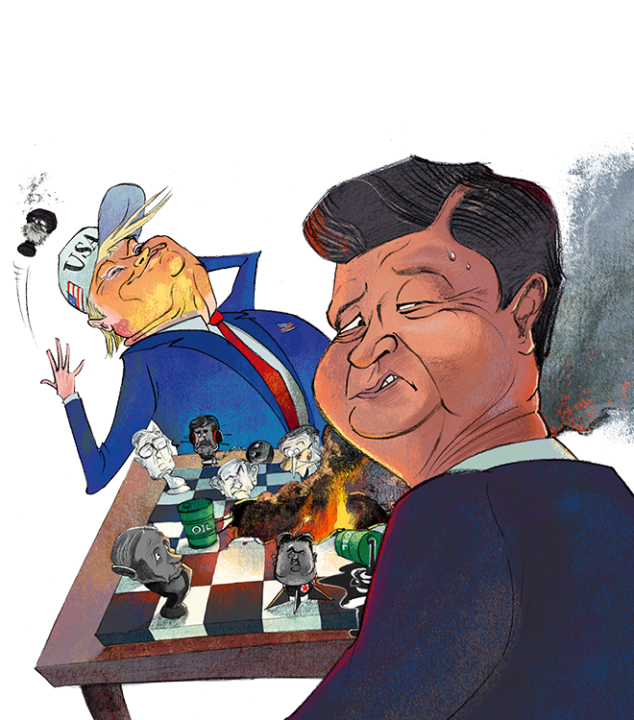
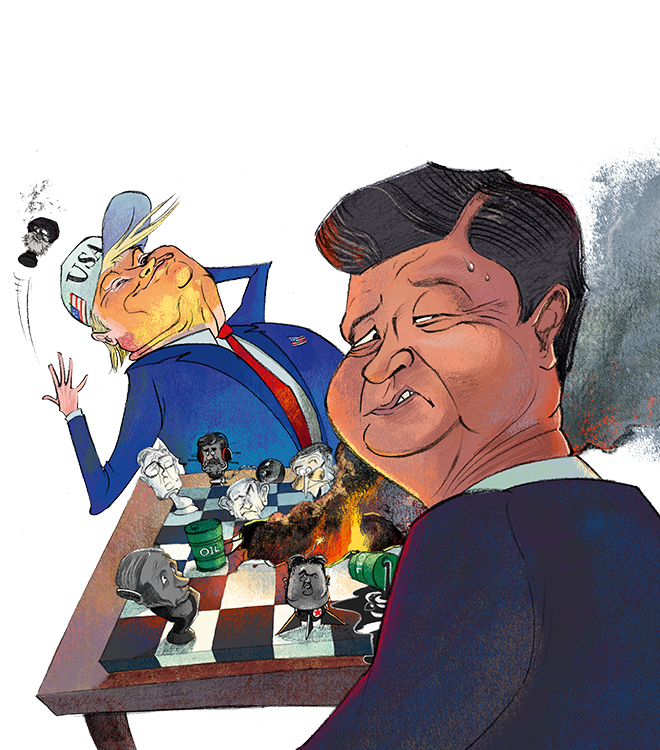
Donald Trump flew to Beijing this week and wants three things when he sits down with China’s President Xi Jinping: a tariff truce that survives his own courts, Chinese pressure on Iran to end the war that never seems to end and a photograph that makes him look victorious.
Xi has problems of his own. But he has watched four American presidencies from Zhongnanhai, the walled compound beside the Forbidden City where the Communist party leadership rules, and he knows the value of silence when his counterpart is talking himself into trouble. Trump’s approval rating is the lowest of his second term.
What Xi wants from this meeting with Trump is recognition: two great powers, two systems, meeting as equals
Trump has obliged Xi noisily. In February, the US Supreme Court ruled, six to three, that the emergency powers he had used for most of his tariffs did not authorize tariffs at all. The law in question was the International Emergency Economic Powers Act, which Trump had turned into the legal foundation for his tariffs last year. Chief Justice John Roberts, writing for the majority, held that the statute did not give the President authority to impose tariffs of “unlimited amount, duration and scope.” The Chief Justice was, in effect, telling the President of the United States to read his own statutes.
Less than three months later, a second court struck down the tariffs that replaced the earlier ones. The administration appealed quickly, and tariffs are still being collected at the border from most importers. Treasury Secretary Scott Bessent has told audiences that tariff revenue will be “virtually unchanged” this year, but the administration’s remaining legal routes are narrower and slower than the one the Supreme Court took away. Trump’s main lever is gone, and Xi can see him wielding a handle attached to nothing. Nearly nine years ago, the same two men met in the same city, and the picture looked very different. Xi gave Trump a private dinner in the Forbidden City and Trump called Xi “a very special man.” But the two leaders have not met on Chinese soil since.
The intervening nine years brought a trade war, a pandemic, a chip-controls regime and Beijing’s continued slow construction of a rival order outside American gatekeeping. Chinese Communist party (CCP) state media now treats Trump as the leader of a tired empire.
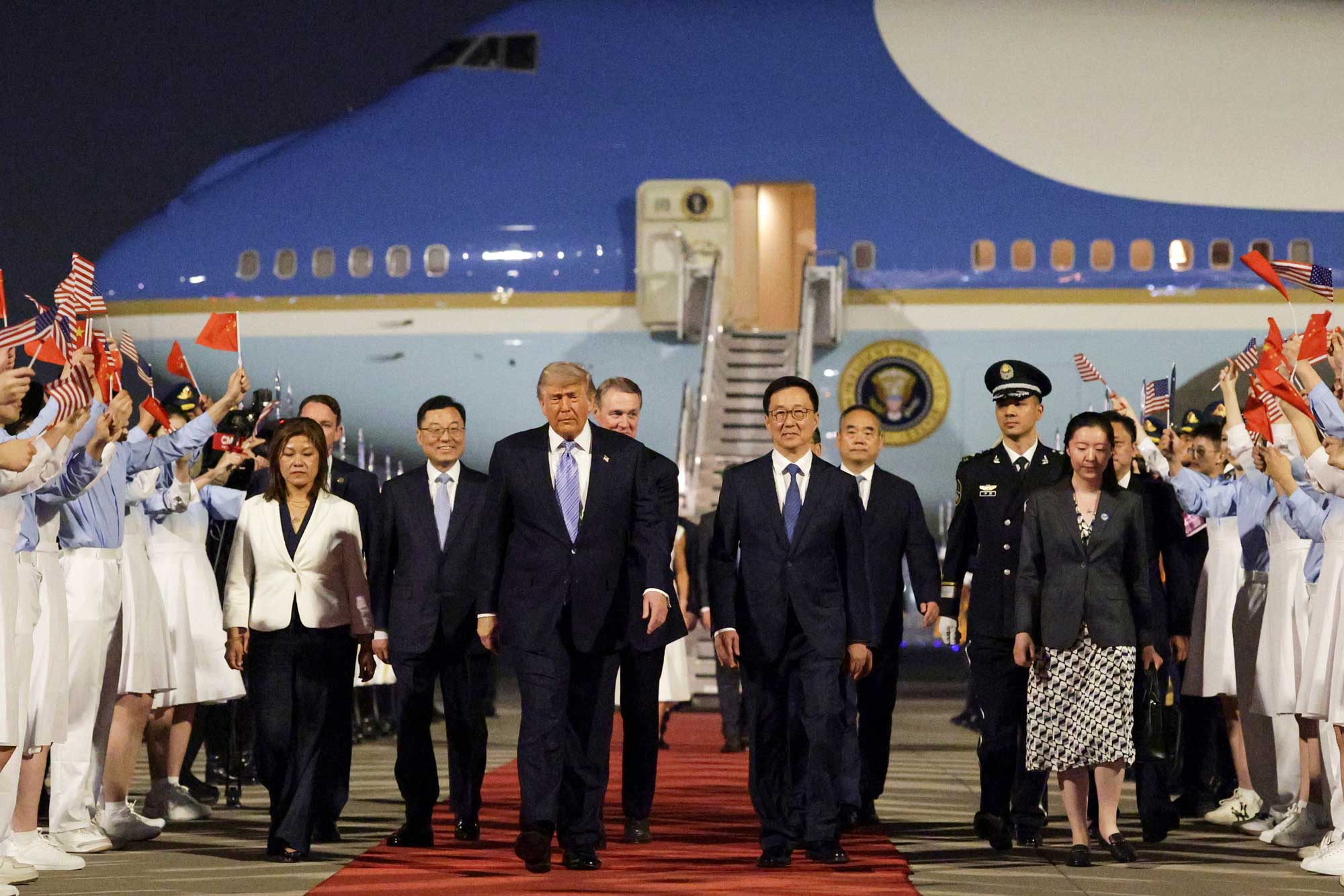
Then there is Iran. Two days before he landed in Beijing, Trump told reporters that the Iran ceasefire was “on massive life support.” It is. The war that began more than ten weeks ago with the American and Israeli strike that killed Ayatollah Khamenei was supposed to last four or five weeks. Trump said so himself, to the New York Times on March 1. We’ve now reached more than twice his own projection. Iran retaliated by closing the Strait of Hormuz, the gateway for a fifth of the world’s seaborne oil, and attacking US military bases in the Gulf.
Pakistan brokered a ceasefire in early April. It has been extended once and strained since. That a country which is in considerable debt to China, plus managing its own nuclear standoff against India, is mediating an American war is a fact worth pausing on.

Iran is in no mood to settle. The regime named the Ayatollah Khamenei’s son Mojtaba as Supreme Leader eight days after the strike that killed his father, choosing the hardliner over the more moderate Hassan Khomeini. When American and Iranian forces exchanged fire in the strait. Trump dismissed the skirmish as “a love tap.” Live rounds in a strategic waterway are not, in the ordinary sense, a love tap.
Oil is above $100 a barrel for the first time since the months after Russia invaded Ukraine four years ago. American drivers are paying around $4.50 a gallon at the pump, the highest since the spike. British drivers are paying about £1.60 a liter, 20 pence more than before the war began.
China buys roughly 90 percent of Iran’s oil exports. US sanctions have pushed Iran out of almost every market except China, where refineries buy its crude at a discount and pay in the Chinese currency. Those purchases keep Tehran’s economy upright, which is what allows the regime to keep fighting. CNN reported a regional source as saying the Iran peace talks would not progress until Trump met Xi in Beijing.
For almost half a century, China has been the party asking the US for concessions – market access, most-favored-nation status, WTO membership, tariff relief and technology licenses. Washington granted them, on the theory that integrating China into the American-led system would make Beijing a more responsible power. The theory has not aged well. And this month it is the United States that is asking.
On May 4, Treasury Secretary Scott Bessent went on Fox News and asked Xi’s government to “step up with some diplomacy” and pressure Iran to reopen the strait. He mentioned on the same broadcast that China buys almost all of Iran’s oil. This was the United States telling its largest geopolitical rival, in public, that the United States needed its help to end a war the United States and Israel had jointly started ten weeks earlier.
Xi wants the war ended too. China imports more oil than any country in the world, and the closing of the Strait of Hormuz has cost Xi real money. The economy at home is not helping either. Property prices have been falling for nearly three years straight. Urban youth unemployment hit 16.9 percent in March, the highest in four months.
At a party conference last December, Xi told assembled cadres that “the fundamentals supporting China’s long-term growth remain unchanged.” Xi can talk about the long term because he has one. He has roughly 18 months until the next Party Congress, where his fourth term will probably be confirmed, with no fixed limit to how long he will stay in power and no clear successor in place. Trump, meanwhile, has six months till the midterms.
Xi can talk about the long term because he has one. Trump has six months till the midterms
What Xi wants from this meeting with Trump is recognition: two great powers, two systems, meeting as equals. That is what the summit is for, in the Chinese reading of it. He would like Washington to drop its careful ambiguity and say plainly that it opposes Taiwanese independence. He would like US export controls eased, and for Washington not to look too closely at the off-the-books oil trade that keeps Iran from collapsing.
Of the three things Trump came for, he will most plausibly leave with one. The tariff truce he signed with Xi last October is up for renewal, and the most likely outcome is its extension, but the Iran ceasefire is too complex a promise for China to grant in a single meeting. There will be a handshake, a banquet at the Great Hall, a paragraph or two in a joint statement. The President will frame whatever he is given as a victory, because that is what he does.
The Americans in Trump’s entourage understand this reality before the communiqué is ready. The chief executives traveling in the presidential slipstream – Elon Musk, Tim Cook, Larry Fink, Boeing’s Kelly Ortberg and a dozen others – are there for market access, exemptions, licenses and a little mercy from China’s ruthless regulatory machine. That is the picture Xi wants the world to see. State broadcasts will show two leaders of equal weight in China’s historic capital. Domestically, the CCP message will be that the President of the United States flew to Beijing because Beijing is where the deal-making happens now.
To the governments Beijing has spent a decade courting, the message will be that China, as the alternative to American primacy, is now ready.
Treaty allies in Asia and Europe have spent seven decades assuming that the order the United States built would also be the order that it will defend. Japan, the most exposed of those allies to China’s aggression, has the greatest stake in this week’s joint statement. In November, Prime Minister Sanae Takaichi told the parliament that a Chinese move against Taiwan would be a “survival-threatening situation.”
The phrase “survival-threatening situation” is the trigger introduced by Japan’s 2015 security laws – the threshold at which Tokyo may exercise self-defense alongside an ally under attack.
If Trump softens his Taiwan language in Beijing, Tokyo will discover that Takaichi’s public commitment is not one the United States is willing to back.
Xi has been making the same argument from his side of the table for more than a decade, building the institutions and the relationships, such as through the Belt and Road programs of infrastructure building around the world, that would carry his vision. It is the first time an American and Chinese leader have sat in a room together with that arrangement as the working assumption of both.
The phrase to watch for in the joint read-out is “mutual respect.” In Beijing’s diplomatic vocabulary, the phrase is shorthand for a meeting held on its terms – and, increasingly, for Washington acceding to that framing without saying so out loud.
If “mutual respect” appears, the meeting will have been settled before the cameras start. Trump and Xi are entering the room as peers. The system that ran the world for more than 80 years will no longer be the system either of them will continue to build around. The great power carve-up begins.



Comments