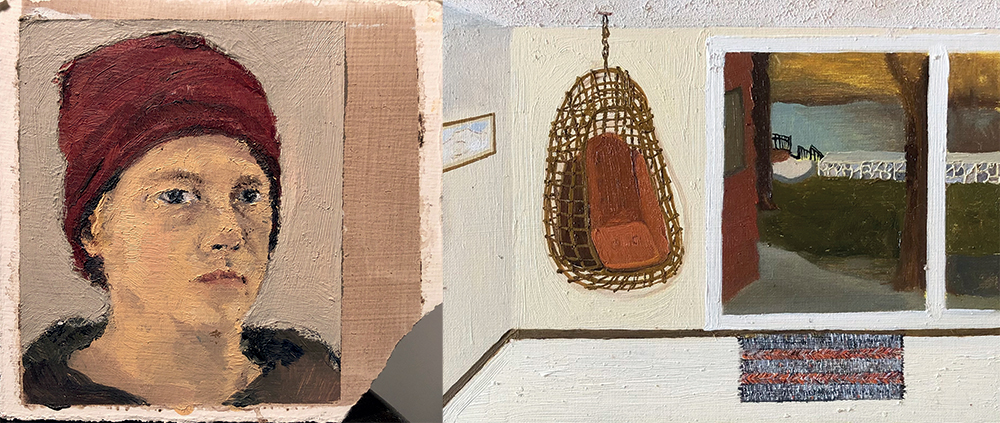
In this clever, moving mosaic of a book, Sara Baume tells us she originally wanted to be an art critic and that she wrote exhibition catalogue copy. It has served her well, as Opening Night is an evolved form of that genre – including 39 excellently reproduced images of paintings by the subject, and one extra – but it is also a form of memoir. By that I do not mean ‘life writing’ or ‘autofiction’, as it is a work of remembering and memorialising, even if that involves recording the gaps and lapses. The lacunae operate like an undercoat: the occluded thing that changes how you see.
Just before the pandemic, Baume states in the opening sentence: ‘I met Mollie’s paintings before I met Mollie.’ The small paintings have skewed perspectives and an ‘atmosphere pitched somewhere between cheer and creepiness’. Mollie is Mollie Douthit, originally from North Dakota, but who considers herself – or at least her work – Irish. She lives a pared-back, spartan existence, and the two women (via Instagram) become friends.
What follows is really rather beguiling. It charts their friendship up to a major exhibition and a life change. Baume is excellent at questioning herself and her motives, wondering if she actually only has acquaintances and whether an argument with her partner was almost staged to provide a novelistic closure to a slice of life.
It is a strange, tentative relationship; neither woman is particularly sociable and both have quietly held but strong opinions. Mollie is simultaneously sharpish about ‘woo-woo’ but keen on astrology. Both are prone to forms of anxiety that they deflect. Baume’s account of her own paranoias during this period – with Covid and then the invasion of Ukraine – will resonate.
This is not a modern version of Eckermann’s Conversations with Goethe, but there is much to be gleaned about art – its praxis and the status of being ‘an artist’. It is astute about the conflicting emotions of a work being sold: money vs loss. It comes close to a provisional definition of art – ‘sincere affinity with a stranger’.
There is one line that particularly struck. Mollie is told ‘delicately, patronisingly’ that ‘there was nothing structurally wrong, that her pain was inexplicable’. It seems to me that quote might be applied to a whole generation – Sally Rooney, Claire Keegan, Eimear McBride, Claire Kilroy, Niamh Ní Mhaoileoin – for whom the ubiquity and mystery of suffering is paramount.





Comments