
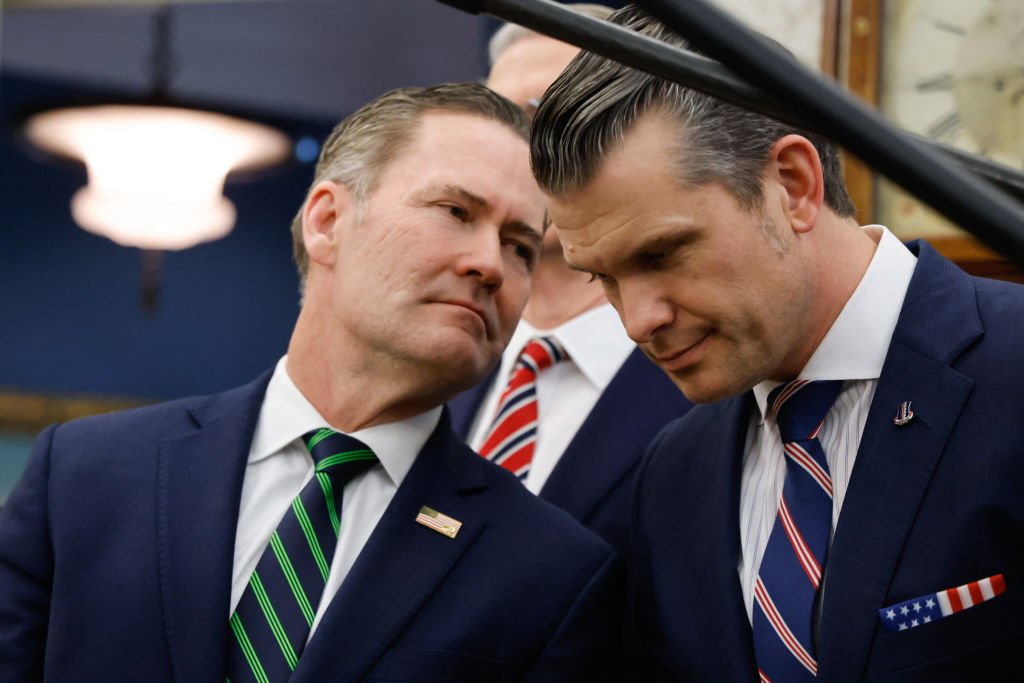
Remember Signalgate? It was quite the story, and worth revisiting now in light of Operation Epic Fury, the ongoing crisis in the Strait of Hormuz and its dire implications for the global economy.
In March last year, Donald Trump’s then National Security Advisor, Mike Waltz, somehow added Jeffrey Goldberg, the editor-in-chief of the Atlantic, to a Signal messaging group for senior government officials to discuss top secret military action against the Houthis in Yemen. The group included the Vice President J.D. Vance, Secretary of State Marco Rubio, Defense Secretary Pete Hegseth, Director of National Intelligence Tulsi Gabbard, White House Chief of Staff Susie Wiles and deputy chief of staff Stephen Miller, among others.
The Houthis are, of course, part of Tehran’s regional axis of resistance, and their attacks on ships had been disrupting maritime trade in and around the Gulf of Aden and the Red Sea, which leads up to the Suez Canal.
According to Hegseth, President Trump had issued a directive to “reopen the shipping lanes,” but the national security team appeared uncertain about whether or not to pause before going ahead with a strike. “I think we are making a mistake,” said Vance. America would be “bailing out Europe again,” he argued, which would be inconsistent with the administration’s “America First” agenda and might cause oil prices to spike.
In reply, Hegseth agreed and disagreed. “I think the messaging is going to be tough no matter what – nobody knows who the Houthis are – which is why we need to stay focused on: 1) Biden failed & 2) Iran funded.” The Secretary of Defense (now War) argued that “Restoring Freedom of Navigation” was a “core national interest.” Mike Waltz added that, “It will have to be the United States that reopens these shipping lanes… we are the only ones with this capability unfortunately.” These remarks take on a rather hubristic quality now that, almost exactly a year later, a more significant US-led operation against Iran has clogged up the Persian Gulf and caused considerably more damage to Freedom of Navigation and the price of oil.
As far as the administration was concerned, however, Operation Rough Rider, the bombing campaign on the Houthis, was an instant success, and the senior Trump team duly exchanged triumphant emojis and patted each other on the back for a job well done.
The fallout came later. After Goldberg published the exchanges, including Hegseth’s sharing of highly sensitive military information, internal investigations were launched. By May, Mike Waltz had been moved out of national security and into the role of US ambassador to the United Nations. Hegseth survived, but in April his official point of contact on the groupchat, Dan Caldwell, a military veteran who opposed the neoconservative position on the Iran war, lost his job. Caldwell and Darin Selnick, the Defense Department’s deputy chief of staff, were escorted from their office by guards. Then, Colin Carroll, chief of staff to Deputy Defense Secretary Stephen Feinberg, was ousted, too. And John Ullyot, a top Pentagon spokesman, also announced he was resigning.
It seemed to be a vicious knife-fight between dovish and hawkish officials on the crucial question of how to tackle Iran, and both sides sustained loses. Waltz, Rubio, and General Michael E. Kurilla, the then head of US Central Command, were all in favor of more aggression, while Vance and Gabbard opposed military actions.
Hegseth, meanwhile, seemed caught between his fervently anti-Iranian views and his allies on the new right. Clearly, given his role now as the war’s rabid cheerleader in Pentagon press briefings, he is now a firm hawk, though he spoke passionately in defense of Vance today, when asked about reports that the Vice President is not aligned with Trump on Iran. “He’s an incredible member, leader of this team,” he said.
Kurilla stood down in August, two months after bombs fell on Iran nuclear sites, while Tulsi Gabbard has found herself increasingly alienated from foreign-policy matters. Trump speaks more to CIA director John Ratcliffe, a firm Iran hawk, when it comes to Middle East affairs. But what’s clear is that the struggle after Signalgate helped shape the US national security team now running the Iran conflict. Ambassador Waltz, for his part, just responded on X to a post suggesting the Iranian leadership were hiding in Mashhad, in eastern Iran, near the border with Afghanistan. “If only we still had Bagram Airbase,” he wrote, referring to the large military station America abandoned under the last administration. Clearly, “Biden failed” remains a key part of the administration’s defense strategy.
This article originally appeared in Freddy Gray’s Americano newsletter, which you can subscribe to here.

Comments