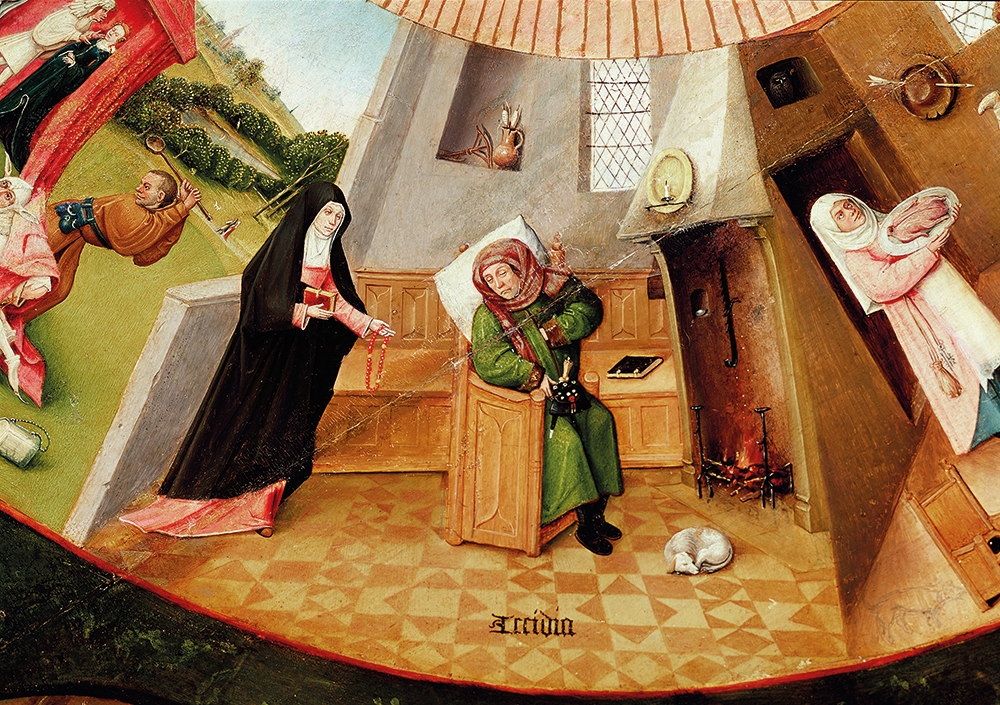
What mistake did Narcissus make when he looked into the water? To fall in love with his own ravishing self, we might think. But to the medieval mind, that wasn’t his problem at all. In John Gower’s 14th-century poem ‘Confessio Amantis’, Narcissus falls in love all right – but with someone else entirely. His fault isn’t that he loves himself; it’s that he doesn’t even recognise himself.
Then, as now, as Peter Jones argues in this revelatory exploration of late medieval psychology, the path to self-betterment went through self-knowledge. Like our own, it was ‘a civilisation geared towards understanding the human mind’. But whereas the tools we use today are rooted in the vast post-Freudian literature of psychoanalysis, the taxonomic framework our ancestors reached for was that of the Seven Deadly Sins.

For many, this might sound risible. But, Jones argues, far from being the cartoonish caricature of the modern imagination, the model offered a psychologically nuanced framework for describing and ameliorating human weaknesses and hurts. More than that, it is a ‘1,600-year-old system that still works’.
It has its origins in the work of Evagrius Ponticus, a 4th-century Byzantine monk in the Egyptian desert. Reflecting on his own spiritual battles, Evagrius identified eight ‘generic thoughts’ which defined the human condition: gluttony, lust, avarice, sadness, anger, sloth, vainglory and pride. Another monk, John Cassian, soon rebranded them as sins. Then, at the end of the 6th century, Pope Gregory the Great reduced the list to seven, merging sadness with sloth, vainglory with pride and adding in envy.
The three worst sins were usually considered to be those of the spirit: pride, envy and anger. The least were those of the body: avarice, gluttony and lust. Between them sat sloth, ‘an absence of love, a paralysis of care, a vacuum of the spirit’, in Jones’s words. It’s at the heart of the book, too, because the medieval diagnosis of sloth, shorthand for the more complex idea of acedia – ‘a concept that no longer exists and yet a condition that’s more alive than ever’ – maps closely on to what we would call depression.
Medieval thought identified three main strands to acedia: restlessness, inertia and tristitia, or sadness. It’s here where we most clearly see troubled medieval souls wrestling with the same intractable human frailties as we do. Jones offers three examples from the 12th century alone. For Conrad of Hirsau, acedia was the feeling that all ‘good things now leave you bored’; Gilbert of Poitiers bemoaned how ‘my soul does little or nothing’; while Ralph of Battle wrote of someone whose inner doubts ‘corrupt and defile everything’.
Reading this last testimony in a manuscript library, Jones ‘could feel the desperation of those words on the surface of my skin’. According to William Peraldus, whose 13th-century Summa de virtutibus et vitiis is a key text here, one cure for acedia was to find yourself a ‘strong mountain’. For Margery Kempe, that mountain was a vision of Jesus himself. (Jones has steamed most of the Christianity from his sources, but traces necessarily remain.)
Jones identifies his own strong mountain as the study of the Middle Ages itself – ‘swimming… in the infinity of the medieval lives I’ve seen’. Some of the most striking passages are those which describe the deep scholarly joys, at once intellectual and visceral, of discovering unlooked-for human connections with the past, complemented by a profound sense of wonder, ‘the quirk of seeing, where you clash with an object and create a new way to encounter the world’.
Jones is a sensitive writer and his account is framed by his experiences of teaching medieval history at a university in Siberia, described as a period of personal emotional crisis, ‘a trap that nearly swallowed me whole’. But he is also attracted to the metaphorical possibilities of its climate: ‘How do we escape the Siberia we sometimes make for ourselves?’ he asks at the book’s close.
These are the least satisfactory aspects of the book. His Siberia is too subtly realised to work well as a metaphor, and he is in any case too in love with its landscapes; but he is also too reserved to offer a fulfilling account of his spiritual anabasis. Attempts to connect each sin directly to his life – losing his temper at a staff meeting, for example, in the chapter on anger – feel a touch contrived.
But, caveats aside, this is a moving, eloquent and important book, reclaiming centuries of subtle psychological thought, and with it the emotional lives of our medieval ancestors, from the permafrost of modern contempt. Their taxonomies might be other than ours, but it is only a kind of historical narcissism that makes us think that we alone have insights into the mysteries of the human condition.



Comments