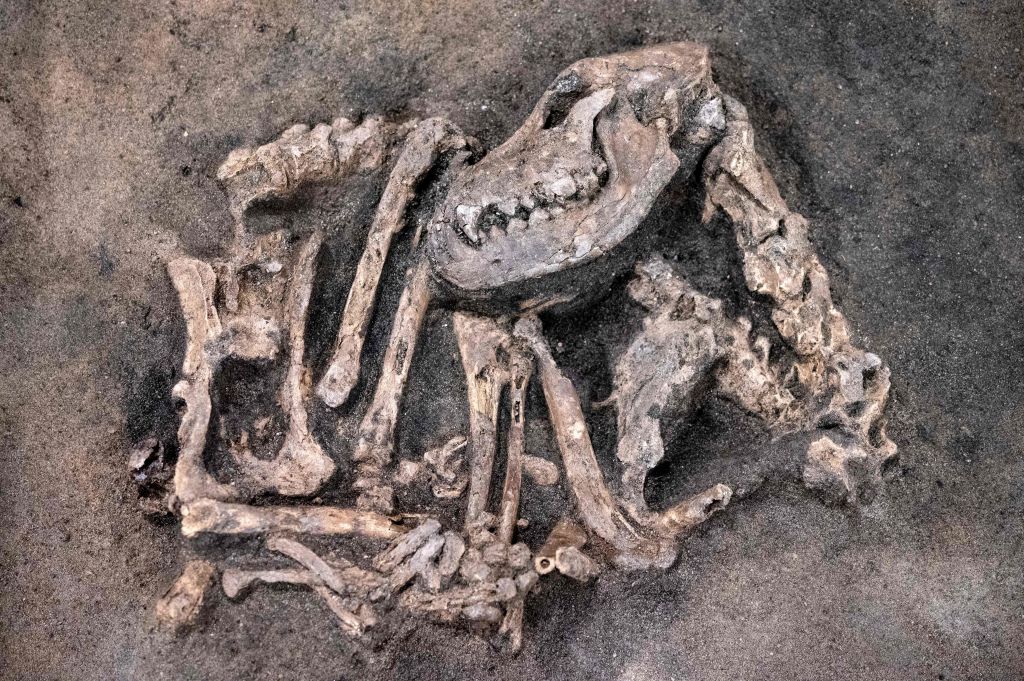
You don’t need to own a dog or a cat to know the two animals behave differently. One is loyal, protective, excitable and eager to please, the other… a cat. Now, large DNA studies have shed light on the historic origins of our closest pets, creating a fable-like explanation for their contrasting personalities.
Modern European dogs can trace half their ancestry to dogs that trotted out with men and women as they tracked Ice Age deer, wild cattle and boar, and perhaps even woolly mammoths
Dogs first. It had long been thought they are the original tamed animals, and have been hanging around people around a millennia before would-be farmers engaged with other species.
Skeletons, up to 35,000 years old, that looked too small to be wolves had been excavated across Europe and Asia. But size is not definitive and early genetic studies found some assumed dogs were in fact extinct wolves. Other finds from the Americas suggested dogs could possibly have been first domesticated there. Where they were tamed, or who was responsible, remained an open question.
All that has changed with two major new studies of canine DNA, published today. Characteristically for the times, each brings together dozens of scholars and institutions from around the world – including in one case the University of Tehran and the National Museum of Iran. Both studies are published in Nature.
They place the first dogs, identified by their genomes, firmly in western Eurasia. The oldest pooch, from Pınarbasi in Turkey, is radiocarbon‑dated to 15,800 years ago. Another in the same study from Gough’s Cave in Somerset is 14,300 years old. If the cave name sounds familiar, this is where a few years ago archaeologists found evidence for ritual human cannibalism. This was happening around the same time, we can now say, as these people bonded with dogs.

The oldest dog identified in the second study, whose remains were found at Kesslerloch in Switzerland, died 14,200 years ago. This team analysed DNA from 216 skeletons, and found 141 of them were dogs (Canis lupus familiaris) rather than wolves (Canis lupus). There were dogs across Europe and western Asia by at least 16,000 years ago.
From Britain to Turkey, these dogs were genetically similar. They likely spread across the region in Late Upper Palaeolithic times during the Ice Age culture known as the Epigravettian. Back then humans were culturally and genetically varied – more so than their dogs. This suggests to the scientists that different communities may have passed animals on to each other in some form of exchange.
As time passed, dogs continued to maintain a remarkably stable DNA. Early farm animals such as pigs and cattle commonly interbred with their local wild counterparts, in this case boar and aurochs – and given the opportunity, would do so today. It seems that Late Upper Palaeolithic dogs, by contrast, steered well clear of wolves. Such separation, it is implied, means domestication was already fully established.
Later, when farming was introduced to Europe by migrants from south-west Asia, there were substantial changes in human populations. In Britain, an extreme case, almost none of the indigenous hunter-gather genome survived. Again, however, dogs proved more resilient. The farmers brought dogs from Asia with them, and there was some cross-breeding, but the genes of the hunter-gatherer dogs continued to dominate. Remarkably, this still is the case today. Modern European dogs can trace half their ancestry to dogs that trotted out with men and women as they tracked Ice Age deer, wild cattle and boar, and perhaps even woolly mammoths.
Cats are a different story. A year ago, two papers were published that examined the domestication and spread of the moggy (Felis catus), descended from an African wildcat, Felis lybica lybica. One of the papers has since been withdrawn, but their messages were similar. For human hunters, wild cats were a competitor for game or a threat, but cats and farmers got on. Their domestication is more recent than that of dogs, occurring no more than two or three thousand years ago. In one notable archaeological find, five newborn kittens were buried together on an Iron Age farm in Dorset around 250 BC.
Genetic analysis suggests such cats ultimately reached Britain from north Africa, carried across Europe in trading ships. Cats were useful rodent-killers. They were also, famously, bred or rounded up in ancient Egypt for mummification, a practice that may have been instrumental in bringing people and cats together in at least one part of Africa.
While early cats were buried as votive offerings, dogs were buried as friends. One of the oldest dated canine finds is a jaw placed in the grave of two people in Germany; the state of the bone suggests the dog had been ill, and could have survived only with human care.
When you next ponder the contrasting behaviour of a dog and a cat, you might wonder if, in their imaginations, one is reliving the thrill of a companionable chase in the vast expanse of an Ice Age landscape: while the other sees the glint of a sacrificial knife.






Comments