
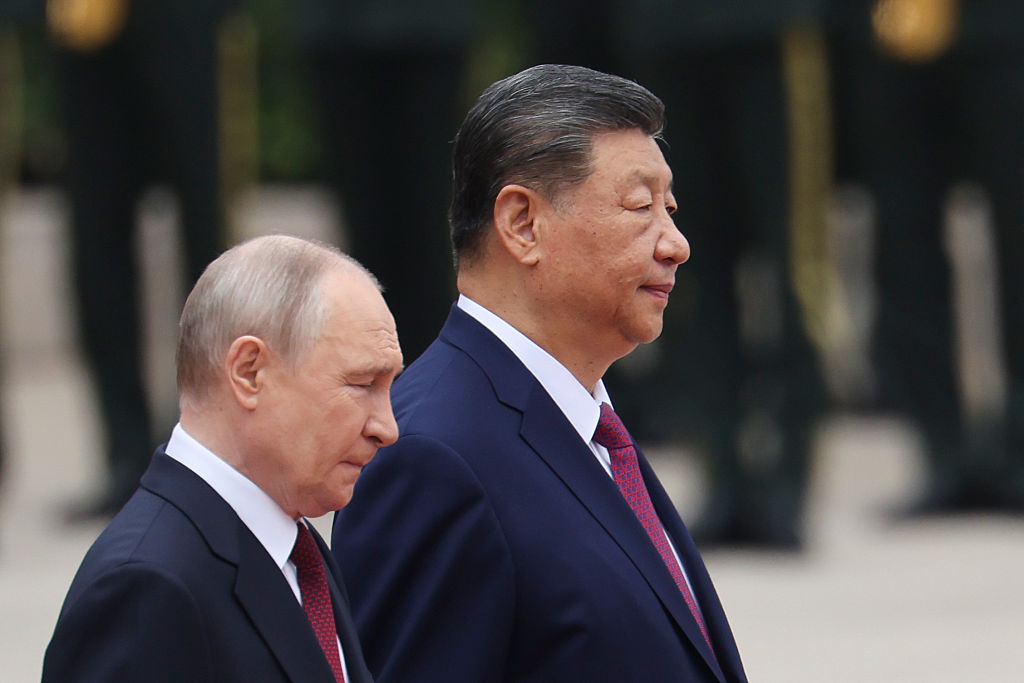
A week after Donald Trump was greeted in Beijing by well-orchestrated crowds of flag-waving schoolchildren, it was Vladimir Putin’s turn to pay a visit to China’s Red Emperor. Protocol-watchers spotted a distinctly lower level of pomp and circumstance afforded to Putin than to Trump – though Kremlin media were quick to emphasize that this was a working meeting, the latest of over 40 Putin-Xi summits over the last two decades.
Both sides paid formal homage to the ongoing strength of the Dragon-Bear alliance. Xi observed that relations between Beijing and Moscow were at “the highest level of comprehensive strategic partnership,” as he called on both countries to oppose “all unilateral bullying” in the international arena. Putin, quoting from his familiar playbook, also claimed that countries’ relationship were at an “unprecedentedly high level,” and observed that Moscow remained a “reliable energy supplier” amid the ongoing Middle East crisis.
Below the surface, though, it’s clear that Russia’s status even as a junior partner in the alliance is shrinking, while China’s is rising. Whether a recent report in the Financial Times that Xi told Trump that Putin could come to regret his war on Ukraine true or not (China officially denies it), it is abundantly clear that economically and diplomatically Moscow is becoming ever more dependent on Beijing. As a plaintive piece in the Kremlin-controlled RT channel put it, “China still often behaves as though it can enjoy the benefits of strategic partnership without fully committing itself to the burdens that come with it.” It complained that Beijing views Russia “merely as a useful resource base operating on China’s periphery” rather than an equal strategic partner.
True, Russia has doubled its trade with China to $240 billion a year since the beginning of the war, making up in part for collapsed trading relations with the West. But Russia is still far down on the totem pole of China’s important trading partners compared to the $1.5 trillion in business it transacts with the US and the EU. Even the Iran war, which supposedly should emphasize Beijing’s dependence on imported energy, hasn’t made much of an impact on Chinese imports of Russian oil or gas. Instead, China has preferred to ride out the storm by relying on strategic petroleum reserves, increasing coal production and accelerating its nuclear reactor program to a staggering 37 new units currently under construction.
Putin’s spokesman Dmitry Peskov hinted that “progress” had been made on Russia’s flagship energy project, the long-planned 2600 kilometer long Power of Siberia-2 pipeline which would carry gas from the Yamal Peninsula in Russia’s Arctic north, transit through eastern Mongolia, and terminate in China’s northern provinces. At up to 50 billion cubic meters (bcm) per year, the pipeline would be the largest single expansion of Russian gas export capacity eastward and help make up for the catastrophic loss of over 120 bcm in European export markets since the invasion of Ukraine.
But the fundamental problem for Putin is that China insists on paying Russian domestic rates of $60 per thousand cubic meters rather than $350, which is what its lost European customers once paid – a pricing gap of roughly 500 percent. More, Beijing insists that Gazprom finance the massive cost itself, which is a near impossible task with Russia cut off from international money markets and its state budget stretched to breaking point by the costs of the Ukraine war. China also has other options, including an expansion of the existing Central Asian gas corridor from Turkmenistan.
When Putin came to power in 2000, Russia was a major exporter of arms and technology to China. But Beijing has long since superseded most Russian mil-tech and is now Russia’s largest source of technology– including much needed computer chips. That growing technology gap was evident last week at the tenth Russian-Chinese Expo, which opened in Harbin in Chinese Manchuria. “Honestly, I have to admit that when we walked through it [the exhibition] and I saw that we only had honey and crabs, while our friends had drones and robots, I felt a bit upset,” admitted Russian Deputy Prime Minister Yury Trutnev.
Diplomatically, too, China continues nominally to support Russia – but in a mealy-mouthed way that falls far short of making Beijing a true ally. Indeed for the most part Chinese banks and businesses with exposure to international markets have chosen to observe US sanctions for fear of damaging relations with Washington. On a strategic level it’s clear that for Beijing both North Korea and Russia are viewed as unpredictable partners who should be kept at arms’ length lest their military adventures upset Beijing’s high-stakes trading relationships with the US and Europe. As Johns Hopkins strategist Sergey Radchenko argues, China “does not want to lead an axis… it wants a profitable protectorate on its northern border.”
Before Putin’s war, the Russian double headed eagle looked in two directions, extending economic and political influence east and west. Now, Moscow’s Westward-looking head has been shut out. As a result Russia is both more dependent on Beijing, and more subservient. With Putin’s visit, Xi will have received the leaders of all the permanent members of the United Nations’ Security Council in Beijing in just a few months. In all cases he has shown China’s strategic dominance. But in Russia’s case the roles of superpower and supplicant have been reversed in just a few decades.




Comments