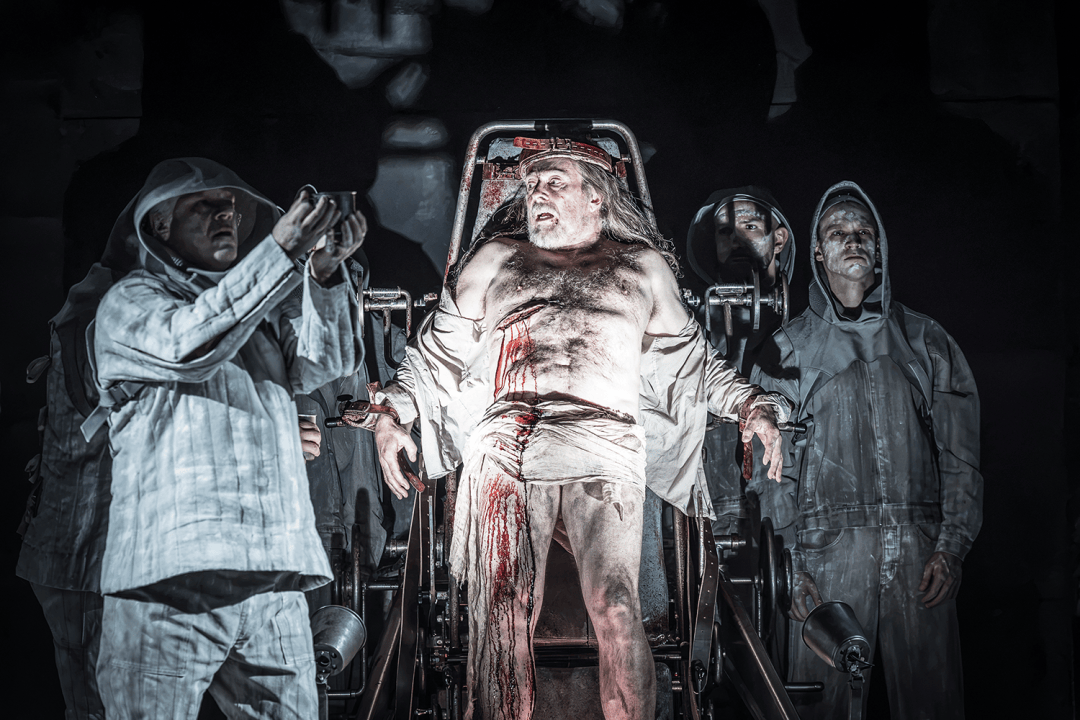
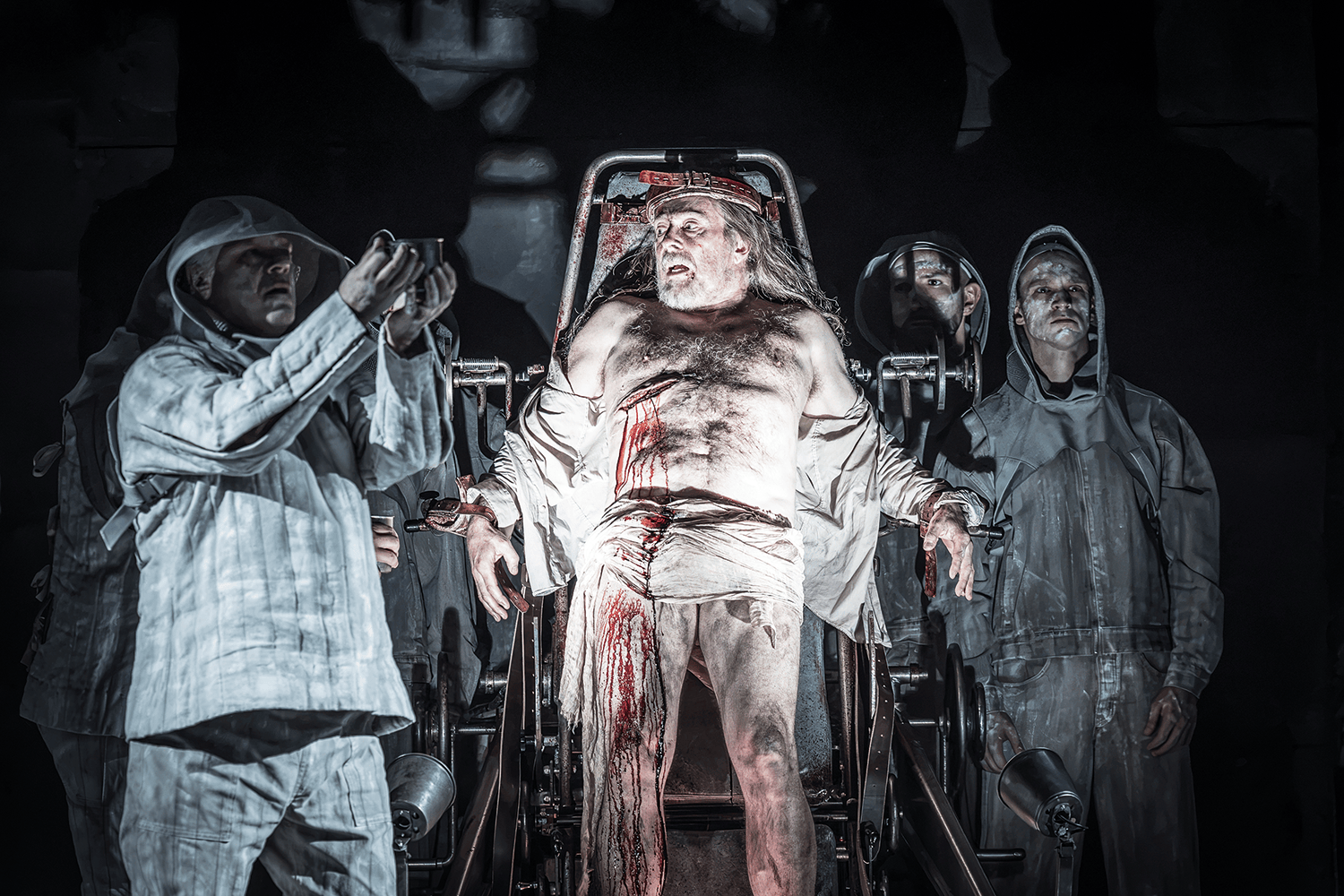
If the Royal Opera’s new Parsifal had ended after Act One, you’d be reading right now that it was one of the finest British Wagner productions of recent years. The prelude is played with the curtain down; a rare gesture of faith these days. When the curtain does rise, it’s on a dark vaulted space that might or might not be Wagner’s Grail temple: sublimity from the perspective of a broken and brutal age. Figures in overalls cluster at a bank of screens (Wagner specified no period for the mystery that’s about to unfold). Others tend, gently, to a man who lies bloodied and prone on the floor.
This is an ambitious Parsifal with some hideous, possibly terminal wounds
This is Amfortas (Christian Gerhaher), and we’ll see, shortly, that there will be no glossing over the physical side of his spiritual pain. In fact, nowhere in this first act does the director Evgeny Titov shy away from the unsettling, appalling implication that the drama is being enacted in reality. The murdered swan twitches; the vast columns of the set (by Etienne Pluss) reconfigure themselves imperceptibly as Parsifal (Stanislas de Barbeyrac) walks forward, amazed. We laugh when he stands up at the wrong moment in the Grail ceremony, because that’s what humans do.
It’s a daring approach. By the end of the act, as blood streams from Amfortas’s open wound (it appears that he actually is the Grail), Titov is taking the sort of risks with Christian symbolism that Wagner himself took when he wove his myth. ‘Do you understand what you have seen?’ asks Gurnemanz (Brindley Sherratt), and although Titov’s first act has set up all sorts of thorny questions, they’re framed with such assurance that you don’t doubt that (like Wagner) he has the intellectual chops – and the inspiration – to unravel the knot.
Then Act Two begins, and it’s a car crash. Not musically: there isn’t a weak link in this cast and Jakub Hrusa continues to conduct with a gravity and a probing, patient compassion that can excuse almost anything on stage. And it really needs excusing, as Titov relapses into Euro-director clichés – Klingsor as haut-bourgeois plutocrat; the Spear as a museum-piece in a vitrine. Child ballerinas scamper on, watch a huge video installation showing Biblical artworks, and scamper off again.
The Flowermaidens, meanwhile, have one job – to be alluring. Titov has expressed misgivings about Parsifal’s depiction of women, though I’m not persuaded that we need lessons about misogyny from a director whose idea of female sexuality is a bevy of bald fembots with Mickey Mouse ears and protuberant fake boobs. The central figure in Parsifal’s exploration of sexuality is Kundry (Ekaterina Gubanova), and in making Parsifal suckle at her bared breast Titov has arguably found an image as charged with Freudian perversity as Wagner’s own music and text.
Still, she needs more consistent characterisation if she isn’t to seem like a different individual in each act, as she did here. Gubanova committed heroically to each persona, from the snarling riot grrrl of Act One to the virginal penitent of Act Three. As with the rest of the cast, there was never any question of vocal beauty for its own sake, sensuous though Gubanova was in her long duet with Barbeyrac. Despite everything, the redemption that Titov creates for her in Act Three provided the evening’s single loveliest image.
By then we’re back in the bunker; where it becomes clear that Titov is unable to solve his own puzzle. The savage, self-defeating final gesture felt like toys being hurled from a pram, and the first night audience responded with a barrage of boos and shouts. That seemed disproportionate; you’ll see worse at Covent Garden, and infinitely worse at Bayreuth, and Titov is hardly the first director to be floored by Parsifal. For now, we’re left to take what consolation we can from Wagner’s transcendent music. It’s probably more than we deserve.
Be in no doubt, though: there are musical wonders throughout the whole maddeningly erratic ride. I’ve mentioned Gubanova, but Sherratt, too, sounded so eloquent that it didn’t really matter when his voice finally began to crack (it was wholly in character, after all).
We’re left to take what consolation we can from Wagner’s transcendent music
Gerhaher, as Amfortas, gave a performance of harrowing self-abegnation; not a hollow man, by any means, but sounding terrifyingly hollowed out. Barbeyrac’s Parsifal was as compelling at the outset – the bold, smiling innocent – as he was at the end, when that muscular voice started to soften and ache with hard-won empathy.
From Hrusa and the orchestra, meanwhile, came some of the most heart-rending Wagner that Covent Garden has heard in a very long time: a tender, wide-grained sound that blossomed out of the softest depths and made even the briefest cadence seem to speak from the soul.
Taken overall, this is an ambitious Parsifal with some hideous, possibly terminal wounds. But as every Wagnerite should know, that’s precisely when redemption feels sweetest.



Comments