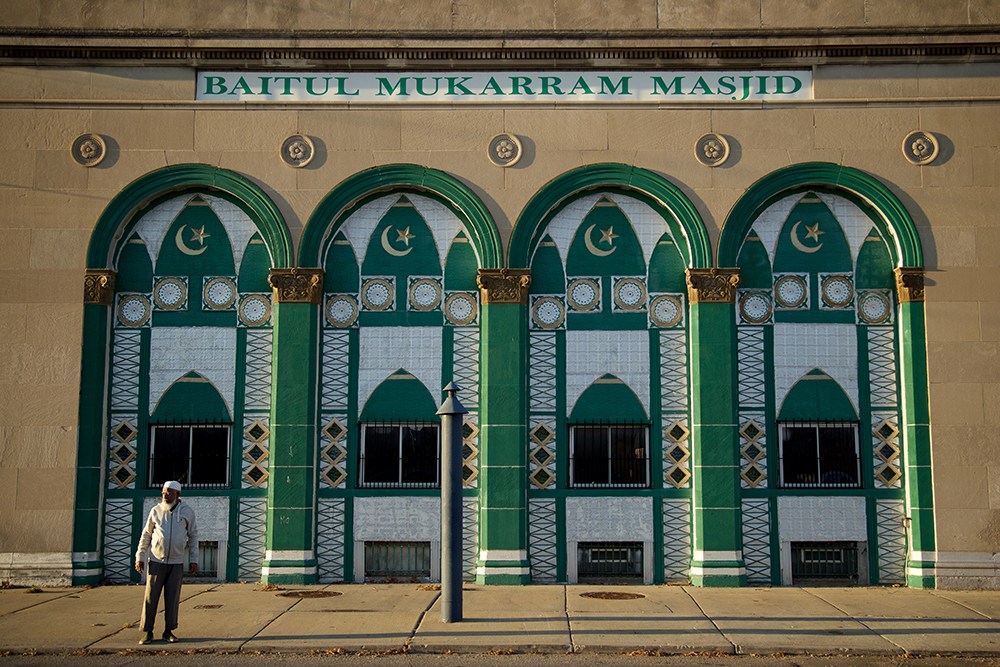
Twenty-five years and two months after al-Qaeda hijacked and crashed four American airplanes and murdered 3,000 American citizens on or over American soil, Democratic voters in the state of Michigan elected to the United States Senate a man of Arab descent whose family had ties with the Muslim Brotherhood and who on election night defiantly greeted his supporters in Arabic and gave thanks to Allah for his victory: “alhamdulillah!”
This same election cycle occurred against the background of a federal investigation into alleged criminal behavior by Ilhan Omar: a Somalian native, a Muslim and a US Congresswoman representing the state of Minnesota near to Michigan who that same night handily won reelection to the House of Representatives.
“Instinctually recognizing the incoherence of liberal movements,” Kenneth Minogue wrote in The Liberal Mind (1963), traditional societies have rightly done all they could do to ward off the liberal infection. “For once liberalism gains a hold, a sort of traditional innocence is lost.”
Abdul El-Sayed became notorious in the course of his campaign for his denial of the State of Israel’s right to exist, while Omar faithfully represents a culture that is flagrantly, unashamedly, and unapologetically out for itself alone. In both cases we find exemplified the truth of James Burnham’s argument in The Suicide of the West (1964) regarding what he called “an inescapable practical dilemma” for liberalism. “Either [it] must extend the [liberal] freedoms [of speech, conscience, association, etc.] to those who are not themselves liberals and even to those whose deliberate purpose is to destroy the liberal society… or liberalism must deny its own principles, restrict the freedoms, and practice discrimination.”
“Surely,” he concluded, “there would seem to be something fundamentally wrong with a doctrine that can survive in application only by violating its own principles.”
Assuming that American civilization has not already deteriorated beyond the possibility of salvation, not even the liberal-progressive ecstasy following upon the Glorious Revolution against King Trump and MAGA will prevent the country from taking note of the extent to which the Democratic Socialists of America are populated at its higher levels by non-western immigrants or their children, Muslim ones in particular. Indeed, the November number of First Things – hardly a populist, know-nothing publication – features an excellent and exquisitely timed essay, “A Muslim Answer to Muslim Immigration,” by Professor James Hankins of the University of Florida.
Citing the allowance by a few small towns and cities in Michigan, Minnesota and New Jersey of the Muslim call to prayer to be broadcast daily over loudspeakers and Friday prayers to be conducted outdoors in public spaces, Hankins predicts: “If Muslim immigration is allowed to increase dramatically, as it has in Europe, we may well see these practices spreading around the country.”
The possibility leads Hankins to what he acknowledges is a provocative suggestion: “We should meditate on what has happened over the past 70 years in the multicultural state of Malaysia. There a society has emerged whose political structures and democratic aspirations accord more with pluralistic societies such as our own than did those of the confessional states of premodern western history. It has experienced relatively little political violence – less than America has suffered in recent years. Malaysia values its traditional Islamic belief and does not allow it to be undermined by incompatible faith traditions. In that sense, it is democratic but not liberal.”
Hankins has in mind some similar arrangement for the United States, with Christianity substituted for Islam. What is perhaps more of interest than the idea itself is the fact that the growing Muslim population in the United States is belatedly being recognized as a national problem.
In 1996, Samuel P. Huntington published The Clash of Civilizations and the Remaking of World Order, a prescient book, and (in the context of an era when neoliberalist thought was at the peak of its influence) a brave one, where he argued that ideological rivalries and conflicts at the global level would be replaced by civilizational ones: confrontations, that is, between the broadest cultural groupings of people, those distinguished by a common history, religion, language and tradition.
The effect of the Muslim presence in the US is certain to be noted,debated – and eventually resisted
The book succeeded in capturing widespread attention, but not in keeping it. Not even the atrocities of September 11, 2001 succeeded in recapturing it, though Donald Trump’s election campaign in 2016 revived the ideas – and the warning – that informed Huntington’s book. Ten years later, and despite an election that the media, the Democrats and many old-school, unreformed Republicans are representing as the end of Trumpism in particular and even of MAGA itself, the effect of the Muslim presence in the US is virtually certain to be noted, debated – and, in the fullness of time, resisted.
The development of such resistance is made all the more likely by the ascertainable fact of a current revival of interest in Christianity in Great Britain, the United States and even in the rigidly secular Republic of France, where young people (and others) are rethinking the benefits of secularism in general and the supposed backwardness and falsity of Christianity in particular. The apparent reawakening of Christian belief in Europe and America, coinciding with the massively expanded presence of an increasingly arrogant, demanding and aggressive Mohammedan “community,” has implications for the future of the western world that are too obvious even for liberal, secular and multiculturally minded politicians to fail to recognize – and to ignore. For them to do so would be to ensure that the future of the West will, in no time at all historically speaking, resemble the chaotic and violent condition of France at this present historical moment.




Comments