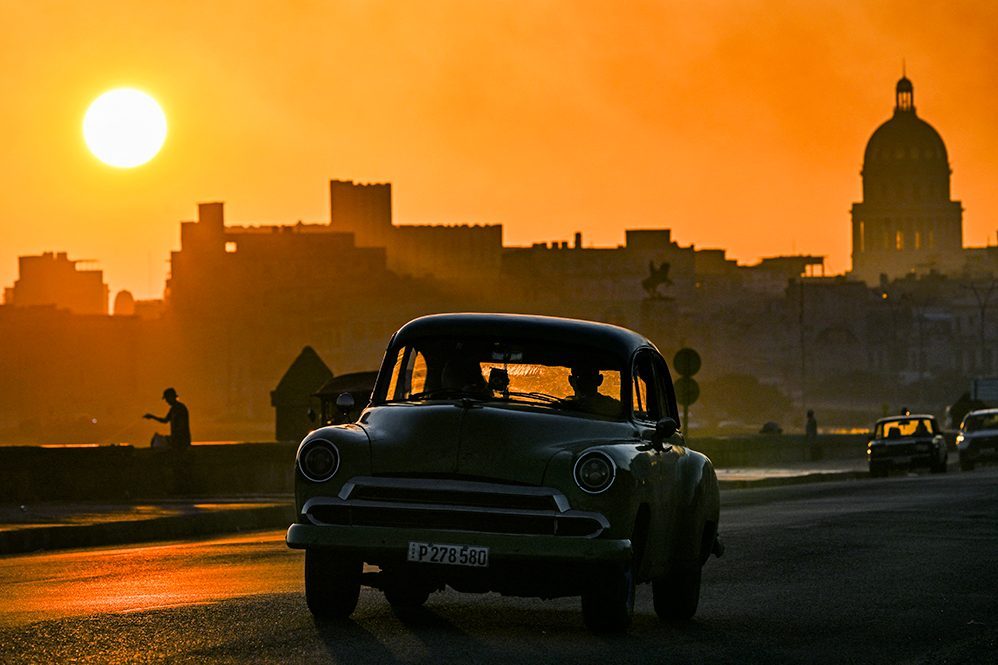
I wonder if Donald Trump occasionally looks at Cuba with envy rather than, say, avarice. The Cuban government makes moves he can only dream about.
The US President is very keen to make daylight saving time permanent, stopping people, he says, from being “late for dinner,” although I wonder if afternoon golf has something to do with it. He has been pushing the Sunshine Protection Act, what he calls the “I Don’t Want to Change My Clocks Anymore Act,” but it’s not going his way. The bill is marooned in the Senate and so on November 1, the US moved to winter hours as normal.
I’d always thought the time change was all about farmers, for reasons that were too boring to interrogate
That was not the case on our benighted isle. Late in October, Cuba’s government announced it was sticking with summer time with no discussion and so little notice that the phone companies were caught off guard. In the first weeks of November my WhatsApp groups howled with shouts of “Anyone know what time it is?” That’s authoritarianism for you. Sadly, Cuba’s reasons were less lifestyle-driven than Trump’s, although they were influenced by him. “Faced with the US energy embargo, unjustly imposed against the Cuban people, it has been decided to maintain summer time in the country until November 7, 2027,” read a decree jointly issued by Cuba’s ministries of energy and labor. They meant that with fuel shipments to run the antiquated electricity generators blockaded, it was better to keep the sun shining as late as possible into the night to ease the pressure on the grid.
It’s a nightmare though. I’m the father of a five-year-old and my gentle pats at 6:30 a.m. saying, “C’mon, my boy, time to get ready for school” are now met with a bleary glance into the pitch black of the tropical night and a “go away, daddy.” I choose not to call on my pretending-to-be-asleep wife, because I know I’ll just get snarled at.
I’d always thought the time change was all about farmers, for reasons that were always too boring to interrogate. It turns out it’s about parents instead.
It didn’t start out that way though. Historically, saving daylight in the afternoon was the result of governments making a mess of things (a tradition Cuba’s doing a fine job of maintaining). The idea took off during World War One, adopted by Germany and Austria to preserve the use of coal in the evenings. The US followed in 1919, but that was quickly repealed as unpopular before being reinstated again during World War Two. Then it was adopted piecemeal by different states, creating utter chaos for travellers, before the 1966 Uniform Time Act.
Havana followed the US in 1945, presumably to maintain the same time zone as Miami and Washington which, as someone who often flies to the US, I’ve found convenient. Now, while conceptually we’re 70 years behind the US (think cars, cigars and communism), temporally we’re an hour ahead.
Earlier this week, getting only grumpiness from my son, I wandered onto the terrace to forlornly look for a faint lightening in the east. I found myself considering how many things in our globalized world are both mundane and really quite important. But it also occurred to me that while the time change was born out of the desperation of war, it seems to have been kept as an act of kindness toward parents, allowing children to go to school in the light.
I love that. After all, the time spent actively parenting children is only a short period in most people’s lives – 15 years, maybe, two decades if you’re churning them out. Bringing light into winter mornings and losing it in the evening is something the rest of the population does for parents’ sake. That’s rather beautiful, I thought, as I went back in to drag my wee boy out of bed.






Comments