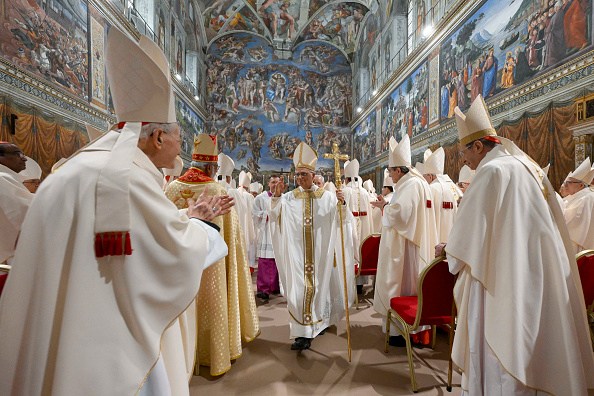
On November 6, the first pope from the United States will begin a tour of South America that includes some of the most anti-American cities on the planet. He will receive a rapturous reception. Until last year, one of the unofficial doctrines of the Catholic Church was that an American could never occupy the See of Peter because cardinals from the rest of the world – and Latin America especially – despise the US. So how do we account for what seems certain to be the jubilant success of Leo XIV’s 12-day apostolic visit to Uruguay, Argentina and Peru?
Let’s start with the obvious. This 71-year-old man had an operation to treat lung cancer as recently as October 13. He has a lovable smile and his Christian witness is memorable for its self-effacing joy. He appears fit and youthful, so people panicked at the thought that they were about to lose him just 18 months into his pontificate. Now it seems that the cancer wasn’t anything like as bad as we feared. His doctors are happy for him to undertake a tour that includes Cusco, which is more than 11,000 feet above sea level; I remember gasping for air when I visited it in my thirties.
Trump accused Leo of being ‘weak on crime, weak on nuclear weapons’ and ‘catering to the radical left’
The former Robert Prevost, born and raised in Chicago, hasn’t renounced his US citizenship, and Argentinians in particular regard los yanquis with almost pathological contempt – a sentiment shared by their fellow countryman Pope Francis (who nonetheless, and for reasons that remain mysterious, refused to set foot in his native land after his election). Yet there will be unforced cheers when Leo arrives in Buenos Aires and a mighty crowd for his public Mass at the basilica of Our Lady of Luján, patroness of Argentina. In Peru, everyone anticipates that his reception will be ecstatic.
None of this is really surprising. Leo is not only the first pope from North America but the second from South America. He was an Augustinian missionary in Peru from 1985 to 1998, and then – after returning to the United States and Rome to serve as global head of his order – spent nine years as diocesan bishop of Chiclayo, on the northern coast of Peru. In 2015, he became a naturalized citizen of Peru, which he calls his segunda patria. Since he’s head of state of the Vatican, he’s the first pope to be a citizen of three countries. He speaks Spanish with complete fluency, in a local accent lightly colored by the vowels of Chicago. To most Latin Americans, he sounds like a Peruvian.
Even so, owning a US passport would normally be quite a handicap for a pope visiting South America – but let’s consider another surprising fact. Prevost was the candidate of the Latin American bloc of cardinals in last year’s conclave. This wasn’t just because he was the senior Vatican official they knew best. He was also a moderate liberal anxious to calm tempers and soothe egos inflamed by the unpredictable, score-settling Francis, but without changing direction dramatically – precisely the mixture they wanted.
But there was a third, crucial factor. Prevost was the right sort of American – so much so that his citizenship even counted in his favor. The Catholic Church, and especially the Vatican, is pathetically dependent on US financial support. Rich Americans, appalled by the corruption that still flourished under the supposed “reformer” Francis, would be far more willing to open their check books if they had their own pope. But – and it is a very big “but” – the Latin American cardinals, and indeed most of the cardinal-electors, would rather have faced a financial apocalypse than elect a “neoliberal” US pontiff who tailored Vatican foreign policy to suit the newly reelected Great Satan President Donald J. Trump.
Prevost, however, was definitely not that sort of American. He couldn’t stand Trump or his brand of capitalism. Granted, in the past he may have voted for old-style Republicans on pro-life grounds. But his addresses to the Augustinian order reflected the mindset of Latin America. Prevost was wedded to the unsophisticated “Global South” discourse that was almost universal, even in the US, among Catholic seminarians of his generation in the 1980s. As he put it in an address to Augustinians in Peru in 2002, “globalization… increases the wealth of a select few and creates more poverty.” Later, this cartoonish worldview – which was not successfully challenged in Latin America until Javier Milei was elected president of Argentina in 2023 – was reflected on Prevost’s surprisingly combative Twitter account. Even more than neoliberalism, the future pope despised Trump’s immigration policies, which he felt dehumanized ethnic minorities. (It’s often forgotten that he is himself of mixed-race Creole heritage.) He made it clear that he was appalled by the so-called “Donroe Doctrine,” under which the United States employs military and financial leverage in an attempt to dominate the entire Western Hemisphere.
Admittedly, since he became pope, Leo has been careful never to criticize the American government in explicit terms. But his comments on the “outdated” concept of a just war, while theologically confusing, left no one in any doubt about his opinion of the attack on Iran – least of all the President of the United States. Trump accused the pope of being “weak on crime, weak on nuclear weapons” and “catering to the radical left.” American Catholics, including some who were privately critical of Leo’s left-leaning naivety, were tribally outraged by this unprecedented attack on the Vicar of Christ by this Protestant President.
At the time of writing, the midterms have yet to happen and it’s unclear just how much damage the Iran war will inflict on the Republicans. Catholics loyal to the GOP are trying to forget about it. Latin American Catholics, meanwhile, buoyed by the victory of their co-religionist Lula in Brazil, certainly haven’t forgotten what happened. It’s one of many reasons why they are about to declare their undying love for a yanqui pope. Stranger things have happened in the history of the Catholic Church, but not often.



Comments