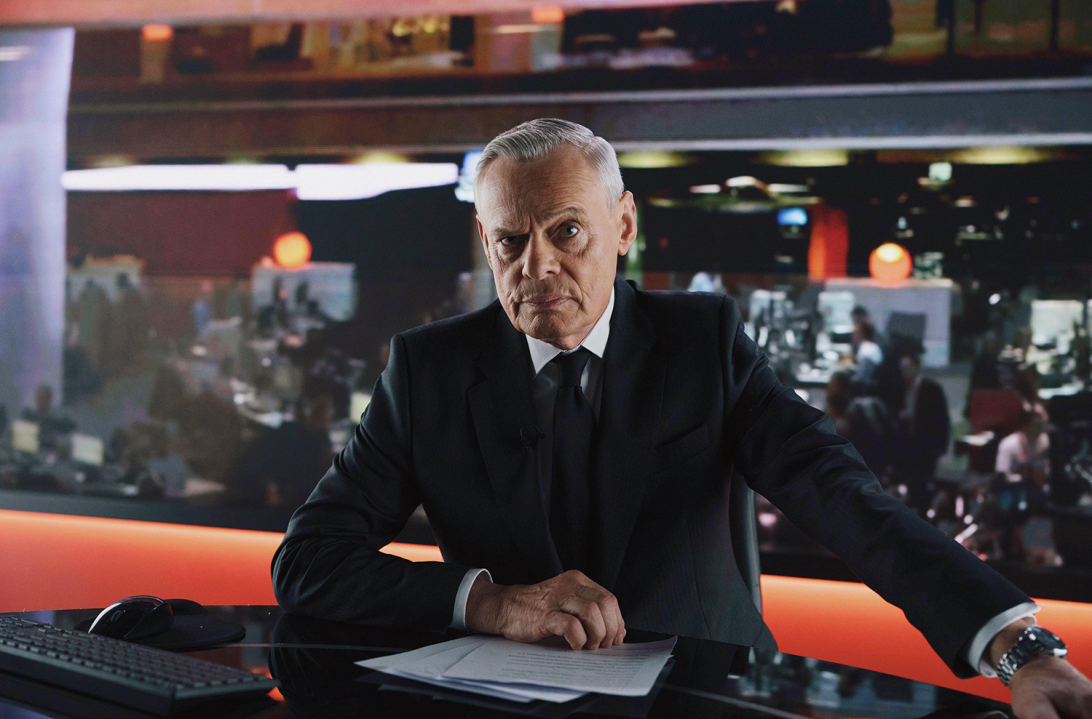
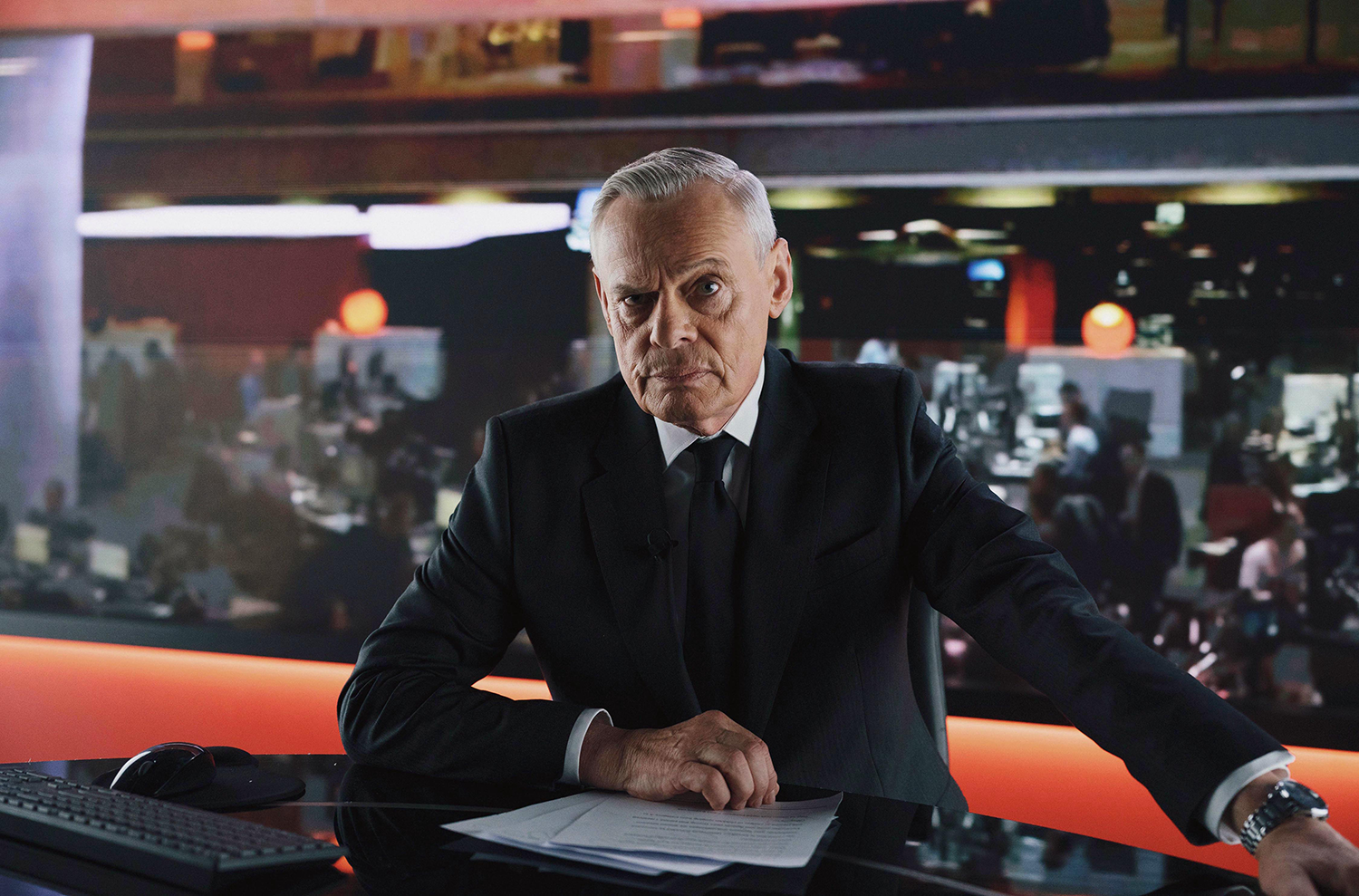
It’s not easy for a drama to be over-cautious and clumsy at the same time. Or to turn a real-life story that shocked (and, let’s face it, titillated) the nation into an oddly flat piece of television. So how did the much-hyped Power: The Downfall of Huw Edwards manage to do both?
The answer, I’d suggest, is by failing to interrogate – or even engage much – with its own material. Instead, it opted to simply pass on the facts drawn from its own research, making only the most half-hearted and sometimes contradictory attempts to explain them.
The programme began with Edwards (Martin Clunes) in his voice-of the-nation pomp, as he announced the Queen’s death. Meanwhile in Wales, the pseudonymous ‘Ryan’ (Osian Morgan) met his friend Alex, who boasted about the gifts he’d received in his role as ‘porn dealer’ for someone famous. Hearing who it was, Ryan contacted Edwards with surprising speed. Nor did Edwards waste much time in texting back admiringly that ‘you look younger than 17’ and asking Ryan to set up a PayPal account.
Before long, there was a scene of Ryan undressing on his phone camera, while Edwards cried: ‘Slowly, baby.’ There was then another one. And then several more. But it was in their purely social chats that Edwards revealed his true colours: i.e., those of a total pantomime villain. ‘Earn your keep,’ he told the boy, ‘and know your fucking place.’
After a while, Ryan’s mum realised something was up, what with her son suddenly having loads of money and taking loads of drugs. Eventually, he revealed to her the source of his new-found wealth and she and his crudely drawn stepfather – his every remark to Ryan either insensitive or plain nasty – went to the Sun.
The way the programme told it, the paper’s decision to run the story without identifying the ‘top BBC star’ involved or the sex of the groomed teenager was a bid to avoid accusations of homophobia – and, at first, Edwards thought he might be in the clear. But then came the double whammy of his wife admitting it was him, and his arrest for downloading the child porn supplied by Alex.
Now and again, Power remembered that Edwards had other aspects to his life – although not how much richer the result would have been if we’d seen more of them. Occasionally, he was sighted at the BBC complaining that his bosses didn’t like him because of his Welsh accent and failure to go to Oxbridge. Mostly, however, he stuck to drinking and masturbating in his study – or alternately flattering and denouncing Ryan over the phone; the trouble being that this behaviour was treated by the programme with a weird incuriosity that proved both frustrating to the viewer and deadening to the drama.
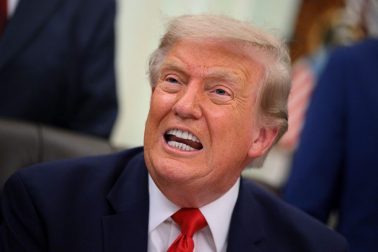
As for Ryan, on whose ‘truth’ Power was keen to stress it had relied, the problem there was the opposite. Instead of no explanation, it gave us an endless series of different ones. Yet, as with Donald Trump on the invasion of Iran, the more these piled up, the more they began to seem like no explanation at all.
And then there was the dialogue, where the playing-it-safe taste for cliché further suggested a programme that didn’t really know what it wanted to say. (‘I don’t know who you are any more, Ryan, I really don’t,’ lamented his mum at one typical point.) In a final miscalculation, Power ended with Edwards reading out the news of his own downfall in full TV style – a meta touch that, by coming completely out of the blue, only served to confirm that this had been a drama never sure how to go about its business.
The taste for cliché further suggested a programme that didn’t really know what it wanted to say
Spectator Easter deadlines being the cruel mistress they are, I haven’t yet seen this week’s second episode of Saturday Night Live UK – but, somewhat to my surprise, I’m now much looking forward to it. The first show was by no means a flawless comic masterpiece. Nonetheless, it was, at the very least, perfectly respectable.
Even with Tina Fey as the guest host, it also had a winningly British feel, with irreverent jokes about national treasures (‘I’m David Attenborough and it can’t be long now’), a sketch about Shakespeare having his head turned by London hipsters and a particularly brilliant impersonation of Princess Diana.
As ever with sketch comedy, some items didn’t land – and, even when they did, the punchlines tended to the dutiful or the faintly desperate. Or, when the chips were really down, why not just get everybody to dance about for no obvious reason?
And yet, even this ruse ended up adding to the general joyous sense of a highly talented, mostly young cast who can’t quite believe their luck – but who’ve turned out to deserve it. (Unless episode two was rubbish.)


Comments