Whether compelling or not, a case can probably be made for most of the heavy-handed things the British state finds itself doing. Lockdowns and curfews are unthinkable until a pandemic comes along, and however unseemly it might look to pursue unpaid carers through the courts, the books do have to be balanced. The optics of imprisoning retired vicars are terrible, but no one is forcing them to march in support of a proscribed terrorist organisation. There might even be a case to be made for censorship. Of all people, I should know: the spies have been making it repeatedly over eight years of polite and not-so-polite discussion about what I can and can’t include in my novels.
Even giving fictional spies the ability to do things your smartphone can do incurs the censor’s wrath
Their position certainly has its merits. Real-world information, they remind me, even if strained through the filter of fiction, can be reassembled like the pieces of a puzzle by this country’s enemies to give an accurate glimpse of the way that MI5, MI6 and GCHQ go about their work. What’s more, depictions of British spies as incompetent or lacking a moral compass eat away at the public’s confidence in organs of state that cannot speak up themselves, while degrading the UK’s ability to recruit the brightest and the best.
There’s also the matter of internal discipline. How can they require that staff lie to friends and family about what they do while allowing former officers like me to publish stories that draw, however tangentially, on their professional exploits?
As with all the most persuasive arguments, running through theirs like a steel wire is the threat of repercussions. According to the Official Secrets Act, a former officer ‘is guilty of an offence if without lawful authority he discloses any information…relating to security or intelligence’ that has been obtained by virtue of his position. Whether or not the information causes damage is irrelevant. Even details that you and I might consider to be squarely in the public domain – that spies use false identities, say, or have the ability to intercept phones – might turn out, in their judgement, to be secret, on the basis that they have never officially been released. It doesn’t matter that everyone thinks it, they say. They don’t know it. Please remove from manuscript.

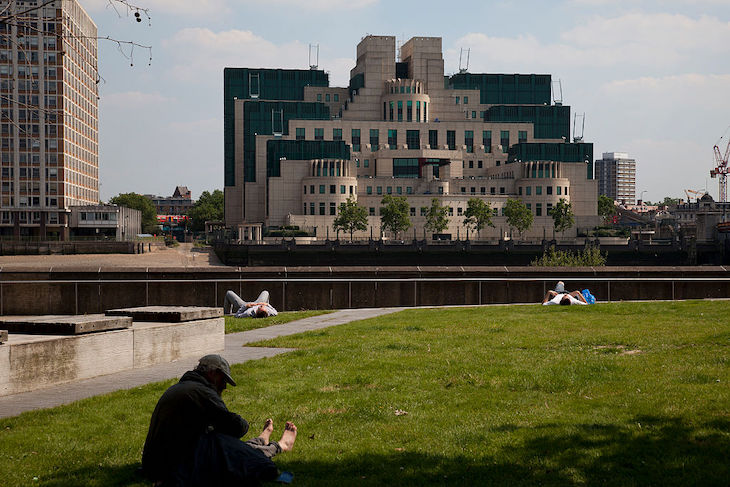
‘Please remove from manuscript.’ It is a phrase I have come to know well. For obvious reasons I have to be careful about disclosing examples of the censor’s high-handedness, but I think I can tell you (let’s find out, shall we?) that revealing the geographical location of the intelligence agencies’ main buildings has proved a cause for concern, despite that information being readily available from street signs, Google and tour guides on sightseeing buses. I once tried to have a character ‘muster’ resources but learned to my surprise that the word ‘muster’ implies that the resources are permanently stationed nearby. Technology is a particular minefield. Even giving fictional spies the ability to do things that the smartphone in your pocket can do incurs the censor’s wrath. ‘Please remove from manuscript’, or if they’re really annoyed, ‘Remove from manuscript.’
It’s sometimes hard to take their demands seriously, or at least avoid the suspicion that they’re having a laugh at my expense. During the redaction process for my latest novel, Spies and Other Gods, they twice asked me to remove details that I was compelled to point out they had published on their own website for the entire world to see. Can their perspective on what is a threat to national security really be so skewed? Edward Heath told the Commons in 1989, shortly after the conclusion of the Spycatcher trial, that there were officers in MI5 ‘whose whole philosophy was ridiculous nonsense. If some of them were on the tube and saw someone reading the Daily Mirror, they would say, “Get after him, that is dangerous. We must find out where he bought it.”’
Why do they bother? It took them 16 months to approve my most recent book – 16 months during which they responded to my queries in a spirit of what the American author Nicholson Baker, writing about the US national security community, called ‘pleistocene ponderousness’. The former MI6 chief Richard Dearlove might have shed some light on this question when he described the spy-turned-novelist John Le Carré as ‘a counter-intelligence nihilist’, claiming most MI6 officers were ‘pretty angry’ with him. The writer’s novels, Dearlove wrote, were a ‘stain’ on the agency that had ‘tarred the moral reputation of his colleagues’.
Does this get to the nub of it? Organisations, it turns out, have feelings too. Organisations don’t like it when people say unkind things about them – people like the High Court judge who found that MI5 had given false evidence to three courts, or the PSNI Chief Constable who criticised the same agency for taking an unreasonably long time to share material with the enquiry into the British agent Stakeknife. Organisations have an instinct for self-preservation as strong as anyone’s. And when the organisation in question has a national security remit, it is all too easy for them to claim that they are being secretive in defence of the realm, whereas the truth is that, at least some of the time, they are being secretive in defence of themselves.



Comments