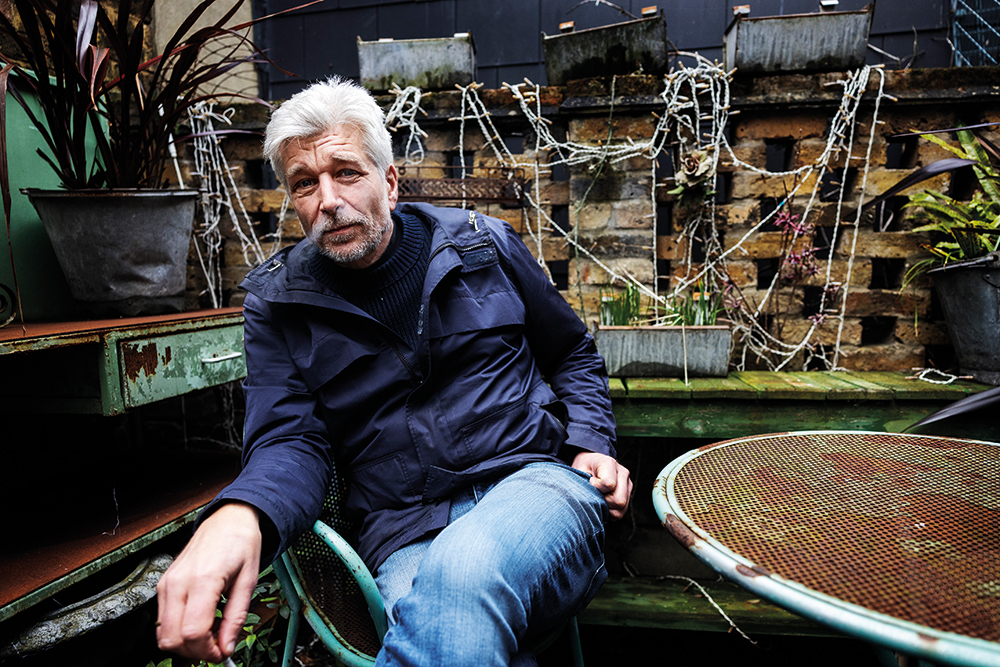
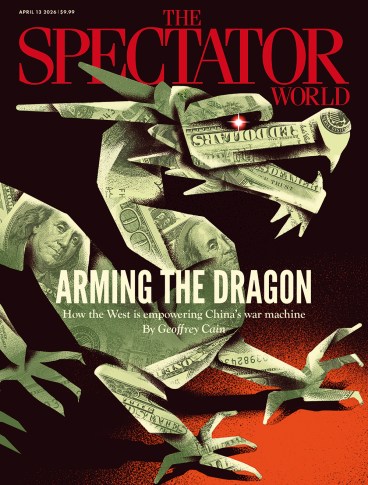
On a winter’s morning, outside the Three Lives bookstore in New York’s West Village, Karl Ove Knausgård has just finished signing copies of his latest novel, The School of Night. His features are familiar from the dustjackets – the gray-blue eyes, the grizzled beard – but he is surprisingly tall and his signature silver mane is now cropped short around the ears. Gone, too, are the cigarettes, traded for a vape.
The School of Night is the fourth novel in Knausgård’s “Morning Star” series. It takes its name from a secret society of Elizabethan poets and scientists, which included the explorer Sir Walter Raleigh and the play-wright Christopher Marlowe. Marlowe’s Doctor Faustus looms over the story, which follows Kristian Hadeland, a narcissistic young art student in 1980s London. He engages in a Faustian pact to realize his dreams as an artist with the help of a mysterious Mephistophelean figure called Hans. It’s all brilliantly diabolical. “None of this was planned,” Knausgård says. “I never know what’s going to happen in a novel. I believe in it if it just turns up in front of me somehow. Then, when I start to write, things just fall into place.”
Knausgård keeps to a demanding, near-monastic writing schedule: five days per week, six hours per day
This is an unsettling admission for readers of Knausgård, especially those who are new to his daunting output. The School of Night runs for more than 500 pages – and seven novels are planned for the series. But Knausgård pulls it off, marrying his exhaustive character studies with a compelling plot that is both eerie and addictive.
The author has lived in London since 2017, when he moved from Stockholm to be with his fiancée, now his third wife. He is an avowed Anglophile, having grown up listening to British bands, reading NME and following Premier League soccer. This was a “completely different world” from the one he knew from his childhood on the southern Norwegian island of Tromøy. It was one he wished to recreate with The School of Night: “I can’t really write about London now. There has to be some element of fiction for me in these books. So I tried to recreate the bleak England of the 1980s.”
He is frank about some autobiographical moments in the book. “The thing with Kristian going to art school, that’s basically me taking a creative writing class in Bergen when I was 19.” I remind him of a passage in the book where he is roundly dismissive of the English, writing about their “perverted minds and exaggerated sense of their own intelligence.” Knausgård laughs: “That’s Kristian, not me.” Over the course of our chat, I manage to blur this distinction more than once, a clumsy but perhaps easy mistake to make when interviewing a writer who made his name as a serial composer of autofiction.
But it appears to be some part of him. He adds: “My way into British culture is the feeling of superiority. I’m starting to get a bit more confident about being in Britain – I do love it so much there – but I feel almost inadequately equipped to live there; it’s weird.” When I ask if he makes anything of Gore Vidal’s quip about the English – “eccentric Norwegians” – he politely laughs.
Knausgård honed his confessional, deeply personal writing style in his magnum opus My Struggle. In six books totaling 3,600 pages, written at feverish pace between 2008 and 2011, he chronicled his life in intimate, unsparing detail. He wrote about everything: the trauma of his father’s death, the challenges of becoming a father himself, and the breakdown of his first marriage.
He even devoted 400 pages to his thoughts on Adolf Hitler. The title, My Struggle, deliberately references Mein Kampf in a pointed contrast between a totalitarian political vision and his own mundane, personal life. It makes for an arresting juxtaposition. On one side, you have the world’s most infamous political manifesto and on the other, you have an author trying to find meaning in the world while taking the bus or chang-ing diapers.
Knausgård’s feelings about Norway are hard to discern. I have yet to find a glowing passage about his home country in the body of work I’ve read, so I asked him if he harbors any patriotic feelings. Will he be supporting Norway in the World Cup, for instance? “I will, very much so… I think I appreciate Norway a lot more now that I don’t live there. I see it much more clearly. When there, you become petty when it comes to your own country, but when you’re outside, you see that it’s great, it’s really like a paradise. If you listen to the Norwegian news hour and the debates, you realize this is a country without any real problems, compared to the UK, or especially the US… I feel Norwegian, very much so, to answer your question in an easy way.”
He is interested in immigration, which he calls the “burning issue” of our time, and points to the debate in Norway about nationhood, sparked by an academic who published a widely read essay called “Will Norway survive what’s coming?”
“When I grew up in my first 40 years, there was never any feeling of threat, or any feeling of dissolving, or a war, or anything. If you read about World War One, for instance, it’s the same mechanism, that we’re getting closer and closer to something. The whole way of thinking of nations, it’s very important of course… I don’t know.”
Politically, Knausgård is hard to pin down. He has railed against political correctness and globalization – “Americanization,” more precisely – and while he has expressed concerns about the rise of far-right parties, he has suggested we should try to learn from their views. He finds the current state of UK politics “really interesting but not in a good way… with Reform and what’s going on. It’s not like Britain is rising. It feels like some sort of chaos underneath.” Knausgård is wary of aligning himself with any kind of ideology. “What you want as a writer is complexity, and politics is the opposite,” he once said. Everything he does seems to be in service of the craft.
And Knausgård is prodigious in that craft, having produced 21 books in as many years. He keeps to a demanding, near-monastic writing schedule: five days per week, six hours per day. “The way to do it is just not to stop, just accept what comes, that’s the clue, just stick to even the bad stuff and continue instead of starting again. Then it will be a novel in the end. I always reread the things I did the day before and then start to write and just stay in there. And I have my editor who helps with that, to stay in it. But we don’t really edit much. Those books are almost written the way that they are.”
‘If you ask me, it was worth it. If you ask people who were affected by it, they would say no’
When the six volumes of My Struggle were published between 2009 and 2011, they became a runaway success. Knausgård became an almost mythical figure, hailed as “Proust redivivus.” Author Zadie Smith likened the books’ addictive qualities to crack cocaine. But the project caused controversy because of its intimate portrayal of his friends and family, some of whom threatened legal action. His success came at a high price. This was Knausgård’s Faustian pact. Was it worth it?
“Depends on who you ask. If you ask me, it was worth it. If you ask people who were affected by it, they would say no. But for me, there was some sort of freedom, and also some sort of innocence. I’ll never be able to do it again. In the beginning, I didn’t think it would take off in any direction, so I just wrote. Six novels in two years, from my perspective of being 40, looking back at my life. If I’d have written it now, it would be a very different book.
“And it was very much an experiment, since I was writing and publishing all these books at the same time, an experiment between real life and fiction. An exchange somehow. You know, I wrote the first book. I got reactions. They were in the next book. It was like a dynamic that was incredibly interesting and also really hard to deal with. So to me, it’s good, it’s there, it’s written, it’s done, it’s over. Nobody died.”
Following Christopher Marlowe’s fatal stabbing in 1593 in a drunken tavern brawl, he was celebrated by his fellow poet and playwright George Chapman as a “free soul.” The same is true of Knausgård. We are lucky to have a writer in our midst who is unmoored from ideology, who is free and unafraid to say exactly what he thinks.



Comments