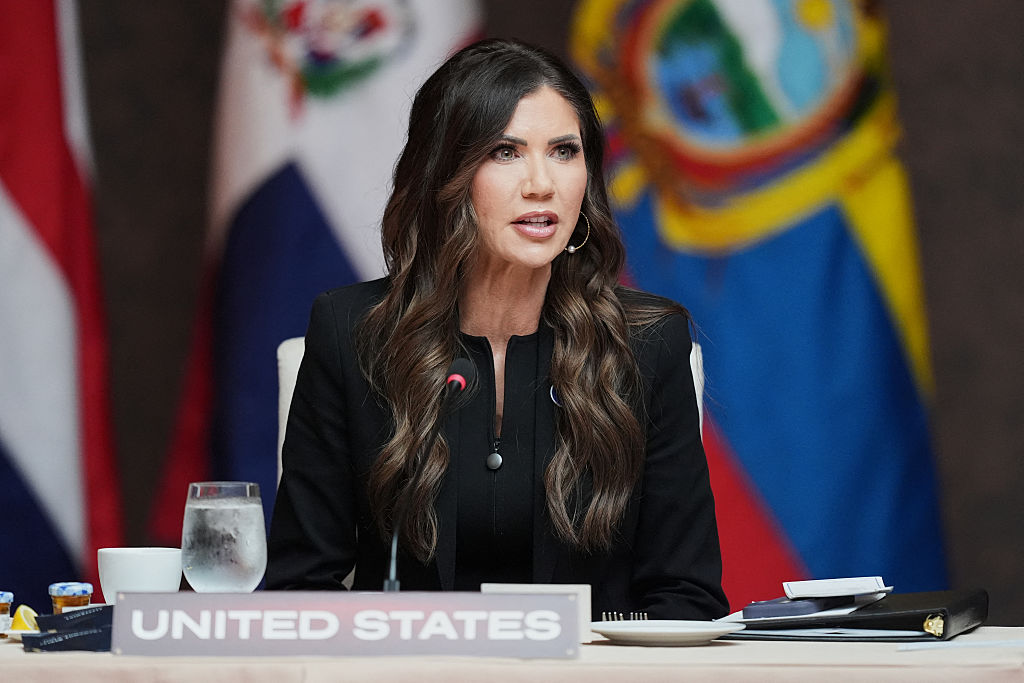


On the final weekend of her tenure as Homeland Security Secretary, Kristi Noem was in South America meeting the President of Guyana. Photos posted by the US Embassy in Guyana show Noem’s “senior advisor” Corey Lewandowski sitting alongside her. It would, of course, be “tabloid garbage” to repeat rumors of an affair between the two, to use Noem’s phrase when questioned (both Noem and Lewandowski have vehemently denied the affair, although she didn’t explicitly deny “sexual relations” when under oath in Congress).
Noem’s South American jaunt seemed to straddle the role she was leaving and the one she’s just started. She was officially in Guyana on DHS business but has a new posting as Donald Trump’s “Special Envoy for the Shield of the Americas.” The Shield is a transcontinental organization Trump created that very week to coordinate military operations with other nations in the American hemisphere.
The envoy-first approach to foreign policy has yet to bear fruit with Iran, Israel, Russia and Ukraine
Make no mistake though: the “special envoy” role is a step down for Noem. Rather than being a cabinet secretary, she now reports to the Deputy Secretary of State. This is a face-saving exercise for Team Trump. The White House didn’t want to fire a failing official so instead gave her a new portfolio, billing the change as a reshuffle. (See also: UN Ambassador Mike Waltz.)
Special-envoy designation is helpfully vague. In the Trump era, “special envoy” can be an empty honorific or a de facto cabinet-level position. “It’s a role whose importance is totally defined in accordance with your relationship to Trump,” says a DC insider.
America’s first special envoy was appointed by George Washington, who sent Gouverneur Morris to Britain to negotiate a commercial treaty. Morris’s current successor is thought to be Mark Burnett, the creator of The Apprentice, although Politico reported earlier this year that he’d been removed. Such is the personal nature of special-envoy status that nobody seems quite sure.
Who a president selects as special envoy reveals something of his priorities. For example, Trump has sought to demonstrate that America is what he constantly refers to as “the hottest country in the world.” To aid in this mission, he appointed Nick Adams to be “Special Presidential Envoy for American Tourism, Exceptionalism, and Values” in March. Adams is an exuberant character, an Australian-American with an oversized social media presence where he posts about his “alpha male” status. “The entire world must be reminded that the United States is the nation where freedom of speech powers the mighty V8 engine of liberty,” he said in a statement after his appointment.
Previously Adams had been nominated to serve as US ambassador to Malaysia – to the consternation of Malaysians – but his nomination timed out as the Senate didn’t debate or vote on it by the end of last year. Unlike ambassadors, special envoys can be appointed without congressional approval. And unlike other countries, America doesn’t have a tourism minister – so now it has Adams. “I invite those who love America and crave their own slice of Americana,” he said, “to come and visit the land where everyone is free to dream, and where our sacred traditions of liberty mean that our dreams can always, and will always, come true in the United States.” Not that he’s overpromising.
Another pick that reveals Trump’s priorities was his choice of Jeff Landry, the sitting Republican Governor of Louisiana, as “Special Envoy to Greenland.” In a tweet directed at the President, Landry said it was “an honor to serve you in this volunteer position to make Greenland a part of the US.” The appointment, in late December, caused the biggest flare-up to date between America, Denmark and the rest of NATO over the Arctic territory’s future.
Most popular
Steven Edginton
Invented claims of lynchings and racist violence are irresponsible — and dangerous
Compare these special envoys to those of Joe Biden. Under his administration, special envoys were appointed for “Advancing the Human Rights of LGBTQI+ Persons,” “Biodiversity and Water Resources,” “Global Women’s Issues” and “Racial Equity and Justice.”
The Trump approach to special envoys also vastly differs from the last Republican president’s. George W. Bush abolished all foreign policy-related special envoys in a 2001 National Security Presidential directive. The Bush team “viewed the deployment of outsiders as an inappropriate method of implementing foreign policy,” wrote Michael Fullilove in Foreign Policy in 2005. “It was no way for grown-ups to govern.”
In the Trump era, some envoys are more special than others. Steve Witkoff is perhaps the most special of them all. The Middle East envoy has a crucial role in the Trump foreign-policy team, in part because of the breadth of Marco Rubio’s portfolio as Secretary of State and National Security Advisor. Along with “informal advisor” Jared Kushner, Witkoff has led American efforts to negotiate between Ukraine and Russia, Israel and Palestine and the US and Israelis with Iran. “There is no structure,” Aaron David Miller, a 24-year veteran of the State Department, said. “Therefore, the President deploys who he wants, where he wants them.” Kushner and Witkoff report directly to Trump.
“Personal representatives can offer certain advantages over resident diplomats when it comes to communicating and negotiating with foreign parties and assessing local conditions and personalities,” wrote Fullilove. “Personal envoys may be able to speak more candidly than career diplomats and negotiate with full presidential authority.” That certainly appears to be why Trump prefers to use Witkoff and Kushner rather than have a standalone National Security Advisor, with all the obligations – knotty bureaucracy, required disclosures and Senate approval – that come along with such a position.
The envoy-first approach to foreign policy has yet to bear fruit when it comes to Iran, Israel, Russia and Ukraine. “You cannot appoint your son-in-law and your best friend to tackle three of the most complicated conflicts in the international arena today and expect positive results,” says Miller. “The world’s most compelling ideology is not communism, nationalism or even capitalism: it’s success. If they were succeeding, then you could say the unconventional, the unorthodox, the breaking of traditional diplomatic crockery, all that stuff, was worth it. But they’re not.”
Still, at least Witkoff has the President’s ear. That’s what makes him so special.




Comments