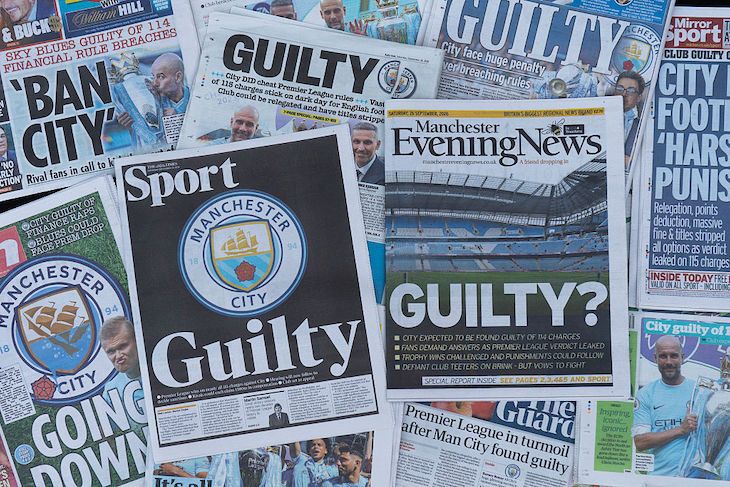
When news broke that Manchester City had been found guilty of all but one of the 115 charges relating to breaches of the Premier League’s financial regulations, ex-Manchester United defender Rio Ferdinand posted sarcastically on X, ‘Another Premier League medal to be added to the cabinet’ For a man like Ferdinand, who won six Premier League champions medals, one more may not make a big difference. Other players who have been on the losing side to Manchester City and have never won a major title will be less sanguine.
Players who have been on the losing side to Manchester City and have never won a major title will be less sanguine
Claims for compensation and re-awarding of titles and medals will be loud and persistent. Given that over the period between 2009 and 2018, when the charges relate to, Manchester City won eight trophies, there are hundreds of players who probably lost out on medals and probably bonuses, not counting how they may have gone on to profit from enhanced careers and transfers.
Managers, too, will have lost out on bonuses and, possibly more importantly for them, boasting rights. Jose Mourinho, now manager of Real Madrid, famously bragged ‘I consider one of the best jobs of my career was to finish second (to Manchester City 2017-18) with Manchester United in the Premier League.’ Reassigning the title to Mourinho would enable him to join Carlo Ancelotti as the only manager to win league titles with five different clubs.
As for the clubs themselves, you can bet your life that they are all consulting their lawyers. In June this year Burnley, who lost out in a relegation battle with Everton FC (the club supported by the Prime Minister Andy Burnham) in the 2021/22 season, was awarded £35 million as compensation for Everton’s breaking of Profit and Sustainability Regulations (PSR).

If that is compensation for relegation one can only imagine how much Manchester City may have to pay to a whole bevvy of opponents who have been cheated out of the biggest prizes. Jurgen Klopp, the former Liverpool manager who now coaches the German national team, could be owed two more Premier League championships, which he twice lost narrowly to Manchester City. Liverpool too will seek their day in court. As a football lawyer has noted, ‘The question isn’t whether the clubs can take legal action… it’s where does the line of people who have a case actually end? The clubs who didn’t win/qualify/stay up; the players who didn’t get bonuses, contract extensions; the staff who missed out on bonuses; the agents who didn’t get their uplift on their player deals…It’s endless and potentially so destructive to the whole ecosystem.’
After charges were first laid in 2023, Arsenal, Liverpool, Manchester United and Tottenham Hotspur, four of the big six English clubs, sent formal legal warnings to Manchester City that they reserved the right to seek legal address in case guilt was proven. Chelsea, who have faced legal problems in recent years was the only one of the big six to abstain.
Because Manchester City’s record of performance in England’s premiership has been so consistent, the club was ever present in European competitions from 2010 onwards. Any European team which lost to them over this period will feel similarly aggrieved. One imagines that many of these losing clubs will claim compensation.
As well as compensation, the English Football Association will come under pressure to rectify the historic record. The en dit is that it is reluctant to go for the nuclear options of forced relegation or voiding Manchester City’s wins in major competitions, but will they be able to resist the public clamour for the harshest possible punishments? The English Premier League’s combined enterprise value of £35-40 billion with players valued at almost £14 billion represents an estimated 40 per cent of the value of all the European leagues. So, the reputational and economic risk to European football is not negligible.
But will the scandal damage the football brand? Unlikely. When cyclist Lance Armstrong had his seven Tour de France titles expunged after revelations of drug doping, fan interest and sponsorship collapsed in the United States; the Tour de California shut down. But football seems to be able to shrug off bad news. Despite the scandals that have swirled around Fifa for years involving presidents João Havelange, Sepp Blatter and Gianni Infantino, the game has grown into a seemingly unstoppable juggernaut. As Ancelotti has opined, ‘Football is the most important of the unimportant things in life’.
While the world sport is unlikely to suffer, the Premier League may be damaged. It is the richest and most followed league in the world, but there are worrying signs that all is not well. The star players in the world do not now join English clubs. They go mainly to the Spanish giants, Real Madrid and Barcelona or sometimes to Bayern Munich. In last Saturday’s international fixture at Wembley between England and Spain, it was noticeable that three out four of England’s forwards play for these three top European clubs.
A relegation of Manchester City to a lower division as happened to Rangers in Scotland and Juventus in Italy after the Caliciopoli corruption trials in 2006 might well lead to a fire sale of star players to European clubs; the most prolific European goalscorer of recent years, Erling Haaland would most likely join Real Madrid. For thirty years now, for most football fans in Asia, Africa and the United States, the Premier League has in effect been the world’s football league. A few years ago, I took an Uzbek friend to see Manchester United (‘his team’) play Manchester City; he spent half the match calling his friends back in Tashkent to brag that he was watching the FA cup final at Wembley.
A relegation of Manchester City might well lead to a fire sale of star players to European clubs
If the dominance of the English football league is at risk, so is Britain’s relationship with the United Arab Emirates’s ruling families. Sheikh Mansour, vice president and deputy prime minister, bought Manchester City through the Abu Dhabi United Group in 2008. By then, wealthy foreigner owners such as Roman Abramovich at Chelsea had become common place but the Emirates was the Premier League’s first quasi state owner.
The findings of industrial scale cheating by Manchester City are therefore not just a sporting scandal but also a political scandal. This is as much an embarrassment to the British government as to the Emiratis. The UAE is Britain’s major trading partner in the Middle East, and its sovereign wealth fund has tens of billions invested in UK real estate, infrastructure and life sciences. With a flailing UK economy and bond market, losing the goodwill of the UAE would be a blow. Behind the scenes it is hard to believe that the UK government will not intervene to prevent a deep humiliation of the Emirates.
In the meantime, Mansour and the managing director of Manchester City continue to protest the club’s innocence. They have deep pockets and are thought to have already spent as much as £100 million on their legal defence; the Emirates might succeed in spending the Premier League into retreat particularly as an appeal looks inevitable. For now, City’s strategy appears to be obfuscation and delay.
It has worked before. In 2020, Uefa banned Manchester City from European competitions for two years for breaches of financial rules. But after appeals to the Court of Arbitration for Sport the punishment was overturned. We should expect that the legal and political ramifications of the Premier League case will go on for years.





Comments