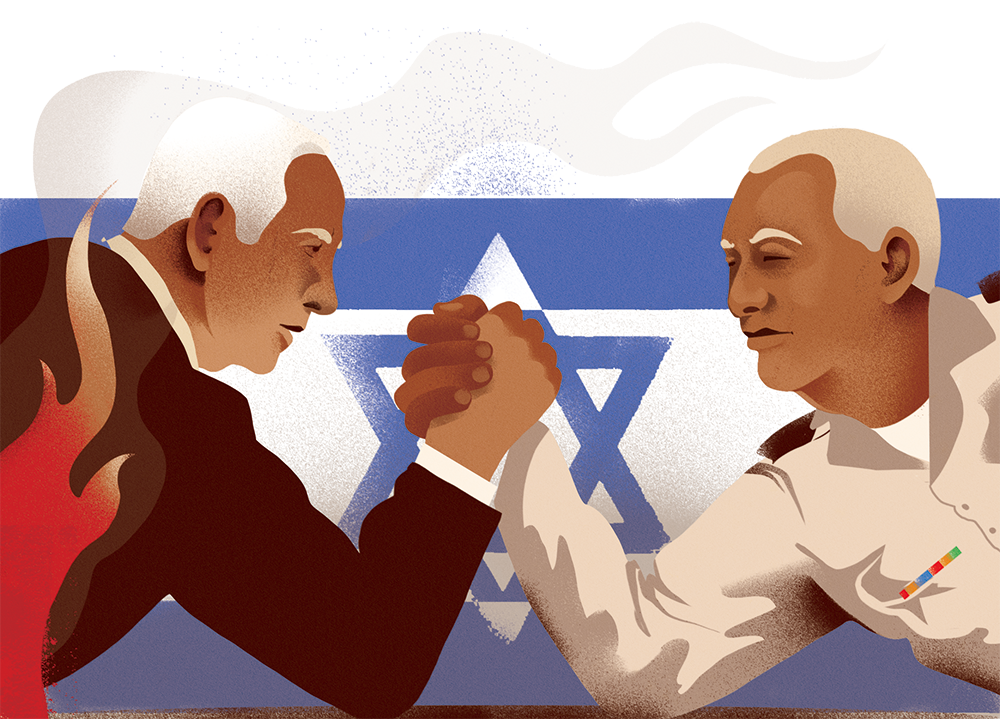
The year is 2019 and, after almost a full term in office, Benjamin Netanyahu’s coalition government of right-wing and religious parties heads to a general election. Opposing him is a former IDF chief of staff heading a new centrist party which quickly soars in the polls, making him the main challenger for prime minister.
That challenger was Benny Gantz. Gantz formed alliances, fought elections and got caught up in the paralysis of Israel’s 2019-20 governing crisis in which nobody was able to form a coalition. Facing the threat of the Covid-19 pandemic, Gantz agreed to a deal with Netanyahu where they’d take turns at being prime minister – with Netanyahu going first, of course. Nobody except Gantz believed his turn would come.
It is August 2026 now and, after a full term in office, Netanyahu’s coalition government of right-wing and religious parties is heading to a general election. Opposing him is a former IDF chief of staff leading a new centrist party as the main challenger for prime minister. It’s a cliché to say this time it’s different. It’s always different. But Gadi Eisenkot, Netanyahu’s main electoral rival, has a compelling background, a moving personal story and is now leading the polls.
The former IDF chief of staff has a compelling background and a moving personal story
Outside of Israel, you’d be forgiven for thinking that the only ethnic divide that matters is between Jews and Arabs. Within Israeli Jewish society, though, the most significant distinction is between Ashkenazim, Jews of European origin, and Mizrachim, Jews from Arab and Muslim countries.
Historically, the local Jews in the region were Arabic-speakers who initially resented the poor, low-status European Ashkenazi immigrants of the early 20th century. When a huge wave of Jewish immigrants from Arab countries arrived in the late 1950s, fleeing anti-Semitism at home, they were often shunted into transit camps and treated as second-class citizens.
This divide carried over into politics too. David Ben-Gurion’s Labor party became associated with Ashkenazi cronyism, low-level corruption and background racism. Menachem Begin rode to victory for Likud in 1977 with masses of working-class Mizrachi voters.
Since then, Mizrachi identity has become associated with authenticity, tradition and supporting right-wing parties, while Likud figures attack “white” Ashkenazi left-wing elitists. Mizrachi culture, food and music have gone from being marginal to the Israeli mainstream. But Israel has never had a prime minister who wasn’t Ashkenazi. Despite his Germanic-sounding last name, Eisenkot is Mizrachi, the son of working-class Moroccan immigrants; a marked contrast from Netanyahu, the nepo-baby son of a politically connected Ashkenazi college professor. Eisenkot joined the traditionally Mizrachi Golani Brigade when he was drafted into the IDF, where he rose through the ranks. (According to the British historian Max Hastings, a young Netanyahu once joked that Golani was “OK as long as they’re led by white officers.” Netanyahu denies this.)
Eisenkot became commander of Golani and then military secretary to prime ministers Ehud Barak and Ariel Sharon – both former generals themselves. He became something of a problem-solver, a safe pair of hands: he led the IDF’s response to West Bank terrorism during the Second Intifada and then took over Northern Command to reshape it after the failures of the Second Lebanon War in 2006.
When a scandal created an unexpected vacancy for IDF chief of staff in 2011, Netanyahu reportedly offered the job to Eisenkot; he refused, saying that the deputy chief of staff, Benny Gantz, should get the role instead. Eisenkot became Gantz’s deputy and eventual successor.
The path from chief of staff to politics is well-trodden. Six of Eisenkot’s seven immediate predecessors made the jump from uniform to the Knesset. As soon as he retired, the major parties started to court Eisenkot as a candidate. He ended up going with his old boss, Benny Gantz, running in the 2022 election on his National Unity ticket.
National Unity didn’t have a great election, and neither did the rest of the anti-Netanyahu parties. Bibi returned to office and Eisenkot joined the opposition. That all changed after the Hamas attacks of October 7, 2023. In an effort to live up to its party name, National Unity joined the coalition and Eisenkot and Gantz became members of a six-person war cabinet.
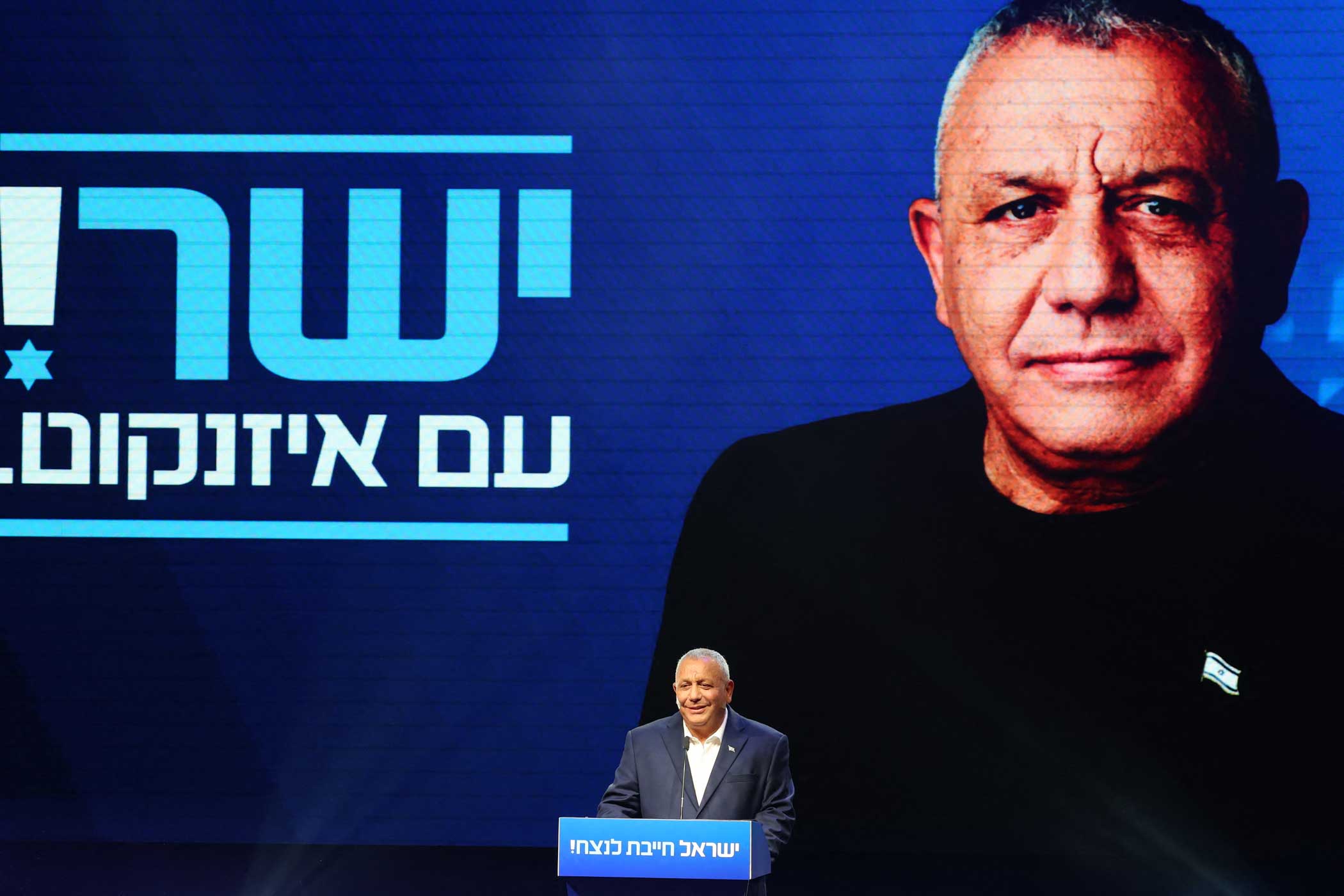
A few weeks later, tragedy struck. Eisenkot’s son Gal was killed in a tunnel in Gaza during a mission to retrieve the bodies of hostages. Eisenkot and Gantz became increasingly frustrated with the war cabinet’s refusal to make plans and eventually resigned, accusing Netanyahu of allowing “outside considerations and politics” to interfere with the conduct of the war with Hamas. But Eisenkot also lost patience with Gantz, his party leader, and resigned from the Knesset a year ago, making it clear he was planning a comeback at the election later this year.
A few months ago, the leading opposition candidate to replace Netanyahu was Naftali Bennett, who was briefly prime minister a few years ago at the head of a short-lived rainbow coalition.
Eisenkot faced pressure to join up with Bennett or another centrist challenger, such as Yair Lapid. In the end, Bennett and Lapid joined forces, leaving Eisenkot out. That decision doesn’t seem to have harmed him at all. Going it alone, Eisenkot’s Yashar (“straight,” in the moral, not sexual, sense) party is now leading in the polls.
But what does Gadi Eisenkot stand for? That’s not such a simple question. His campaign focuses on his story and character: working-class Mizrachi boy made good, bereaved father of a fallen hero, honest and against corruption, security-conscious but focused on solutions.
A major issue roiling Israel has been military service by Haredim, ultra-Orthodox Jewish men. Since their service exemption was struck down by the Supreme Court, the Netanyahu government has been desperately legislating to appease its Haredi coalition partners, passing giveaway legislation to try to restore the exemption and “compensate” them with policy benefits and wodges of public cash.
Eisenkot, like most of the country, supports the Haredi draft. And yet, the Haredi parties aren’t ruling him out as a coalition partner; Rabbi Yitzhak Yosef, spiritual leader of the Shas party, declared that Netanyahu will never “repent” and become an observant Jew, but that he still has hope for Eisenkot. Perhaps the Haredi parties are bluffing, seeking more leverage with Netanyahu. Or perhaps they can tell which way the wind is blowing and don’t want to be locked out of power.
Eisenkot’s son Gal was killed in a tunnel in Gaza during a mission to retrieve the bodies of hostages
The Yashar party, and Eisenkot, are notably vague on the Palestinian issue. He says now isn’t the time to discuss the two-state solution, opposes annexing the West Bank and wants a Palestinian-run (but Hamas-free) Gaza. All fairly mainstream positions, but perhaps lacking in vision: in opposition, it’s easy to wave away questions about a Palestinian state as a future problem; a leader is supposed to move the country toward that future.
And that’s a bit of a theme with Yashar. The party platform hits all the usual notes – education, fighting crime, cutting corruption, lowering prices – but there’s little in the way of structural reforms or ambitious plans.
We get some hints from Eisenkot’s approach to military strategy. On the one hand, he was one of the pioneers of the Dahiya Doctrine, which supports the use of massive force against civilian neighborhoods that play host to terror groups. On the other, he developed the IDF’s “Campaigns between wars” strategy, using constant low-level military operations to keep foes deterred or, failing that, degraded. These suggest an approach of trying to manage continual conflict, combined with a readiness to hit hard when necessary.
The attacks against Eisenkot from the right fit a familiar pattern. Netanyahu and his supporters claim he’s a gruff, uncharismatic novice, with poor English and no charm. They say that he, too, will betray his voters to the Haredi parties, so why not stick with the devil you know?
Those attacks, though, cut both ways. Voters might be done with polished, charming candidates like Netanyahu, and be drawn to Eisenkot’s humble origins. The Haredi claim also neuters one of the other charges against Eisenkot: that he’s a far-left plant who’ll rush to do a deal with the Arab parties. Something about Eisenkot’s background and style has created a permission structure for center-right voters to feel like he’s “safe” to support.
Much like Donald Trump in the United States, Netanyahu has reshaped politics around himself. To support Netanyahu is to be right-wing; to oppose him, even ostensibly from the right, is often enough to be considered a leftist traitor. Beyond left and right, the two major political camps in Israel are “Only Bibi!” and “Anyone but Bibi!”
The “Anyone but Bibi!” camp has had an array of leaders: Isaac Herzog, the son of a one-time president of Israel who ended up in the top job himself (with Netanyahu’s support); Yair Lapid, the media-star son of a Knesset member; Bennett, a multimillionaire startup founder; and Gantz. All men, all Ashkenazi, all somewhat well-connected. Two ended up prime minister, albeit briefly, but Netanyahu found his way back.
Much like Trump in the United States, Netanyahu has reshaped politics around himself
This time it’s different, and not just because of Eisenkot. Netanyahu will be 77 on election day, 82 at the end of his term if he’s reelected. He has a pacemaker and secretly underwent treatment for prostate cancer last year. And, of course, he’s the sole political survivor of the October 7 disaster. If Netanyahu loses this time, he’s probably not coming back.
And Likud’s other elected representatives, however much they back Bibi in public, are getting tired of waiting for a vacancy at the top.
On October 27, the voters will have their say. But in Israel, that isn’t the final word; an election triggers months of deals, threats, bribes and horse-trading to win over enough Knesset members to form a government. These weeks are where Netanyahu’s wheeler-dealing often gives him the edge. In the past few weeks, though, the polls have shifted ever so slightly in Eisenkot’s favor, giving him the easier-looking path to power.
David Bitan, an outspoken Likud representative, complained to the media that it’s unfair. Eisenkot, he said, is “both a bereaved family and Moroccan – and that gives him a very interesting advantage in these elections.” He might be right.


Comments