
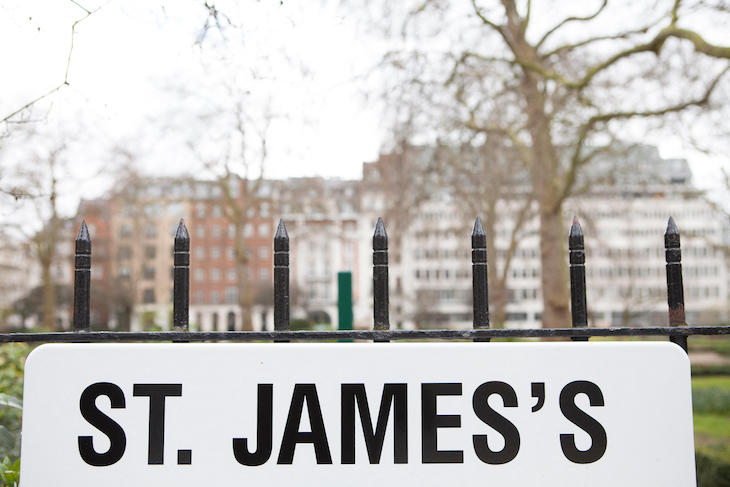
London is full of little ecosystems: areas that are distinctive by virtue of their purpose or history and where individual elements make up a sum greater than the whole. St James’s is like that: a patch south of Piccadilly where the pleasures of a walk down the street are all to do with being able to look at the windows of the art galleries. There’s a succession of independent dealers selling paintings – Old Masters in some cases – drawings, objects d’art and art books. You probably can’t afford to do more than look, but there’s pleasure in fantasising like a Dorothy Parker character about what you might buy if you only could.
Cork Street, once famous for its dealers, is a ghostly shadow of what it was
There used to be streets like that on both sides of Piccadilly but Cork Street, once famous for its dealers, is a ghostly shadow of what it was, with a few anonymous contemporary galleries – somehow, all white – and much of one side dominated by the blank windows of a dealer in modern art, Stephen Friedman, who had to shut up shop in February, partly because of high rent.
It’s looking as if St James’s is going the same way. There are five businesses in and around Duke Street and Ryder Street which are facing closure because the Crown Estate is dramatically increasing the rents, proposing to double them in some cases. (Others too are affected, including those with other landlords.) And owners of little galleries and shops can’t afford to pay; they’ll close. If the rents double, the rates go up correspondingly. The Crown Estate is, in short, threatening to obliterate the distinctive character of what estate agents like to call a quarter, but is really even smaller.

The dealer I know best there, from years coveting his illustrations, is Chris Beetles, a dealer in illustrations and cartoons as well as Victorian drawings and watercolours and contemporary paintings. The Crown Estate is proposing to double his rent, from £104,000 a year to £208,000. He’s already paying £67,000 a year in rates; that would go up too. If the Crown Estate goes ahead with this, he’ll have to shut up shop and operate online from a warehouse. From eight employees, he’ll go down to one. He’s been there for 42 years; the others have been around for decades too.
He’s not alone; the five businesses which are making their case against the dramatic rent rises face closure or a drastic reduction in their gallery space.
Thomas Heneage runs a specialist art bookshop (there used to be two; one had to close) and his lease comes up for renewal later in the year. He too is exercised about the increases: “I am concerned that The Crown Estate will make it impossible for specialised, high end art retailers to remain in the area”, he told me. “If St James’s loses the art market, or just becomes a place for contemporary galleries it would no longer be worth our while to be in the area. We have been described as “the last remaining specialist bookshop selling Art Reference Books in the world”. We would want to remain just that and not be forced to move or close.”
So what would replace these galleries if they were forced out of business? A couple of very small dealers have in fact opened at increased rents, but it remains to be seen if they survive. But what’s likely is that contemporary galleries – like the white spaces in Cork Street – would take the place of the dealers that at present specialise in Victorian work, Impressionists or Old Masters. And the contemporary galleries deal in work that commands vast sums. Saatchi Yates, down the road, could probably shrug off rent rises of any size. If modern galleries take over from the very English dealers in older work, the feel of St James’s will change forever. It matters; it would be one more marker in the homogenisation of London. But if there aren’t takers, there would be a temptation to amend the present rule that galleries may not be replaced by fashion retailers or restaurants. Another branch of Ralph Lauren or Prada then?
The thing about the Crown Estate is that it is indirectly owned by us all. The properties it owns all over Britain belong to the Crown with the revenues going to the Treasury – £1.1billion in 2024-5 of which the Crown receives some 12 per cent. Lucky King Charles. From the website it looks like a positively philanthropic outfit; there’s talk of shared prosperity and social benefits with images of diverse communities engaging in fun activities, plus wind turbines. A spokesman for the Crown Estate told me: ‘Art galleries and specialist retailers are an important part of the distinctive St James’s neighbourhood, with many more opening across the portfolio in recent years. We work closely with our customers to support that heritage while also following our statutory responsibilities to commercially manage the portfolio for the long-term and for the benefit of public spending.’
But the question is whether it’s necessary in order to fulfil its statutory responsibilities for it to put long-established tenants out of business. How to square doubling rents with supporting that heritage, then? I did ask the spokesman but haven’t heard back yet. Yet the rent increases from the galleries are the merest blip in the £1.1 billion profit in 2024 of the Estate, that come chiefly from offshore wind energy. As a result, the pay of Dan Labbad, the CEO originally from Sydney, rose to £1.9 million a year. The Crown Estate may have to get a return from its properties but it doesn’t have to double rents from small galleries to do it.
The dealers are already struggling. Chris Beetles says that last year he lost money. So did at least one other of the galleries facing closure. The gallery next door, Martin Beisly, a famous dealer in Victorian art, can’t take a rent increase of any size. The little group of dealers versus the Crown Estate represents the plight of many others, including the tenants of other big property owners. Once the owners think they can squeeze tenants to any extent, others will follow. More traditional individual private businesses will be forced from central London, and it’ll be London’s loss.
The galleries can challenge the rent increases, but the tribunal that deals with these things doesn’t deal with intangibles: the way that people and businesses are drawn to the area precisely because they’re surrounded by beautiful things, the character and tradition of the streets, the way one business bolsters another, creating a distinctive sense of place. An awful lot of central London is already soulless – take a walk around Mayfair – and many small independent places have closed. Do we need more?






Comments