
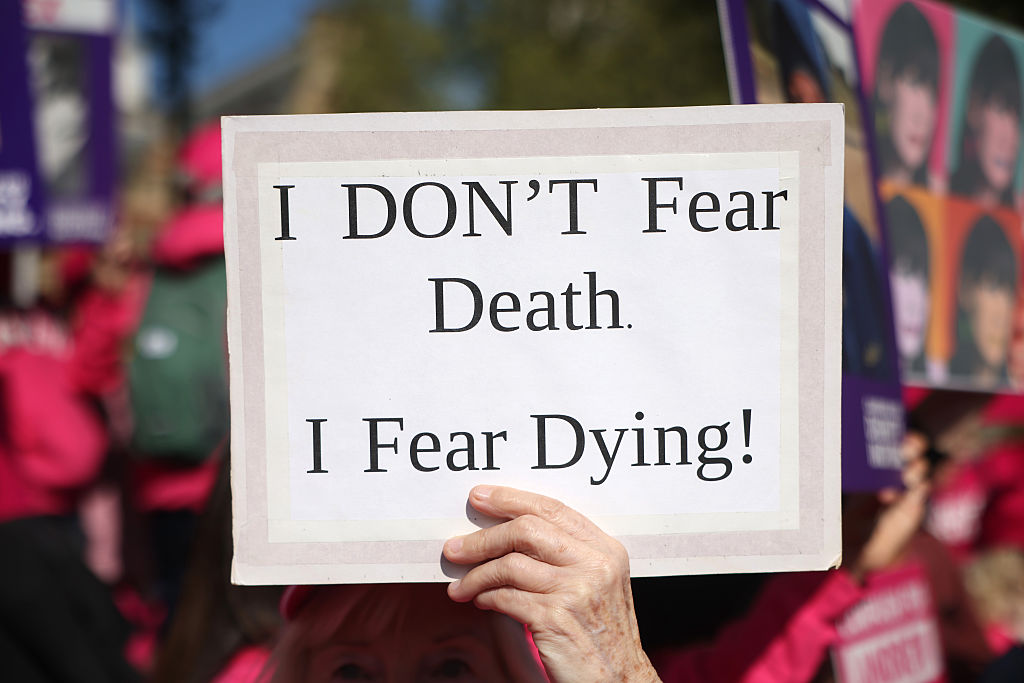
Summertime, and the living isn’t as easy as it used to be. The dying, though, is getting easier, especially if you’re in France, Canada or New York.
New York’s MAID law will come into effect August 5: supposedly only for those whose deaths are expected within six months, supposedly through self-administered doses only. But the details don’t matter. The important part is this: in New York, the state can now authorize the taking of innocent human life.

In early July, the French Senate rejected euthanasia for the fourth time in a row. But the government invoked Article 45 of the French constitution and forced the legislation through, “creating a right” to assisted suicide (as if the state were the divine origin of rights, and could create them at the snap of a finger).
In Canada, there was a spark of hope earlier this summer. Canada is already struggling under one of the most permissive euthanasia regimes in the world, but was set for worse things with the expansion of the program to those suffering from mental illness. Thankfully, in June the parliamentary committee entrusted with reviewing the situation concluded that MAID for the mentally ill should be put on a permanent hold.
But the activists at Dying with Dignity aren’t taking it quietly. A whole class of vulnerable adults to be considered legally protected from invitations to accept lethal injections? Surely not. They are now calling for the decision to be taken away from Parliament and given to the Supreme Court.
The Supreme Court in Canada have long been allies of Dying with Dignity, ruling unanimously in the 2015 case of Carter v. Canada in favor of a previously unheard-of Charter right to euthanasia. They forced parliament to establish a legal framework for it, and Canada’s abhorrent MAID program was the result. The ruling was condemned at the time as judicial activism – but who can stop a Supreme Court with the bit between its teeth? When the courts become the sole source and arbiter of public morality, the answer is, no one. Thanks to their decision, over 100,000 Canadians have since been put to death.
Besides Dying with Dignity, nobody really wants to give the mentally ill euthanasia. Canadian psychiatrists say that no acceptable framework exists to distinguish between suicidal ideation and requesting MAID. They say that providing death as a solution to mental suffering cannot be reconciled with society’s duty to offer steadfast hope and support to sufferers. When it comes to mental illness, doctors tell us, there is always hope.
There’s nothing like contextualization to make it OK to cut the heart, lungs and liver out of a living person
The only other group that might, possibly, want the mentally ill to choose death, are those, who, when they look around hospitals, don’t see fellow human beings, but negative dollar signs. Every person who wants health care or disability support costs money. It’s a lot cheaper to convince them to shuffle off this mortal coil than to treat them – especially if they’re not likely to return to the workforce and generate tax revenue.
Is this an exaggeration? It is not. Canadian veterans looking for wheelchair ramps have been offered MAID. An elderly lady with back pain was offered MAID before a diagnosis. Father Larry Holland, aged 79, of Vancouver was twice offered MAID for a fractured hip, even though staff knew he was a Catholic priest and morally opposed to suicide. A woman with cancer was refused treatment but offered MAID. Her husband has since brought her to America where her treatment is going so well she’s back in the gym weightlifting.
These are happy endings. Far more common are stories with sad endings for the person, but budget savings for the state.
But the state hasn’t yet made all the cost cuts that it could. A group of doctors – a bioethicist from Harvard and two Canadian critical care physicians – published a paper on July 8 in the New England Journal of Medicine with the ominous title, “Contextualizing the Dead Donor Rule in an Era of Voluntary Euthanasia.” Right. There’s nothing like contextualization to make it OK to cut the heart, lungs and liver out of a living person. For that is indeed the idea: since people already want to die, maybe it’s OK to carry out the procedure by harvesting their vital organs?
It’s not OK, of course. It’s morally wrong to take the life of an innocent person, and particularly disgusting to do so by cutting out his organs for someone else’s benefit.
But society has lost its bearings. Time was religious instruction and exposure to decent art and entertainment formed both people’s emotional worlds and their moral sense – so that when faced with horrendous ideas like euthanasia and organ harvesting, they would react negatively. But nowadays the majority have been persuaded that, under the right circumstances, euthanasia can be merciful and kind.
If they can be made to think that, then the bad news is this: legal harvesting of vital organs is just a PR campaign away.



Comments