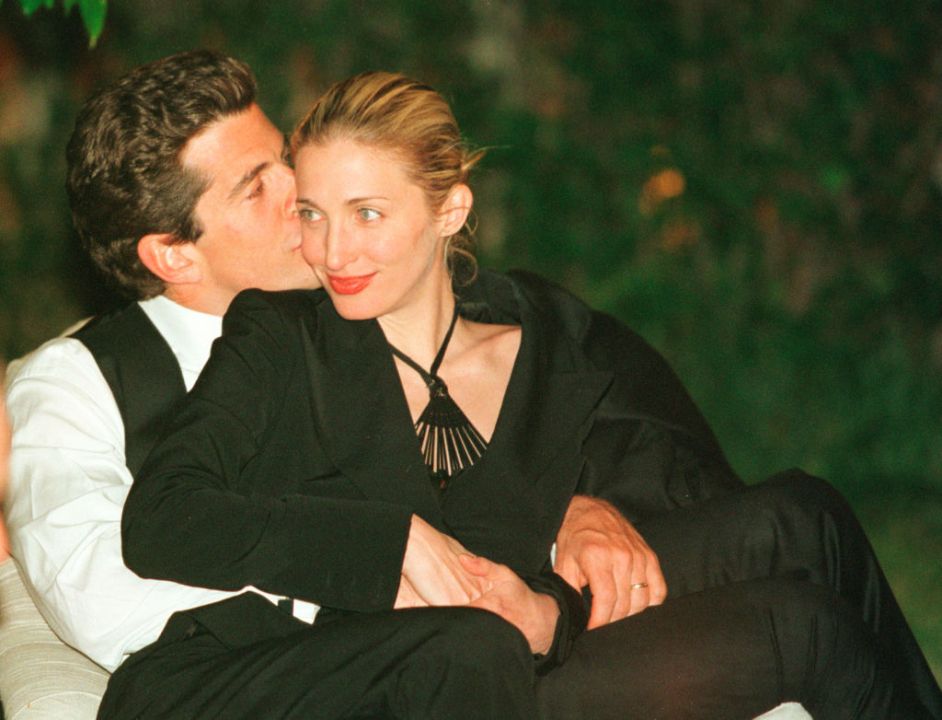
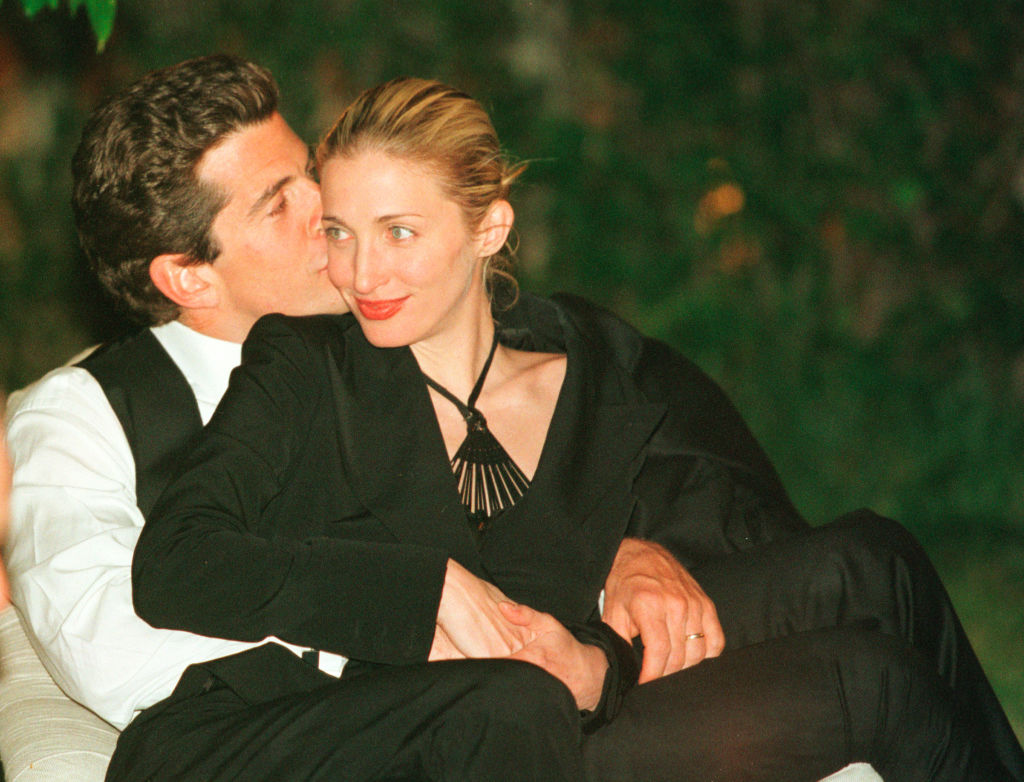
Last June, Jack Schlossberg, the Kennedy nepo baby currently running for the open seat in New York’s 12th Congressional District, called out the television mini-series, Love Story: John F. Kennedy Jr & Carolyn Bessette. Executive producer Ryan Murphy was, Schlossberg declared, exploiting this couple’s courtship, marriage and death, and “profiting off of it in a grotesque way.”
On a key point, Jack can rest easy. Love Story, now airing on FX/Hulu, treats his uncle John F. Kennedy Jr. reverently. Elizabeth Beller, Bessette’s biographer, praises the show for “honoring the legacy of everyone involved.”
If JFK Jr. had a single physical flaw – I am grasping at straws here – it was a head slightly too large for his body
Which is, actually, the problem. The worshipful empathy lavished on its central characters makes Love Story banal and fundamentally false television, despite artful set-dressing that richly evokes the world of mid-1990s New York City. That the show is advertised as a modern-day Cinderella story presents an even bigger problem. In what version of the classic fairy tale does the prince, having plucked a young woman out of obscurity, then bring about her death – and her sister’s?
It’s not as if American audiences are averse to searing truths about the rich and glamorous. Succession, among the most successful TV dramas in recent years, presented a fictional family (stand-ins for the Murdochs) and, using a darkly comic, tragic tone, put an all-too-real spin on how it must feel to be them. Imagine if the makers of Love Story had attempted something similar. Instead, the Kennedys are depicted in counterfeit ways. Uncomfortable truths about young John – his recklessness, inattention and conceit – are glossed over, while his mother, Jacqueline Kennedy Onassis (played ineptly by Naomi Watts), is smeared, depicted as a hectoring parent and a resentful, chain-smoking snob. In one gruesome scene, Onassis, a woman of remarkable poise and dignity, drunkenly dances to the score of the musical Camelot while swooning over a portrait of her late first husband, President John F. Kennedy.
Why would Love Story creators give John Jr. a pass, flatten him into a kind of endearing everyman (with very expensive clothes) looking for true love in the big city?
Does it all start with one heartbreaking image? On November 25, 1963, his third birthday, at the funeral of his father, assassinated three days earlier, John was photographed saluting the casket. Afterwards, that winsome tyke was whisked away from Washington by his protective mother, to grow up in the relative privacy of Manhattan. He later attended prep school at Andover and went on to Brown University. His contemporaries (I was tangentially acquainted with him) considered him a decent guy – not overly clever, a bit of a pothead, yet larkish and likeable. Thanks to his oft-photographed, striking good looks, the experience of encountering him was a bit surreal, like a movie still springing to life. If he had a single physical flaw – I am grasping at straws here – it was a head slightly too large for his body.
While his mother and, even more so, his older sister, Caroline, instinctively shied away from public view, John appeared to relish it. Robust and athletic, he roller-bladed and biked around New York City. Playing touch football in Central Park, he’d take the first opportunity to strip off his shirt to show off his buff bod. It was only a matter of time, pundits intoned: John would inevitably follow his father and uncles Bobby and Teddy into the family business of politics.
Instead, after a brief career as a lawyer (he flunked the bar exam twice), John decided to start a magazine. This was 1995 and magazines were hot, just like he was. Newsstands groaned with offerings, yet publishers were finding success launching new titles.
I was working on one such launch – American Marie Claire – when my bosses at Hearst Magazines took a meeting with Kennedy. I heard about the occasion later: how the Hearst brass, sitting around a conference table, were smiling broadly, likely already imagining how they’d describe John-John (a media-bestowed nickname) to their wives. Kennedy started his pitch – I want to launch a monthly about the intersection of politics and popular culture – and the smiles faded. What a squishy idea. No definite audience, no unique selling proposition. Politics was a topic both dull and grubby, a bad fit for a glossy magazine.
Hearst turned him down and so did Condé Nast. But publisher David Pecker (later a Trump confederate) found the gravitational pull of brand Kennedy irresistible. His company, Hachette, backed John’s baby, which was christened George, as in Washington. Supermodel Cindy Crawford appeared on the cover of the first issue, dressed up as the nation’s father.
Prior to this, Kennedy was best known for appearing in magazines. Crowned People’s sexiest man alive in 1988, he had since the late 1970s been photographed with a string of girlfriends. In the first episode of Love Story, Kennedy (played by Canadian model Paul Anthony Kelly) is frustrated with his current squeeze, movie star Darryl Hannah (Dree Hemingway). She’s flaky, whiny, and entertains her louche Hollywood pals in John’s Tribeca loft. His mother doesn’t approve of her. John meets Bessette (Sarah Pidgeon), then working for designer Calvin Klein, at a modern-day “ball,” a charity event. They lay eyes upon one another and feel immediate electricity, only for Bessette to scurry away, sure that supernova John could never be serious about little old her.
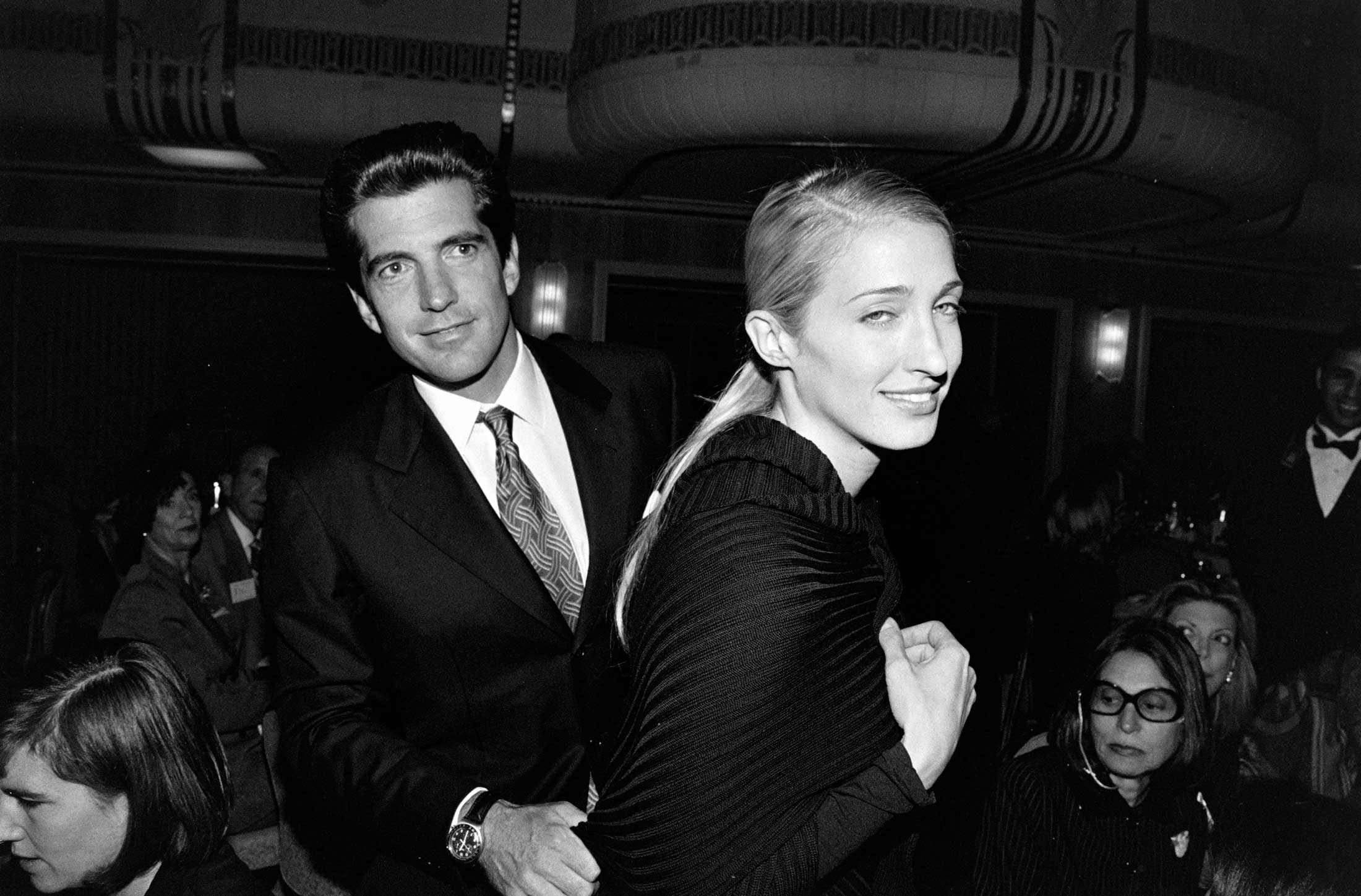
In reality, Bessette was the opposite of a meek maid – tall, sexy and stylish, she had plenty of ambition and self-assurance. She and Kennedy began dating while the press still linked him with Hannah; Bessette even invited John home to meet her mother, Ann Freeman. When John was subsequently photographed with Hannah at a movie premiere, Freeman sent the clipping along with a note to her daughter: “Carolyn, please get on with your life, love Mom.” Bessette cut off contact with John.
Jackie Onassis’s death from cancer aged 64, in May 1994, seemed to push John out of Hannah’s arms permanently and into Bessette’s after Carolyn called him up to express her sympathies. Their romance, typical of John, played out on the streets of New York, including a screaming fight in Washington Square Park. Tensions flared, especially after their wedding in 1996.
The fading fortunes of George didn’t help. In the beginning, newsstand sales were strong, and advertising dollars flooded in thanks to the Kennedy name atop the masthead. But John lacked moxie as an editor; his magazine was so much hum-drum content wrapped up in a slick package. To be fair, Kennedy also landed in a pickle not of his own making. The most important political story of the late ’90s should have been picture-perfect for George, but Bill Clinton’s affair with intern Monica Lewinsky was hardly mentioned in the magazine. When your own father conducted extramarital affairs in the White House, covering another president’s Oval Office lasciviousness would have been awkward.
By spring 1999, Hachette had lost patience, and during his last months, Kennedy was in search of a new business partner. He and Bessette were on the rocks. He had to plead with her to attend his cousin’s wedding in Massachusetts. On the evening of July 16, piloting his Piper Saratoga, which he had owned for less than three months, John took off from Essex County Airport bound for Martha’s Vineyard with Carolyn and her sister Lauren as passengers. Although he was still using crutches for a broken ankle, and had been up until 2am the night before, Kennedy refused a flight instructor’s offer to accompany him. He was delayed – as were the Bessette sisters – arriving at the airport because of heavy traffic leaving the city. Instead of a planned departure around 6:30 p.m., they were “wheels up” at 8:38 p.m., by which time it was dark. Kennedy failed to file a flight plan and came close enough to a commercial flight landing at Westchester County Airport to trigger that jet’s collision alarm. As the National Transportation Safety Board investigation later determined, the night was hazy with only a sliver of moon, and Kennedy lost sight of the horizon flying over the ocean, became disoriented, and – having neglected to switch on the autopilot – he inadvertently put his plane into a graveyard spiral seven miles from the airport. Everyone on board was killed upon impact with the water.
Love Story has other problems beside the sanitizing of John Jr. The dialogue can be stilted and contrived, and the pace drags – rather than nine episodes it should be four. Producer Ryan Murphy is hardly alone in his reluctance to present Kennedy in a clear-eyed way. Last year’s three-part CNN documentary American Prince: JFK Jr. touched on all the familiar tropes. Kennedy, a shining star, an innovator with the vision to see where the culture was heading, had the potential to be a generational political talent. Historian Leigh Wright Rigueur gushed at the conclusion: “John’s legacy is far more complex and comprehensive than we actually give him credit for.”
Pushing aside that load of twaddle, what is interesting today are the parallels between JFK Jr. and the nephew who protested Love Story. Jack Schlossberg, now 33, is the only son of Caroline Kennedy. He shares his late uncle’s fondness for public display, and his passion for the media of the moment – he has made a name for himself with silly, tasteless, and downright bizarre posts on X, TikTok and Instagram. On the day of Donald Trump’s second inauguration last year, he tweeted “True or false: Usha Vance is way hotter than Jackie O.” For TikTok, he recited “She Walks in Beauty” by Lord Byron, while riding a wave-board. On Instagram he’s mocked the voice of his cousin Robert F. Kennedy Jr., whose rasp is caused by the neurological disorder spasmodic dysphonia.
Schlossberg was a late arrival into a crowded field competing for the seat representing some of Manhattan’s wealthiest precincts. He’s a graduate of Yale and both the business and law schools at Harvard (he passed the New York bar on the first try), though he seems to lack a wealth of real-world job experience. He calls his provocative online presence a deliberate strategy to attract attention in our current jam-packed media landscape. Will the Kennedy connection be enough to carry this scantily qualified candidate to victory? I wouldn’t bet against him. Or them.


Comments