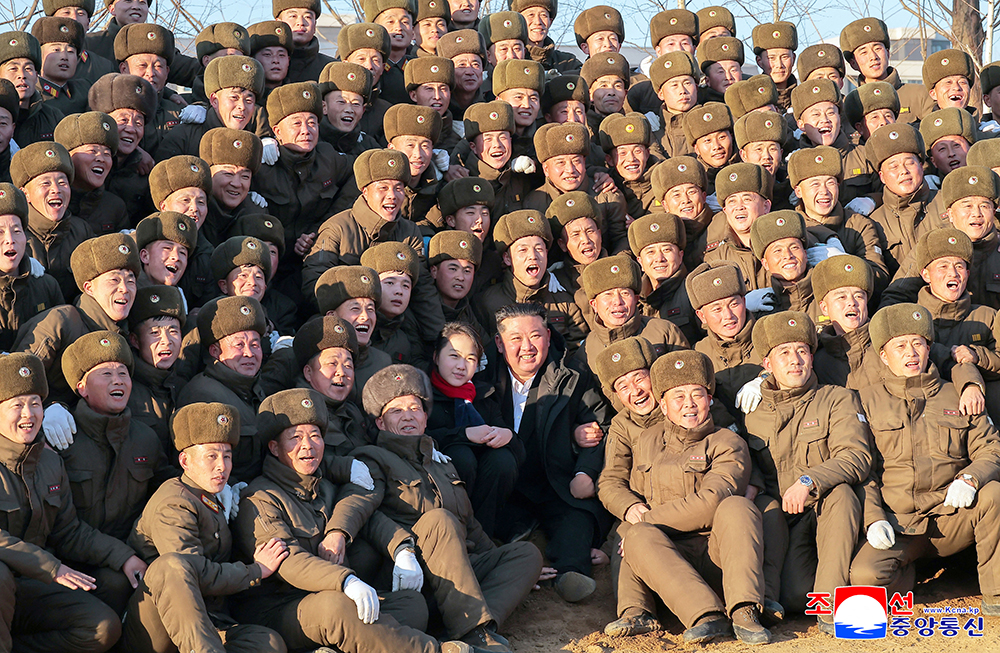

As a birthday treat, a good father might take his ten-year-old daughter to the ballet or a Disney movie. Three years ago, North Korea’s ruling dictator Kim Jong-un (“Brilliant Comrade”) took his ten-year-old daughter Kim Ju-ae to the launch of an intercontinental ballistic missile. It was her first public outing. Subsequent kiddie treats have included visits to the mausoleum that houses the bodies of her grandfather, Kim Jong-il (“the Dear Leader”), and great-grandfather, Kim Il-sung (“the Great Leader”). She also got to stand at military parades, inspect nuclear facilities and make an official visit to Beijing.
In the North Korean media, Kim Ju-ae is referred to as the Supreme Leader’s “beloved” or “precious” daughter. In effect she seems to have taken on the role of first lady. Speculation about her elevation to successor designate reached a peak last month when she and Kim Jong-un, like stereotypical baddies in Hollywood movies, wore matching black leather trenchcoats to an official parade. South Korea’s National Intelligence Service then reported that she is undergoing “successor training.”
For reasons unknown, the Supreme Leader’s son has been completely overlooked
For reasons unknown, Kim Jong-un’s son has been completely overlooked. Instead, Kim Ju-ae’s rival to the throne is another woman, her 38-year-old aunt, Kim Yo-jong, who is as slight as her brother is fat. It is often assumed that North Korea is a determinedly patriarchal society, but in fact Kim Jong-un does favor women, albeit in a somewhat backhanded way. “Though physically weak, [North Korea’s women] are obviously strong-willed,” he said in a speech this week on International Women’s Day. “Their plain faces assuming courage and the wrinkles on them denoting their strenuous exertion and thus arousing much greater respect.”
Kim Yo-jong is North Korea’s deputy leader in all but name and has often served as her older brother’s attack dog. When South Korea’s President suggested economic aid in exchange for nuclear disarmament, she told him to “shut his mouth,” and called the defense minister a “senseless scum type guy.” But she can play pretty as well. In the joint north-south Winter Olympics of 2018 (a rare period of rapprochement) she became the first member of her dynasty ever to step foot in South Korea. In 2022, however, she threatened to nuke the entire country.
So why is succession becoming an issue when her brother is only 42? The reason is that Kim Jong-un’s health has often been the subject of rumor. From a pudgy youth, he grew up fat – not a Cyril Smith-scale fatty (as in the pedophile Lib Dem MP who weighed in at 350 pounds; a record for a British parliamentarian), but more like the very ample former Conservative chairman, Lord Pickles. As a result of his gluttony – his favorite foods reportedly include Emmental, Kobe steak, caviar and foie gras – Kim Jong-un may have diabetes and other medical problems. Efforts to portray him as outdoorsy and healthy are unconvincing. Photographs of him riding a horse make him look as safely mounted as Humpty Dumpty.
Nevertheless, the designation of an heir at this stage does seem premature. His succession planning may reflect uncertainties in his own rise to power. Kim Jong-un himself was not the expected heir. That was meant to be his older brother, Kim Jong-nam.
Rarely can a wish to go on holiday have proved so disastrous. At the age of 30, Kim Jong-il’s eldest, and clearly dim-witted, son used a fake passport to enter Japan so he could experience the delights of Tokyo’s Disneyland. He was apprehended at the Japanese border and sent packing. His star subsequently waned and in 2003 he was exiled. He later claimed that he fell out with his father ideologically.
Any hope of a return must have ended when Kim Jong-un was announced as leader designate in 2010, a year before his father’s death. By then, Kim Jong-nam had reportedly become a CIA asset. In 2017, Kim Jong-un organized his brother’s assassination at Kuala Lumpur International Airport.
Kim Jong-nam was not the only perceived rival to be murdered by Brilliant Comrade. When Kim Jong-un’s uncle, General Jang Song-thaek – who as vice-chairman of the National Defense Commission had effectively ruled North Korea during the last years of Kim Jong-il’s life – fell out of favor, the young dictator had him executed by firing squad.
The smallest misstep can be fatal. In 2015, defense minister Hyon Yong-chol was executed for falling asleep at a meeting. He was put in front of an anti-aircraft cannon and blown to smithereens. For senior bureaucrats, even a “disrespectful posture” can be a capital offense.
Murder has been a common companion to the story of North Korean succession. Kim Il-sung came to power as head of the Workers’ party after murdering his rival. Drama of a violent kind also accompanied his later years. By the early 1990s, North Korean politicians were already jockeying to replace him and debating the future direction of the country. Tangentially, I became involved in this drama. A year before the Great Leader’s death in July 1994, I was asked to join a colleague on a trip to Pyongyang. We had been invited by Kim Il-sung’s nephew, a reformer, to give a presentation on “capitalism” to a committee of the Politburo. The nephew’s aim was to persuade his colleagues to abandon hardline Marxism and instead follow the “liberal” path paved by Deng Xiaoping in China.
In the event, Kim Jong-il, who was already embedded in the army and the Workers’ party, outmaneuvered his succession rivals and became the first hereditary Marxist ruler in history. I later heard that the sponsor of my trip to Pyongyang had been put to death by firing squad.
How will the new succession drama play out? While promoting his daughter as heir, Kim Jong-un probably sees his sister as a future advisor to the throne. But what happens if he dies before his daughter reaches adulthood? Would her powerful aunt accept the role of de facto regent or would she grasp power for herself? One of these two female North Koreans is liable to be executed. On past form, there is no room for two at the top.




Comments