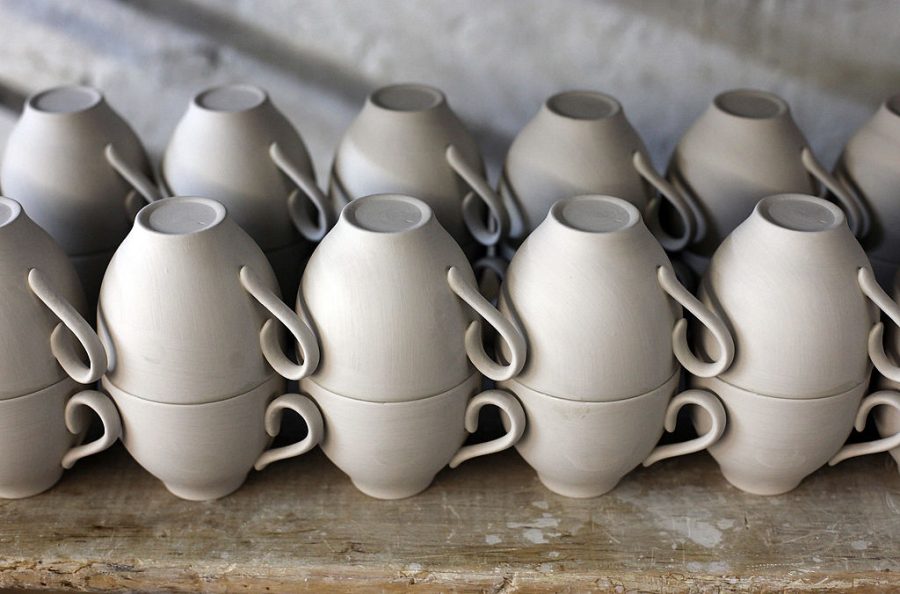
I’m not sure just how quickly the Labour government is actually moving Britain towards being ‘net zero’, but it is certainly speeding us on our way to becoming ‘mug zero’. Or more precisely, to being a zero creator not just of mugs, but also of plates, bowls and teapots, too. In fact, anything made of pottery or porcelain that we eat or drink from. This is all thanks to Ed Miliband’s hard-line net zero ideological zealotry, because of which another venerable name in British crockery could be about to go pop.
This time the Labour bottle of doom has stopped spinning on the 217-year-old potter Denby. The firm has gone into administration – blaming energy prices and increased labour costs – with some 600 jobs now hanging in the balance. There can scarcely be a single person in Britain who hasn’t at some point raised a heavily glazed Denby stoneware mug to their lips. But it could all soon be a distant memory.
The potential collapse of the Derbyshire pottery, a going concern since 1809, comes hot on the heels of the failure of Royal Stafford, based in Burslem, Stoke-on-Trent. Royal Stafford had been making china tableware since 1845 – although the site it occupied had been manufacturing crockery items since 1787. The company went bust with the loss of 80 jobs in February last year.
What does it say about us that we can’t even seem to make our own tableware?
Back then the union GMB said that the collapse of Royal Stafford was a ‘wake-up call’ to the government over the impact of high energy prices on Britain’s manufacturing sector. Plainly, ministers weren’t listening: and what’s more, it’s plain that they’re still deaf to the needs of the UK’s struggling makers.
According to UK Steel, electricity prices in Britain are currently between 14 and 25 per cent higher than those in France or Germany. Looking further afield, British companies pay four times more for their electricity than firms in the US, and 46 per cent more than the global average cost, says Make UK, a trade body for Britain’s manufacturing sector. Small wonder, then, that businesses that have survived Napoleon, two world wars and the economic illiteracy of Labour’s reign of economic terror in the 1970s are now going to the wall.
Last year, Make UK called for the removal of ‘regressive policy levies’ to cut electricity bills by 15 per cent for firms and for the introduction of a fixed price for industrial electricity users to ‘level the playing field’ with international competitors. It warned that ‘UK manufacturers are at risk of de-industrialisation without urgent energy cost reform’. Well, it appears that this is happening, at pace.
So the question is: how many more businesses need to go under, how many more jobs need to be lost and communities blighted, before the government reconsiders its approach to net zero? The Tories, for example, are now doing just this with their commitment to scrap carbon taxes on industry. As important as it is to cut our greenhouse emissions, surely Ed Miliband can’t be blind to the madness of forcing our own potteries to close so that we can enjoy the satisfaction of buying imported mugs and plates from abroad?
After all, these imports will doubtlessly have been made using electricity from less environmentally friendly energy systems – before being driven in a supertanker halfway around the world to get here, if they can, through the Straits of Hormuz. I mean, how green can you get?
Surely if we are to tax our own manufacturers to oblivion, shouldn’t it at least be in alignment with the green objectives that Miliband is so wedded to, rather than perversely working against them?
But, more than this, what does it say about us that we can’t even seem to make our own tableware? Can it really be the case that if we keep going as we are, we’ll soon have to import every last mug, plate and bowl that we, a country of 70 million people, need in order to fulfil as basic a need as eating or the enjoyment of hot beverage? And that’s not to play down the economic and cultural impact of the destruction of a centuries-old industry based in Stoke on Trent – a city long referred to as the Potteries, don’t forget. Is this not something that ought to be a major concern for our Business Secretary, Peter Kyle?
In the past weeks we’ve all come to discover, for example, how woefully ill-equipped the Royal Navy is: yes, we have six Type 45 destroyers, but only two of them are apparently working. Ditto the Astute-class nuclear attack subs that cost more than a billion each are similarly stricken, so only one is reported to be operational.
If we aren’t careful, we won’t just have a ‘hollowed out’ armed forces, we’ll have a hollowed out Britain, too, one where we are seemingly incapable of meeting any of our own needs, including making the very things we eat off.
If Denby does fold – and a campaign (#SaveDenby) is underway to keep it going – then it will be industrial blood on the hands of Labour and Ed Miliband in particular. They will have put well-intentioned but ultimately misguided climate zealotry ahead of our hard-working people and communities, and they won’t be forgiven for it. And nor should they.






Comments