

In Scotland, a changing of the guard is near. But while Hearts are set to break the duopoly of Celtic and Rangers this season, there is no sign of the SNP yielding its iron grip on power. This, though, is a triumph less of technical brilliance than a series of own goals by Labour’s team captain.
Facing a stagnant economy and middling public services, Scots are being asked at next week’s Holyrood elections to answer the oldest question in politics: ‘Who’s to blame?’ The answer, it seems, is ‘not the SNP’.
If Starmer is to be felled in the coming weeks, vengeful Scots will be leading the charge
The nationalists have governed Scotland for nearly 20 years; Labour has been in power in Westminster for little more than 20 months. Yet polls suggest that voters are more willing to heap blame on Keir Starmer for their problems. The SNP currently enjoys a double-digit lead, with Labour’s Scottish leader, Anas Sarwar, now struggling to retain second place. ‘It’s the old story of UK Labour,’ says one aide, reflecting on his party’s decline since July 2024. ‘Defeat from the jaws of victory.’
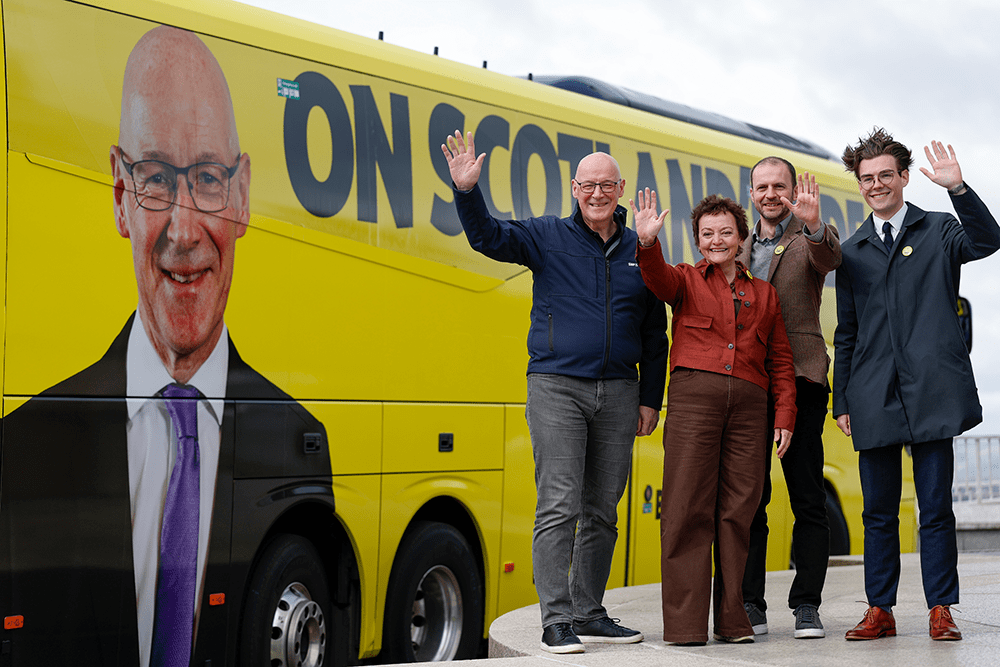
SNP leader John Swinney, a former management consultant, has performed a decent corporate turnaround in two years as First Minister. He has tried to scrub the barnacles from the boat, ridding the SNP of its baggage on gender and social policy. The economy and global security have long been his opponents’ strongest cards, so Swinney is making this campaign about energy independence and grocery caps, while also tying it back to the constitutional question.
His pitch is unashamedly economically populist. Swinney has pledged to limit the cost of bread, milk, cheese, eggs and chickens; bus prices will be capped at £2. A £200 freebie, meanwhile, will be handed out to anyone turning 18 ‘to spend on cultural pursuits’; artists and creatives are to be guaranteed a basic minimum income. Free backpacks are promised to schoolchildren; opponents jibe that ‘they can [be used for] the free laptops they promised and never delivered – to use in the new playgrounds they pledged and never built’. While SNP adverts feature the actor Brian Cox, the party – to quote his Succession character, Logan Roy – are ‘not serious people’.
The shift to cost-of-living reflects independence dropping down the list of priorities for most voters. Support remains at 50 per cent – but other issues are crowding it out. Back in 2021, when these seats were last fought, Nicola Sturgeon was riding high after the battles of Brexit and Covid. But now independence ranks 13th in the list of priorities, according to voters, beneath social care and climate change. ‘Many opting for the SNP do not want their vote to be taken as a proxy vote for another referendum,’ says Scarlett Maguire of Merlin Strategy.
After a decade of independence debates, new parties smell new opportunities. Reform UK is battling for second place. Leader Malcolm Offord produced the most memorable moment of the campaign so far when, fuelled by a pint of Tennent’s, he accused Sarwar in a Channel 4 debate of trying to secretly ally with Reform. Afterwards he proudly told an aide: ‘I think tonight we saw the end of Scottish Labour.’ Reform is taking both unionist and nationalist votes: a sign, perhaps, that the 2014 faultline is receding in some voters’ minds. The Scottish Tories stand to be the losers. ‘Our support rises when people feel the Union is at stake,’ admits one.
The consequences of the SNP finishing first on 7 May are likely to be threefold. First, there will be backlash from the 37 Labour MPs in Scotland, who have seethed as Starmer torpedoes Sarwar’s hopes. ‘The poor delivery and unpopularity of the government is the thing that has sunk us more than anything,’ says one. ‘It’s not like the people you talk to don’t like Anas – by and large, the opposite, actually. But they are anti-Keir and they are anti the government.’ If Starmer is to be felled in the coming weeks, vengeful Scots will be leading the charge.
Then ministers must navigate the headache of a nationalist government intent, in the words of one, ‘on pushing all our buttons and finding our pressure points’. Douglas Alexander, the Scotland Secretary, is regarded among colleagues as hawkish on Westminster’s interests. ‘Douglas has been playing this game a long time,’ says one. ‘He knows what is coming out of the nats’ box of tricks.’ Swinney’s food pledge was viewed in Whitehall as a warning shot over the UK Internal Market Act, which ensures shared trading standards across Britain. Already, the SNP, Sinn Fein and Plaid Cymru are co-ordinating in ways hitherto considered unthinkable.
Longer term, there remains the challenge of statecraft. The SNP will argue that re-election shows the Union needs a complete rewiring: that it is the system, not parties to blame. Even if one disputes this framing, a fifth straight SNP triumph ought to force unionists to ask whether the current set-up strikes the right balance between power and responsibility. Too many in Scottish Labour have simply expected the nationalists to be torn apart by their own contradictions. New thinking is needed. With the BBC charter due for renewal next year, one MP raises the issue of media consumption to boost scrutiny of Holyrood, citing Scots’ use of UK-wide media: ‘We had the devolution of power in 1999, but we never had a devolution of media, media scrutiny and media habits.’
Such concerns ought to trouble opposition parties too. The parliament elected next week will sit until 2031: well into the life of the next British government. The avowed aim of Reform is a full-scale constitutional revolution. Figures like Danny Kruger cite the thesis of Dr David Starkey, who argues that the clock ought to be turned back to 1997 to undo New Labour’s legacy. Yet even Reform concedes that the abolition of the devolved assemblies is politically unachievable. Devolution is an established fact of political life – a challenge the architects of the Thatcher revolution never had to wrestle with. Given the strength of national sentiment in Scotland, careful thought will be needed to ensure that Reform does not, inadvertently, wreck the UK.
For many Scots, the events of next week will pass off without much excitement. Campaigners of all parties attest to a lack of enthusiasm: pollster Luke Tryl declares it less a May election and more a ‘meh’ election. But it is with a whimper and not a bang, that the course of the next five years of British politics could be set.


Comments