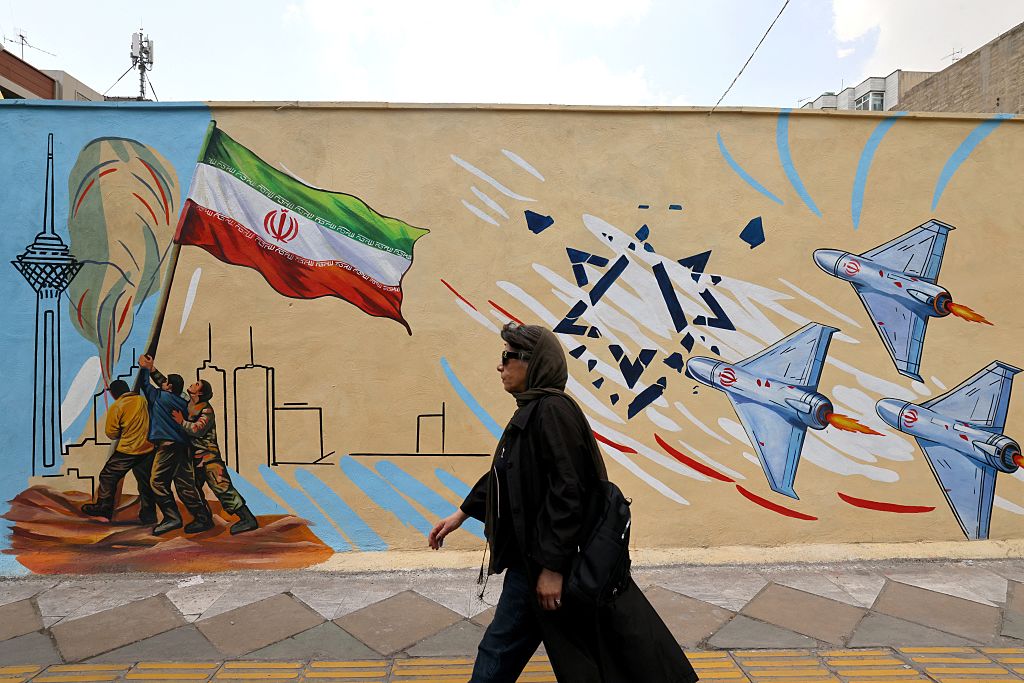
After years of negotiations, two wars, a succession of ruthlessly quashed uprisings in Iran and countless billions of dollars’ worth of ordnance smashing into rubble across the region, we have the bones of an agreement. Not a deal, it should be said. Instead an understanding that manages to speak volumes and yet say very little in the way of concrete details. Vice President JD Vance’s trip to Switzerland may have been postponed — after Israel and Hezbollah exchanged fire over Lebanon last night — but the Memorandum of Understanding between America and Israel has been signed, and both sides seem confident that the peace process has not yet been derailed.
Who won, you might ask? Surely, Iran. The US, after all, has not achieved one of its stated aims of the conflict; the regime still stands, missile stockpiles still exist, the proxies still fight and a Khamenei rules over the people of Iran.
Tehran has gained some mighty financial concessions from the US. Clause 9 of the Memorandum of Understanding (MOU) clearly states that Iran’s nuclear program will “maintain” the status quo, i.e., still be able to enrich uranium and maintain centrifuges. Gone is the Trumpian red line of zero enrichment.
You could say that the Islamic Republic has undergone a coup, of sorts
Likewise, Iran will, subject to compliance, receive a $300 billion reconstruction fund (double what the Marshall Plan would be worth in today’s money), paid for from regional pockets. Those very same pockets that have taken such a hammering both literally and economically since Iran decided to close the Strait of Hormuz, a concession which must be a bitter pill to swallow across the Gulf, and in Tel Aviv.
Let’s not forget, one of the main reasons for Trump pulling out of the JCPOA in 2018 was due to significant pressure from Gulf powers, alarmed at how Iran was spending its new sanctions-free income on proxies and expanding its influence in the region. And now they are being asked to pay huge sums of money to rebuild the economy of their most troublesome neighbor.
Similarly, the Strait of Hormuz, once closed, can always be closed again, a reality that gives Iran the sort of latent leverage that a nuclear bomb might once have provided. But at a fraction of the cost, and without any of the aggravation.
Dig a little deeper, however, and the truth becomes more complicated. For despite the Islamic Republic’s apparent ascendancy, both in its ability to shape a global narrative which pits them as the plucky underdogs, but also in its ability to survive months of bombardment, Tehran has repeatedly returned to the negotiating table.
What has driven this desire to negotiate again and again has been the economic imperative. Or put simply, a currency in free fall, an economy utterly decimated by the internet shutdown that has crippled Iran’s highly significant e-commerce sector and rampant inflation that has put even the most basic foodstuffs beyond the reach of ordinary Iranians.
Iran may well feel entitled to claim this MoU as a great victory, and so they should, but the clearer eyed strategists in the Islamic Republic (and there are many of them) are aware of the scale of the challenge ahead. The regime knows that staying in power is not simple, nor is managing their “victory” in such a way that gives Iranian people a measure of economic relief, skates over the horrors of January’s massacre and the drumbeat of executions of political prisoners. Overcoming these problems will take time, money and is by no means a sure thing.
The Islamic Republic of today is fundamentally different to the Islamic Republic of last year. January saw the IRGC and the Basij kill thousands upon thousands of Iranians in the name of staying in power. The war has simply cemented the power of these same people. An Islamic Republic shorn of its Supreme Leader, Ali Khamenei, is more akin to a military dominated state such as Pakistan. Mojtaba’s whereabouts are simply unknown. You could say that the Islamic Republic has undergone a coup, of sorts. And not everyone is pleased.
Clerical hardliners have vocally opposed the signing of the MoU, publicly denouncing Mohammad-Bagher Ghalibaf, the parliamentary Speaker, and Abbas Araghchi, foreign minister, accusing them of having the blood of former Supreme Leader Ali Khamenei on their hands. Mojtaba Khamenei condition and whereabout remain a mysterious, but he’s no doubt wary of an over-powerful IRGC rendering him obsolete and is reportedly shoring up his power base wherever he can.
Ghalibaf and the IRGC, despite being on the same page today, will ultimately diverge on how Iran evolves from conflict to post-conflict. Ghalibaf, a sharp elbowed mercantilist and pragmatist, will seek to use the money to make Iran prosperous and secure. Meanwhile, elements of the IRGC will look to reconstitute, gradually, Iran’s Axis of Resistance, and perhaps stick more closely to Iran’s revolutionary heritage.
Without the ruthless guiding of a feared Supreme Leader, it remains to be seen for how much longer the centre can hold. As the spoils of war, sanctions waivers and unfrozen assets, start to trickle into the Iranian system, these splits and fractures could potentially become the fault lines. Nothing corrodes quite like a huge influx of money into a corrupt political-economic system.
Donald Trump is significantly less popular on the streets of Iran than he was in those heady days of January 2026, when he was recklessly promising help to brave Iranians fighting bullets with bottles, urging them head out to resist. “He’s just as bad as the IRGC,” an Iranian said to me yesterday. There will, undoubtedly, be more popular unrest in Iran in the coming months, but as the US seeks to remove sanctions (a hugely complex venture fraught with US and EU legal challenges), what support can the people of Iran expect in their valiant struggle?
Who can derail this now? Iranian decision makers are adamant that this deal will go through, and have told their military that responding to Israeli aggression is best done obliquely. Tehran will seek to use Israeli attacks on Lebanon to drive a harder bargain with the US during these crucial 60 days, driving a wedge between Donald and Bibi and ultimately feeding the Iranian regional charm offensive which aims to portray Israel, not Iran, as the real regional menace. It seems as if message discipline in Iran will hold when it comes to resisting Israeli provocation.
Both Donald Trump and J.D. Vance have talked a tough game since the signing of the MoU, stressing that they won’t tolerate any Iranian backsliding. But in reality, US options when it comes to pressuring Iran are limited to economic levers. Washington has been strategically outplayed by Tehran to the extent that Iran has rendered superior military might obsolete. Any US military attack on Iran would simply be met with asymmetrical attacks across the region, and once again a closed Strait of Hormuz. Historians will, one day, marvel at how, once again, the world’s most mighty military has been blunted by a smarter, more ruthless, more cunning foe.
Beyond the recriminations in DC and the muted jubilation in Tehran, it’s worth noting the huge significance of this moment. There may well be a realignment in the Middle East, with a resurgent IRGC-dominated Iran, an isolated Israel and a bloc of Sunni Arab nations looking on nervously. The next 60 days will define the next decade, and beyond.

Comments