
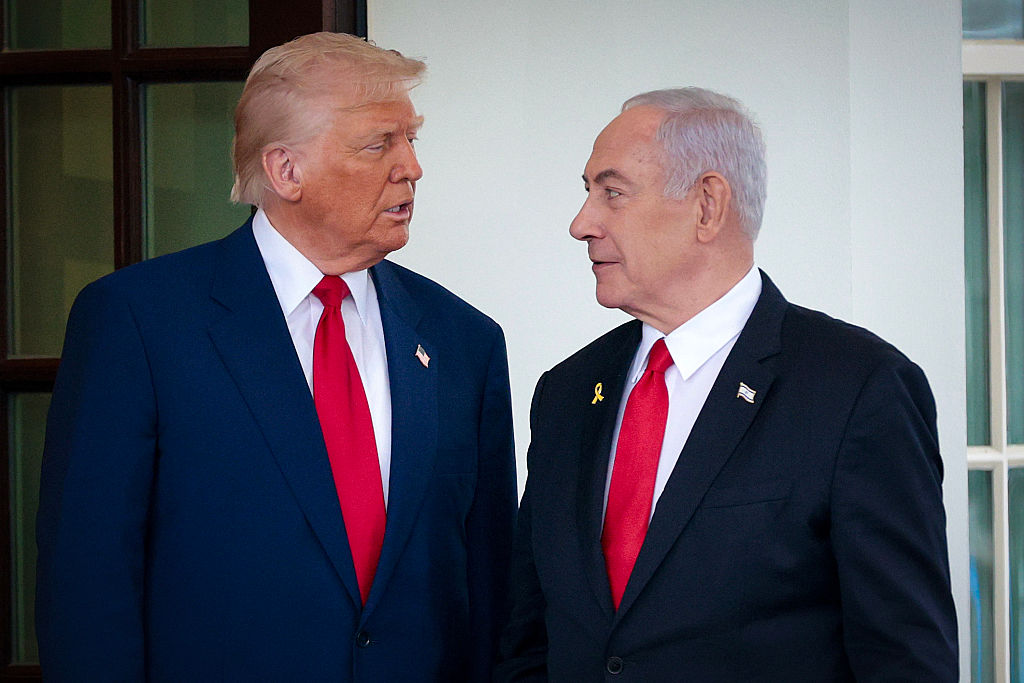
Cutting US military aid to Israel was once an impossible dream of the most extreme fringe of the Democratic party. Today axing the $3.8 billion annual package is a bipartisan issue being spearheaded by the GOP.
The number of free US tax dollars that Israel would receive to spend on its military under a GOP plan being discussed by both governments would be reduced to zero. The brainchild of Marlin Stutzman, a staunch Israel ally and Republican congressman from Indiana, the proposed memorandum of understanding, which would come into effect when the current deal ends in 2028, now forms the basis of the negotiations and was endorsed by Benjamin Netanyahu.
While the new arrangement might choke off US grants, some analysts believe that Israel could receive the same if not more via new Pentagon contracts. US intelligence officials are working on a deal that would deepen cooperation between Israel and the US military to develop weapons and technology. The new arrangement might be quieter but not smaller than the current $3.8 billion annual aid, experts say.

Israeli Deputy Foreign Minister, Sharren Haskel, believes major US defense investment is still going to flow into her country. Under the current deal, Israel is only allowed to spend the US money on US arms. But under the proposed deal, Israel would be free to invest in Israeli defense firms, which are in line to get preferential access to Pentagon contracts and would be able to partner with US defense contractors.
The current arrangement, Haskel told The Spectator in an interview, “is limiting” Israel’s ability to produce arms. “We are building cooperation with the American industry and there’s going to be much bigger revenues from doing that. America and Israel are going to produce in collaboration some of the top equipment in the world, and that’s going to have a demand all over the world.”
War in Gaza has fast tracked Israel’s defense technology, she says, and made the country an attractive partner for the US and governments around the world. “The new war is a very much advanced war. Our industry is in a serious boom of startups, of specific equipment, of specific weapons, of specific drones, to advance your army.”
Haskel denied that Israel felt pressure from the US to end the current arrangement. “This is a very much bipartisan issue. America understands that we are their greatest ally, especially in the Middle East.” The decision was Israel’s alone, taken in the national interest. “We need to create the least dependency possible on any other country.”
It is somewhat unlikely that the US was not pushing to end or substantially reduce the current deal. With his proposal to reform it, Rep Stutzman read the room. Israel has become a high priority for US voters of both parties since the war in Gaza. Recent Pew research found that the number of Americans who have an unfavorable view of Israel has increased from 53 percent to 60 percent. The number of GOP voters under 50 with a poor opinion of Israel has gone from 50 percent to 57 percent.
So the contours and details of the deal will be of keen interest to increasing numbers of voters. Especially since the current ten-year deal ends in 2028 when there will also be a presidential election and the proximity and relationship of candidates to and with Israel is likely to be examined.
Donald Trump has admitted to furious arguments with Netanyahu over his peace plan with Iran and JD Vance, the most obvious heir to Trump’s MAGA crown, also appears to be growing impatient with Israel. Trump has pushed him in front of the cameras to defend the deal with Iran, but the Vice President has reserved some of his sternest words for Israel. He has said that Israel and America’s national interests “diverge” and that Israel “may not like” Trump’s deal but should accept it. How many of Vance’s fellow GOP presidential candidates in 2028 will share his misgivings?
Among Democrats, opposition to Zionism is a virtual shibboleth. Bernie Sanders, two-time Democratic presidential race runner and longtime opponent of military aid to Israel, is now positioning himself against the emerging deal and specifically a provision in the National Defense Authorization Act that would integrate American and Israeli defense industries.
There’s been this memification of US aid to Israel
Section 224 of the act requires the Secretary of War to designate an “executive agent” responsible for synchronizing cooperative efforts between the US and Israel, including “bilateral defense technology research, development, testing, evaluation, integration and industrial cooperation.” Sanders said “this is a provision I will strongly oppose.”
The new section is one of the mechanisms by which US defense dollars will keep flowing to Israel after the $3.8 billion yearly deal ends. But by funneling the money through the Department of War, rather than the current arrangement where it is distributed by the Department of State, the precise amount is harder to track, analysts say. The shift will strip away oversight mechanisms and move the money into the opaque machinery of defense acquisition. It is not a reduction in American support, they claim, but a reorganization of it.
Joe Kent, who resigned from his position as director of the National Counterterrorism Center because he believed that Israel had dragged the US into war with Iran, thinks that the new deal is just a “rebranding” of the old deal. Kent recently wrote that section 224 “transforms Israel from a top US aid recipient to a full member of the US defense and intelligence apparatus. By embedding Israel in the production of critical defense technologies, we are creating access and control mechanisms for a nation that has drastically different goals than America does.”
The view is already gaining traction in America First Circles. Marjorie Taylor Green, who speculated Jewish “space lasers” might have started California wildfires, is among a number of MAGA figures demanding that section 224 be removed.
But governance need not necessarily be watered down with the new deal, according to Avishay Ben Sasson-Gordis, senior researcher at the Institute for National Security Studies at Tel Aviv University. “I think there’s going to be congressional oversight.” That, however, won’t be enough for some critics. “What has happened is that there’s been this memification of US aid to Israel. For some people it doesn’t matter whether the US pays for it or it’s just the US giving Israel access to American industry. For them, it’s all packaged within this idea of American military aid to Israel.
“I think the people who see the US as complicit in Israeli wrongdoing are going to continue to do so. And so I think we have to be very clear-eyed on what can be achieved solely on moving from funding to non-funding.
“They’re looking at the Iran war and they’re saying ‘Do you feel standing by Israel has served our interests?’ The point is that these people, whether they are on the right or some folks on the progressive side are saying this already and this is not going to make it go away.
“I do think the memification matters because often in politics that governs, not what is actually happening.”
Proponents of the deal say that it would allow the US to have preferential access to cutting edge Israeli defense technology, much in the same way as the Department of War is doing in Ukraine, and also to maintain access to Israeli intelligence. It is far from a one-way street.
The current arrangement whereby America supplies Israel with arms began during the Cold War to counter Soviet influence in the region and developed into a broader strategic partnership for the defense of Israel and its shared values – with the US benefiting from regional intelligence and technology in return.
Dr. Eyal Hulata, former Israeli National Security Adviser, described Israel as a “model ally” and that whatever deal is eventually struck, and despite Kent’s reservations, intelligence sharing will continue because it’s crucial for the US. “Definitely we have issues, we have problems. Many of them are political. Democrats don’t like Netanyahu. The Republicans would want to cut aid all over, but I don’t foresee a landslide in the relationship.”
It is too early, he says, to predict exactly what the new arrangement with the US will say, and the Israeli elections in October will have a huge bearing on it – especially if Netanyahu is removed as Prime Minister. “Nothing will be agreed before the Israeli elections and things can change.
Negotiations between the US and Israel on the new memorandum of understanding began at the start of June. The US team is being jointly led by US Ambassador to Israel Mike Huckabee and State Department Counselor Daniel Holler. Huckabee posted on X that “Israel receives $3.8 billion but spends far more than that buying US military goods.” He added that the new memorandum of understanding “ends aid & will be based on trade.”
Huckabee and his team are keeping the precise details of their negotiations private. But if the true extent – and cost to US taxpayers – of the new deal are never fully disclosed, it will only inflame the anger it was supposed to quell. Even if the deal eventually struck is a triumph for the US.






Comments