
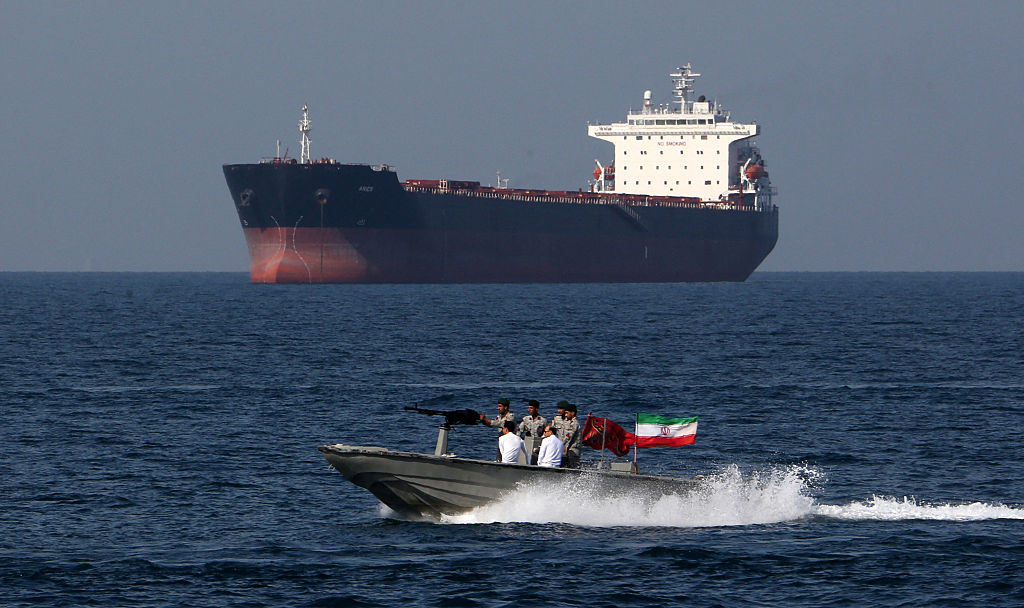
“Whoever rules the waves rules the world” – Alfred Thayer Mahan.
Would Donald Trump have attacked Iran on February 28 if the Supreme Court had not ruled against his tariffs on February 20?
The two issues may seem unrelated. Yet, as a fascinating piece by Captain John Konrad has pointed out, a closer inspection of Trump’s international agenda reveals his administration’s intense focus on trade, energy and maritime control – and that might help explain the otherwise inexplicable folly of the situation in the Strait of Hormuz.
Trump is determined to bring about an American Golden Age. That involves controlling gas and oil, aggressively reducing China’s expanding control of shipping lanes, and establishing US dominance over key maritime chokepoints.
Trump knows all too well that crisis represents opportunity
In April last year, Trump signed an Executive Order called “Restoring America’s Maritime Dominance.” In December, at around the same time his National Security Strategy was unveiled, he also announced a new US initiative to build a “Golden Fleet” of “Trump-class” carriers with the aim of out-classing the Chinese navy long into the future.
The move was widely scoffed at by military analysts who tended to ignore how a Golden Fleet might fit into Trump’s broader agenda of disrupting global trade through tariffs to advance America’s strategic and long-term economic interests.
First on that agenda: the western hemisphere. In the inaugural address of his second term, Trump declared that America had given away the Panama Canal: “Above all, China is operating the Canal and we’re taking it back.” His administration promptly pressed Panama to pull out of China’s belt and road initiative, and has since introduced the “Shield of Americas,” a US-led military alliance which aims to counter drug-trafficking by controlling the Caribbean.

And of course, Trump started this year by regime-altering Venezuela to secure a more biddable government on that coastline. He is now pushing to collapse Cuba’s leadership, too.
Then there’s the north. Straight after the raid in which Nicolás Maduro was captured, Trump began applying strong pressure on NATO allies to give him Greenland, which would grant America power over the so-called Greenland-UK gap, the most critical waterway in the North Atlantic. At Davos, Trump pulled back from his threats of annexation – but his bully tactics forced European allies to at least pretend to take Greenland’s defence more seriously.
Last, but not least, the Arabian seas. This time last year, America carried out Operation Rough Rider, a powerful bombing campaign against the Houthis, who were disrupting shipping around the Red Sea.
The operation was successful, but, as discussed in my last newsletter, what came next was Signalgate – the publishing of a highly sensitive conversation between Trump’s top national security team about keeping the Gulf of Aden and the Red Sea open.
What that conversation revealed most of all was Team Trump’s antipathy towards Europe over its failure to protect vital shipping routes. The US administration seemed utterly determined to make Europe pay for Uncle Sam’s military largesse.
As Konrad writes, after Signalgate, “every [US] maritime initiative began to stall.” Panama pulled back on agreements over US shipping. The French Shipping Group CMA CGM withdrew a $20 billion commitment to US shipping and ordered vessels from China and India instead. Mike Waltz, the guilty man of Signalgate, had to be moved out of the position of National Security Adviser and into the role of US ambassador to the United Nations. And the SHIPS Act, a major piece of legislation to revive America’s shipbuilding capacities, which Waltz had sponsored back in 2024, got stuck in the congressional committee stage.
Another crucial clash came in April last year, at the International Maritime Organisation in London, when 63 countries voted to approve a net-zero framework to impose carbon pricing mechanisms on large ships. The Trump administration asked that US vessels be exempt. European authorities refused; Trump called the framework “the Global Green New Scam Tax.”
The upshot was that the US and Europe reached an impasse over a crucial piece of global shipping legislation, which threatened to weaken America’s maritime strength. To stop that happening, Trump had deployed his favourite diplomatic weapon: the threat of tariffs.
But then, on February 20, the Supreme Court voted against the President’s tariff regime and, though Team Trump quickly switched to a different legal mechanism for imposing charges on imports, his ability to stick tariffs, willy-nilly, on any country that challenged him had been hampered.
Just over a week later, Operation Epic Fury began. Perhaps the war would have begun regardless. Trump had already ordered a massive military build-up around Iran.
But his defeat in the Supreme Court did threaten to diminish his ability to coerce allies into supporting his agenda, rather than China’s – especially on trade and shipping. He needed another method to impose pressure. Initiating the conflict with Iran may turn out to have been precisely that.
The war has exposed the world’s vulnerability in a way that could give the US strategic leverage
Of course, all this could be seeing meaning where there is none. But a lot has been said about the Trump administration’s lack of a plan for dealing with the Strait of Hormuz. And all the tutting might be missing a bigger point.
The fact that the war has caused an energy crisis, which will hurt Europe more than America, has exposed the world’s vulnerability in a way that could give the US strategic leverage. This, among other things, may prove valuable as Trump tries force Europe to accept an end to the conflict in Ukraine on terms more favorable to Vladimir Putin than to Volodymyr Zelensky.
Konrad even suggests that the US Navy’s slowness in protecting the strait may be a deliberate tactic to ratchet up pressure on the rest of the world. That may be stretching his hypothesis, which he admits is highly speculative. But there’s no doubt that America has, since it first replaced Britain as the world’s pre-eminent power, always understood the need to rule the waves.
In the 19th century, the great naval strategist Alfred Thayer Mahan, who I quoted at the top of this newsletter, studied British sea power to inform American foreign policies under president Theodore Roosevelt and others.
Nobody believes that Trump curls up at night with a copy of Mahan’s The Influence of Sea Power upon the French Revolution and Empire, 1793–1812. It’s far more likely that the Iran operation has already spiralled far out of America’s control in ways that will undermine the Donald’s political legacy.
But Trump knows all too well that crisis represents opportunity. Within three days of launching this latest war, he ordered the US International Development Finance Corporation (DFC) to create a $20 billion maritime reinsurance facility, which could make the US Treasury and American insurance giants the lenders of last resort to commercial vessels in the Strait of Hormuz. The DFC announcement spelled out that the facility must be implemented in coordination with US Central Command. As Konrad says: “They cannot pass without Navy permission. The green light has not yet appeared.”
Perhaps the light will never turn green. For now, the energy markets are too muddled to tell. But just as the great financial innovation of maritime insurance, through Lloyd’s of London, helped guarantee the expansion of the British Empire in the 18th and 19th centuries, America’s increasingly assertive 21st-century empire may end up being backstopped by a protection racket.
This article originally appeared in Freddy Gray’s Americano newsletter, which you can subscribe to here.

Comments