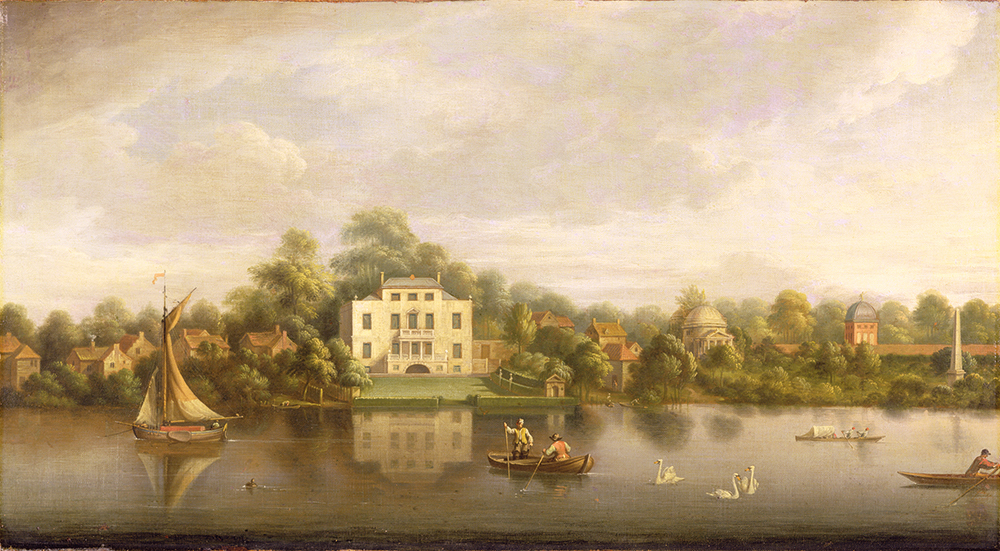
In the summer of 1726, the writers Jonathan Swift and John Gay spent several weeks at the home of their friend Alexander Pope on the banks of the Thames at Twickenham (then known as ‘Twitnam’), not resting but toiling away at their various literary activities and mutually inspiring each other.
On the surface they were an unlikely trio: Swift was almost 20 years older than either Pope or Gay; Pope was Catholic (at a time when Catholicism was still treated with suspicion) and financially independent, while Swift was an Anglican cleric, the Dean of St Patrick’s Cathedral in Dublin. Gay, in contrast, was a jobbing writer, dependent for financial security on his amiable sociability and maintenance of good relations with a long list of wealthy patrons. Swift, who was fastidious (ordering and roasting his own coffee beans) and stern, thought Gay lazy and irresponsible, telling Pope: ‘He hath as little foresight of age, sickness, poverty or loss of admirers as a girl of 15.’ Yet he was deeply affected by Gay’s early death in 1732, at the age of 47, writing to Pope that he was not yet ‘hardened’ by life to such a loss.
What all three shared was their wit, which at that time meant not just humour but the ability to make connections between ideas and to dazzle with their use of language and clever verse. In different ways (Pope with poetry, Swift in essays and Gay in his dramas and opera) they each had a keen eye for the absurd, cutting through hyperbole and the disguises we adopt to hide our true nature.
That summer was a partial reunion of the Scriblerus Club they had formed a decade earlier, the writers meeting weekly in London (Swift was at the time hoping to make his career in England) and attempting to launch a new periodical to rival the original Spectator. Their intention was to elevate publishing by attacking with merciless intent what they considered to be dilettante writers without academic learning, greedy publishers who plagiarised the works of penniless writers and pedantic critics. (Does any of this sound familiar?) That the club did not last long is perhaps a reflection of its idealistic aims. But its impact endured, sparking the creative output of those involved.
As Hester Grant argues in The Twitnam Summer, the weeks that Pope, Swift and Gay spent together in 1726 burnished their already highly developed literary gifts. Swift had brought with him from Dublin the manuscript of Gulliver’s Travels, which was published in November that year with several thousand copies sold in the first week. His absurdist visions of the kingdoms of Lilliput and Brobdingnag, of the Yahoos and the Houyhnhnms, the talking horses and impertinent pygmies, soon entered the language.
Meanwhile, Pope was preparing his next venture into print after his hugely successful translations of the Iliad and the Odyssey, from each of which he had earned £5,000, enough to buy a riverside estate and extra acres on which to create a landscaped garden. The Dunciad was written in the style of an epic poem but, instead of glorifying the courageous acts of classical warriors, Pope’s characters are writers and publishers who find themselves battling to stay awake while reading the work of fellow hacks or competing in the sewage-laden Fleet river for the prize given to the writer who ‘flings most filth’.
It was Swift who suggested to Gay that he should write ‘a Newgate pastoral, among the whores and thieves there’ as a way of satirising the lack of realism in the current vogue for Italian opera, in which plot was the victim of the super-inflated egos of the singers. Gay surpassed his brief with The Beggar’s Opera, which takes us into the criminal underworld of Captain Macheath and Polly Peachum. It has never since been lost to the repertoire, like Gulliver’s Travels crossing genres and audiences.
What all three men shared was their ability to dazzle with their use of language and clever verse
Grant’s re-enactment of this friendship is compellingly written and packed with intriguing details. Swift, we discover, travelled with a toothbrush and suffered from piles. When he returned to Dublin, he took with him green tea, coffee, chocolate, sugar and seeds of fennel and broccoli – the last also making a surprise appearance in Pope’s description of the garden he created at Twitnam: ‘Content with little, I can piddle here/ On Broccoli and mutton round the year.’ The suggestion, though, that 1726 was such a crucial time for all three writers is somewhat manufactured and, as a consequence, many of the descriptive passages have to be qualified with ‘may have remembered’, ‘if the building works were sufficiently advanced’, ‘if so, it can probably be traced to…’ And the thematic nature of the chapters (‘London’, ‘Twitnam’, ‘Travels’, ‘Gulliver’) leads to a degree of repetition.
That said, The Twitnam Summer is an engaging introduction to Pope, Swift and Gay and a reminder that if ever there was a time when we needed writers of such calibre, curiosity and courage it is now. They were human, with all the contradiction and complexity that implies, but at heart they understood, as Swift wrote to Pope and Gay: ‘I am so far of your opinion that life is good for nothing otherwise than for the love we have to our friends.’



Comments