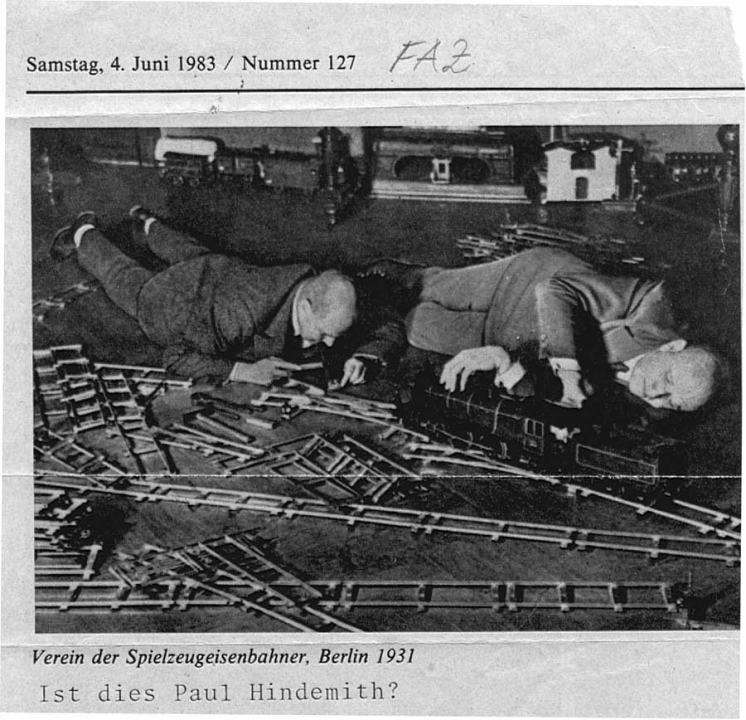
There’s a photo of Paul Hindemith with the pianist Artur Schnabel on hands and knees, surrounded by model railway track. Huge railway enthusiast, Hindemith, you see: he laid sprawling networks through the rooms of his Berlin apartment (before the Nazis drove him out), and organised marathon operating sessions with friends. Anyway, for various reasons, this knowledge makes me warm to him in a way that his music only erratically manages.
It’s not that it’s impossible to like (although this is a man whose idea of a crowd-pleaser is called Symphonic Metamorphoses of Themes by Carl Maria von Weber). But there can be few composers whose effect is so hard to anticipate. Catch a great performance of the right piece – Oistrakh playing the Violin Concerto, say, or a really passionate account of the Trumpet Sonata – and you can believe that you’re hearing the fierce, prophetic voice of a century. At other times, it can feel like gnawing through cardboard.
Jac van Steen opened his Birmingham concert last week with Hindemith’s Concert Music for Strings and Brass (another zinger of a title), and it’s a fair bet that it cost them a few ticket sales. A pity, if so, because on this occasion the stars absolutely did align. Symphony Hall makes every orchestra sound glamorous, but no players know how to work that acoustic like the CBSO; and the Concert Music, unusually for Hindemith, was actually written for show – a Koussevitsky commission for the Boston Symphony. Hindemith targets, with forensic precision, the two sections of any orchestra where any lack of precision is fatal.
Then, true to his self-identification as a sort of 20th-century Telemann, he throws the textbook at them: chorales, fugues, processionals. No problem. Van Steen and the CBSO played it like a Hollywood score, and you could practically see the muscle tone gleaming as the brass hefted their blocks of sound across the orchestra. Meanwhile the strings struck streamlined attitudes, draped in gun-metal satin. Imagine a painting by Tamara de Lempicka rendered in sound. The Concert Music blows hot and steely-cold; sensual in a bracing sort of way. You don’t have to love this stuff, but it delivers a definite and very distinctive sort of thrill.
Van Steen continued with two more train-adjacent pieces. Ravel famously conceived his G major Piano Concerto on the Great Western between Oxford and Paddington, and without overdoing the glitter, the soloist Benjamin Grosvenor really made the track-joint rhythms dance and sing.
Then came Honegger’s Pacific 231; a kinetic sculpture in sound, composed in 1923. Lots of composers imagine they know what a steam locomotive sounds like, but with Honegger you actually hear the emptying drain-cocks, the opening of the regulator and the shifting cut-off. The CBSO found every colour, and made it glint. They finished with Petrushka (with the rarely heard concert ending); a thrillingly tactile performance that sounded – in the clarity of Symphony Hall – as if light was streaming through each note. That’s the whole problem with hearing orchestral music in Birmingham. It makes everywhere else sound beige.
The Royal Opera has revived Deborah Warner’s 2022 production of Peter Grimes, which was stunningly delivered then and is even better now, with most of the same cast having grown more deeply into their roles. Allan Clayton’s Grimes seems more passionate and lyrical; Maria Bengtsson’s bright, beleaguered Ellen is even more touching and Bryn Terfel (Balstrode) is still Terfel, but it works because Balstrode is a big, respected man in the Borough and – well, you get the idea. The aerial effects and lighting create dream-like images and Jakub Hrusa’s Janacek-inflected way with the score gives Britten a gravelly, red-blooded physicality that you wouldn’t have thought possible. It’s superb. But.
But. Gifted directors can have bad ideas. Warner has switched the action from 1830 to the present – a depressed English coastal town complete with boarded-up shops and lairy locals – and she describes in the programme how she ventured out of London to observe common people in their natural habitat. I don’t want to come over all class war about this, but when you’re in the £154 seats, enjoying that meticulously reproduced litter and deprivation, there must come a moment, surely, when you start to feel that something here doesn’t quite sit right?
Sure enough, when the proles turn feral, Warner shows her establishment colours. She has them wave Union and English flags, although the story has absolutely nothing to do with nationalism. A beefy extra strips off his shirt, gets down on all fours and beats his chest like a gorilla. Got it, yet? For Warner, these people are subhuman. In choosing to update Peter Grimes, she ditches Britten’s moral complexity – his empathy with the marginalised – to make a particular point about contemporary British attitudes. And she does; she certainly does. Just not, perhaps, the one that she intended.





Comments