Covent Garden’s new Ring cycle has reached Siegfried, and once again, you can only marvel at Wagner’s Shakespeare-like ability to anticipate modern preoccupations. Want to talk about the manosphere? Well, here’s opera’s most profound study of the playful, disruptive, world-making energy of the adolescent male psyche. The least interesting thing that you can say about Siegfried is that he’s an impulsive oaf. Well, duh. Have you never met (or if you’re really unfortunate, been) a teenage boy?
Wagner could hardly make it more clear. Siegfried’s upbringing has been toxic. He has been isolated from humanity, and his only inkling of love has been brutally transactional. He’s the eternal disposable male, valued only for his future ability to fight and die for people more cynical than himself. Wagner, true (as ever) to nature, portrays Siegfried’s blossoming, chaotic instincts as a life force that finds its natural purpose in his union with Brünnhilde – herself an anxious and vulnerable beginner at this whole impossible business of being human.
Theater lovers who get to see Schager as Siegfried can count themselves lucky indeed
Apologies for going on like this, but the point is that the director Barrie Kosky gets it. He absolutely gets it, and coupled to Andreas Schager’s magnificent, multilayered performance as the orphaned hero, the result moves Kosky’s Ring cycle up a gear. Imagery that has been present (and sometimes unclear) since Rheingold now slots into place and reveals its latent meaning. The final tragedy is not yet visible, but we can feel the ground beneath us starting to tilt.
Take the naked, passive crone who represents Erda (Illona Linthwaite), and whom I’d written off as the faintly pervy side product of Kosky spending too much time in Germany. She’s still silent, but now she’s active: turning to gaze fondly at Siegfried as he sits on a forest swing. Through Erda, Kosky shows nature reaching out to meet him: the Woodbird (sung by Sarah Dufresne) is simply a bunch of feathers in her hand. Later, when Erda is compelled to speak by the Wanderer (Christopher Maltman), a comically grotesque sequence sees her give birth to a singing (and fully clothed) avatar (Wiebke Lehmkuhl).
The bleakness of Kosky’s Ring becomes meaningful, too. The chilly monochromes and blasted tree trunks finally add up when, having passed the flames (heard but not seen), we witness Erda tending the first living flowers in the whole cycle. A Parsifal-like meadow has grown up around the sleeping Brünnhilde (Elisabet Strid), and the sense of her love story as nature-myth is unignorable.
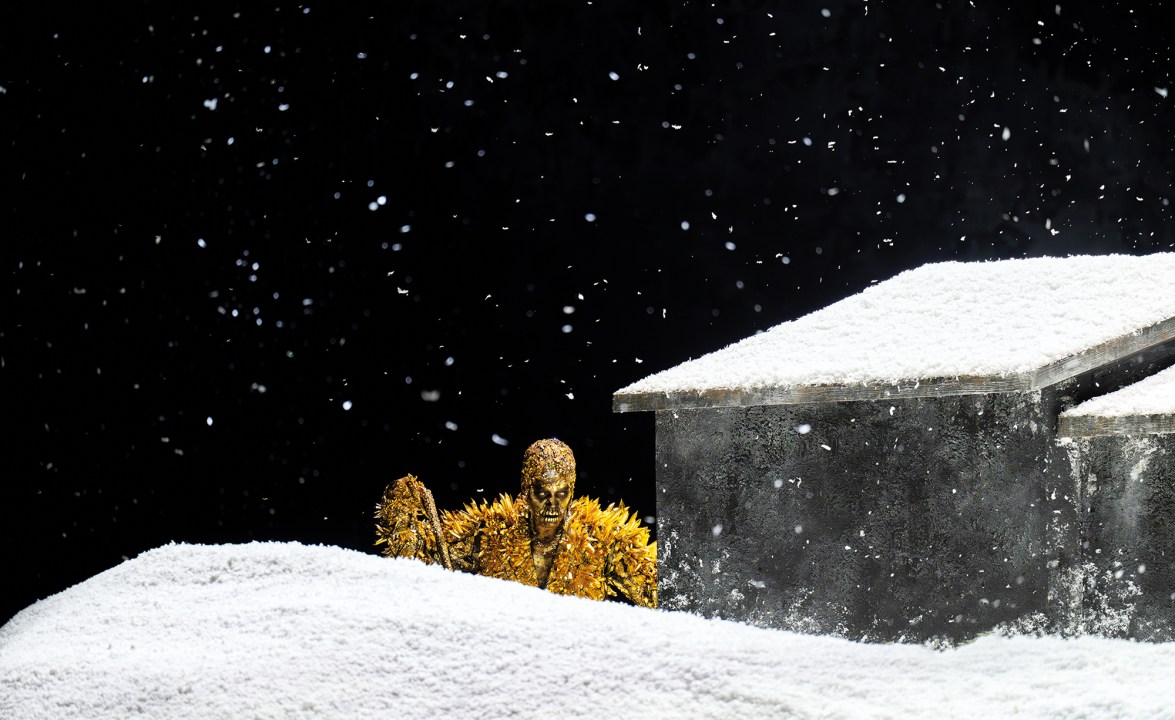
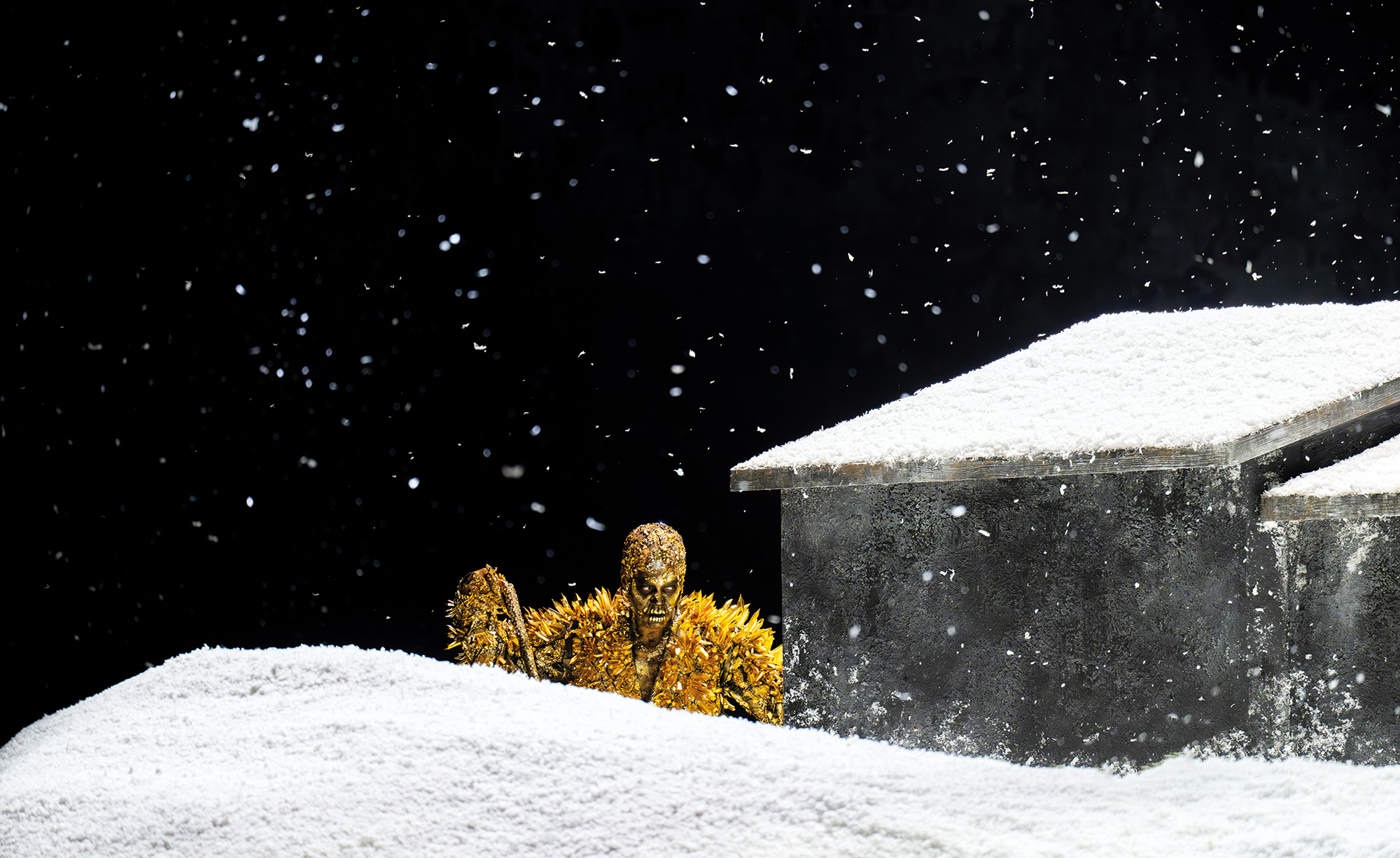
True, Kosky’s visual imagination has had an atmosphere of eerie, distilled Germanness from the start, with designer Rufus Didwiszus filtering Grimm fairytales and Weimar noir through Anselm Kiefer and Caspar David Friedrich. Now, we get a grungy kind of black humor. Mime (Peter Hoare) and the Wanderer are a pair of bums out of Beckett by way of Steptoe and Son. The Wanderer munches from a packet of crisps as he meets Alberich (Christopher Purves) by a snow-covered road, and he’s grown careless about where he leaves his spear.
He’s not alone: Siegfried is so busy making snow-angels that he nearly mislays his newly forged Nothung. The crisis ahead will not be resolved with weapons, though we do get to see – in glorious pyrotechnic detail – the making of the sword on a delightful Heath Robinson forge. Only the Wanderer’s final meetings with Erda and Siegfried really disappoint, visually. Performing on the lip of the stage in front of a huge blank screen is doubtless a practical necessity, but it feels half-realized, especially given the majestic, wounded power of Maltman as the ailing god – a characterization whose vocal grandeur seems to have deepened and redoubled since Die Walküre.
But in his disheveled, resigned state this Wanderer is no match for Purves’s clenched, steel-toned Alberich, though he toys easily with Mime: a surprisingly lyrical performance from Hoare, who chops his deadly herbs with the camp theatricality of a TV chef. Soloman Howard brings out the pathos as well as the strangeness of the dragon Fafner, encrusted in crystalline fragments of the Rhinegold. Strid, we already knew, would be a radiant, girlish Brünnhilde and her awakening to life and love – dancing and running through that sunlit meadow – provides just the catharsis we need.
Antonio Pappano conducted. He’s never been an instinctive Wagnerian, but after several Covent Garden Ring cycles this was an active and searching account of the score, possibly his best yet. Still, the key to this opera is in its title, and throughout, Schager’s singing had the clarity, sheen and directness of the sword Nothung itself.
That’s miracle enough in this voice-shredding role, but Schager was tender and articulate too, with an ability to convey both teenage bravado and desperate pathos in a glance or the turn of a phrase. Casts come and go; productions endure (for a while, anyway). Still, any theater lovers who get to see Schager as Siegfried can count themselves lucky indeed.




Comments