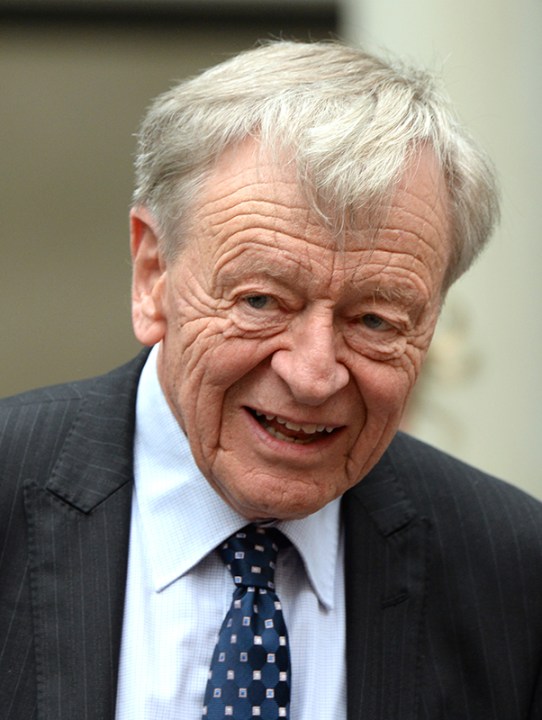
For all that it is an anachronism, the House of Lords contains some remarkable specimens, not least Alf Dubs. The child of a mixed marriage – his father was Jewish, his mother not – he arrived in this country from Prague on one of the kindertransports organised by Sir Nicholas Winton, with his possessions in a knapsack and a luggage label on his coat identifying him. Many of his Jewish compatriots were not so lucky and perished in the death camps.
He was fortunate in another respect, too. Unlike with many of his companions, his father had already made it out and was there to greet him. His mother eventually managed to join them, arriving in the UK just four days before the outbreak of war. Her first application for an exit permit resulted in her being thrown down stairs by the Gestapo officer in charge. Luckily, he also threw her passport after her, which enabled her to escape.
Initially they lived in Northern Ireland, where Dubs’s father had found work in a textile factory; but he died within a year and young Alf and his mother moved to a bedsit in Manchester. There she, a trained nurse, found work scrubbing floors in a restaurant and later as a school meals supervisor. Alf, meanwhile, progressed via a primary school for Czech exiles and Cheadle Hume grammar school to the LSE. His interest in politics was sparked by the discovery of the death camps as they were liberated by the Allied armies: ‘I believed that if evil people could do such terrible things, they could be countered by others doing something good.’
After national service and a spell as a supply teacher at a rough secondary school in Hackney, Dubs ended up working for an advertising agency, in due course becoming a councillor in Westminster. Among the controversies of the day were plans to drive a dual carriageway through Piccadilly Circus and demolish the old Covent Garden, both which were seen off by the public outcry.
Dubs was lucky to be elected to parliament for Battersea in 1979, not a good year for Labour, and he retained the seat against the odds in 1983, an even worse year, only to be defeated four years later. A highlight of his seven years in the Commons was the struggle to save Battersea power station from demolition by developers. He also describes a mentally ill constituent turning up at his surgery, first with a knife and later with a hammer, intent on killing him. Death threats to MPs are nothing new.
Out of parliament, Dubs eventually found work as chief executive of the British Refugee Council, helping to assimilate successive waves of refugees from places such as Vietnam and Bosnia. In 1994, he was appointed to the Lords, where he flourished, first as a minister in the Northern Ireland office and later as a campaigner for the more humane treatment of refugees, particularly children. The Dubs amendment to the 2015 Immigration Bill obliged the government to admit 3,000 unaccompanied minors living in destitution in European refugee camps. After initially accepting it, the government eventually reneged, but not before 480 impoverished children had been rescued. Although Dubs received much public encouragement, not everyone was happy. ‘A pity you survived the Holocaust,’ wrote one anonymous correspondent. ‘They will become terrorists like you,’ wrote another.
Having visited the camps in France, Jordan and Greece and looked the damned in the eyes, Dubs writes:
It is the lack of hope that so appals me about the plight of refugees today… I have found desperate people, including many lone children, who have no prospect of finding a new life. They may have survived the terrible experiences that led them to flee, but just surviving has become their lot… It is my hope that we will also remember the humanity that was shown to children like me – and honour that humanity by standing together and once again welcome those persecuted by war so they too can have hope for the future.
The Boy with the Knapsack contains no great revelations. Dubs’s causes will not be everyone’s cup of tea, but his energy, sincerity and integrity shine through. He writes: ‘I shall always want to say thank you to this country. Lifelines were provided for me and, in turn, I have tried to provide them for others.’ Aged 93, he is still going strong.


Comments