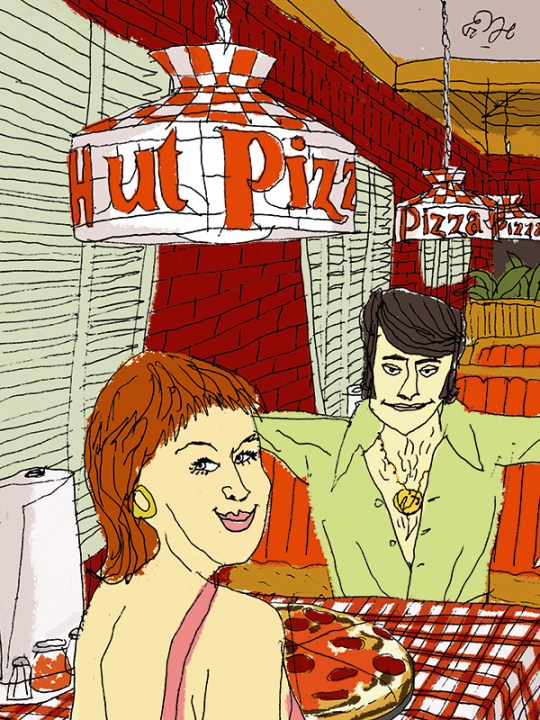

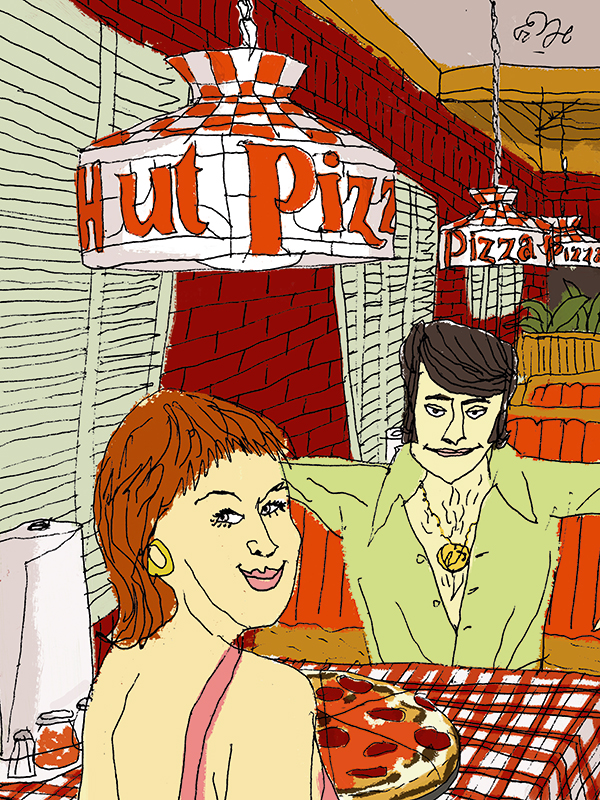
About 15 miles off the I-80, tucked away in the Cleveland suburb of Warren, you’ll find a delightful bit of yesteryear, preserved from the 1970s and serving up your childhood dreams. Here you’ll find a Pizza Hut that forgot to evolve into a quick counter-service and delivery outpost like almost all the others.
I had heard rumors of Pizza Hut Classics for some time. For years I’ve wanted to find one. As a person who would live solely on pizza if it weren’t for the heart disease and kidney stones that would inevitably follow, I knew I had to find one. Lo and behold, one such restaurant happened to be in my path on a road trip to Detroit over the holidays.
The good people of Warren, Ohio, don’t know what they have
If you’re a person of a certain age who grew up in America in the 1980s or 1990s, the Warren Pizza Hut is just as you might remember it. As you enter you’re greeted by a host, ready to whisk you away to nostalgia-land. The restaurant floor is covered in green carpeting, the tables in red-checked vinyl table coverings. There are red banquettes in the booths, with the legendary Tiffany-style Pizza Hut lamps over each one.
We’re here on a Saturday and discover it’s the only day of the week where the all-you-can-eat pizza buffet isn’t on offer. We’re also sad to find out we’re the only customers – the good people of Warren, Ohio, don’t understand what they have. Or maybe we’re just annoying tourists from New York. And maybe they understand better than we do that there’s no buffet on Saturdays.
The salad bar, though, is roaring and ready to go. We’re told by our server that “the salad bar is $3.99 and you can go up as many times as you want.” Music to my ears. There are few times in life I would say I love a salad, but all of them are times when I get to load a plate with iceberg lettuce, bacon bits, shredded cheese and croutons and drench it in ranch dressing.

Unfortunately, the bacon bits are missing. The bar also features an assortment of raw vegetables, which I bypass. The biggest disappointment was that it wasn’t covered in kale. Pizza Hut was, at one point, the largest buyer of kale in the US – they used it as decoration on their salad bars long before Whole Foods made it a staple on your plate.
Our Pepsis come served in red plastic cups. We’ve opted for the medium pepperoni-lovers pizza and a personal Buffalo chicken pizza. While the normal pizza looks somewhat normal, the personal pizza almost certainly came directly from a plastic bag. On reflection, they were just as I remembered from the Book It program, though I thought they were more delicious back then.
The Book It program, for those who never learned to read, was and still is a program put on by Pizza Hut to incentivize children to read. After finishing a book, your teacher would give you a sticker on a badge. When you had collected a certain amount of stickers, you could turn your badge in at a Pizza Hut in return for a personal pizza. This was dangerous for me, a young child who loved nothing more than to read books and eat pizza. It may help explain why my doctor recently referred me for a cardiac CT scan.
I won’t bother going into detail on the actual quality of the food – it was exactly what you would expect. It tasted like Pizza Hut, for better or worse. The menu is dotted with old classics such as the Big New Yorker, one of my favorite innovations from the early 2000s, with which I have some history and hold a legendary distinction among my friends for regularly taking down solo. (This might also help explain the CT scan.) Disappointingly absent was the Bigfoot Pizza, a square 21-slice pie from the early 1990s which I hoped had lived on somewhere.
It might be important to pause for a moment and ask how this restaurant still exists. Well, we can ask – but we’re unlikely to find any real answers. There’s basically zero information anywhere on the internet about an initiative from Pizza Hut to keep these sit-down restaurants going. Any research will just turn up a few food blogs and some Reddit threads asking the same question. There’s nothing on the Pizza Hut website mentioning Pizza Hut Classics. Emails to the chain’s public relations team went unanswered.
The only sign that this is an intentional preservation of the past is quite literally a sign – at some point, the giant roadside sign has been converted into a “Pizza Hut Classic” one. Our server, though, tells us that she grew up in Warren and the restaurant hasn’t changed since the 1970s, ruling out any sort of viral marketing stunts – though if that was Pizza Hut’s plan, they haven’t done a great job spreading the word.
While Pizza Hut is keeping mum on the topic, the internet has done a solid job of chronicling the Classics. Reddit forums are alive with people stumbling upon them and alerting the thread, and one enterprising Substacker called the Retrologist has been compiling a list of known Pizza Hut Classic locations. By his count, there’s an astonishing 83 of them, which is hard to believe considering almost no one I know knew of their existence.
The world is full of nostalgia for the restaurants of our youth. In New York, a slew of spots have opened over the past few years mimicking the supper clubs of the Midwest or French bistros of old New York. Some of the hardest reservations in town are still the classics – try getting into Minetta Tavern or Keens without a reservation at least a week in advance and you’ll be disappointed. As far as I can tell from my Instagram feed, one of the hottest restaurants in LA at the moment is Max and Helen’s, a faux-vintage diner serving matzoh ball soup, patty melts and breakfast all day. You’ll wait hours in line just to get in.
In our digital age, there’s something comforting about going to a warm, cozy, no-frills spot that will serve you piles of hearty food. Everyone seems to be looking for a connection to the past. And for someone who grew up in the 1980s and 1990s, the idea of a restaurant that slings pizza and pitchers of beer and soda makes my heart sing – even if my doctor doesn’t like the tune.
This article was originally published in The Spectator’s February 2, 2026 World edition.




Comments