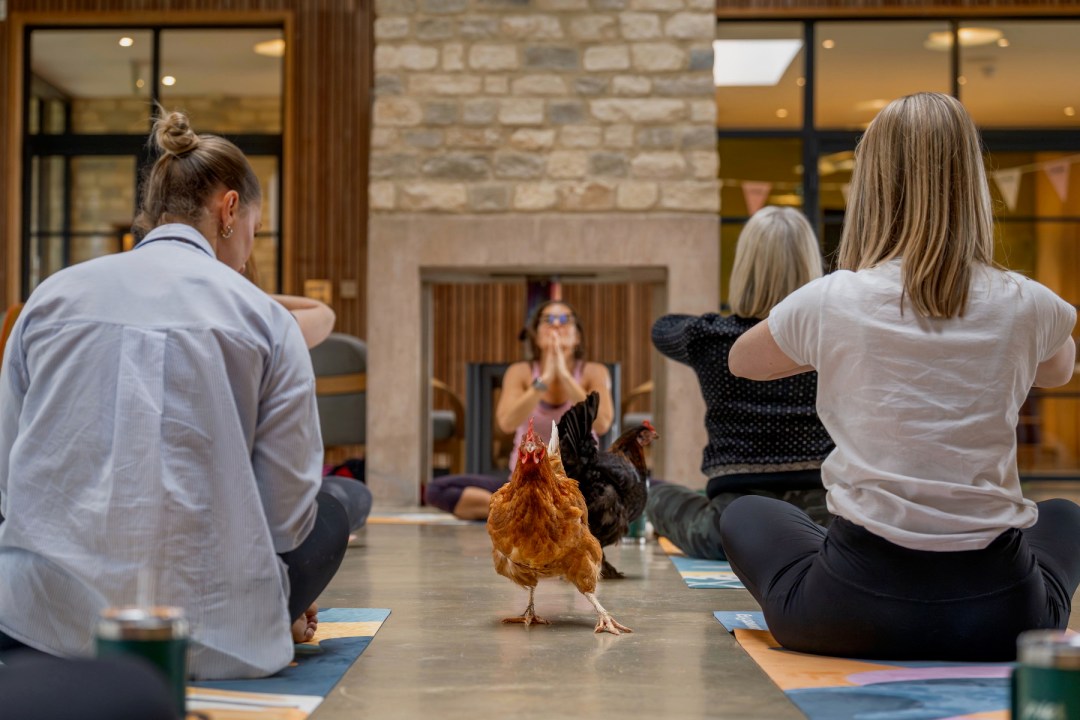
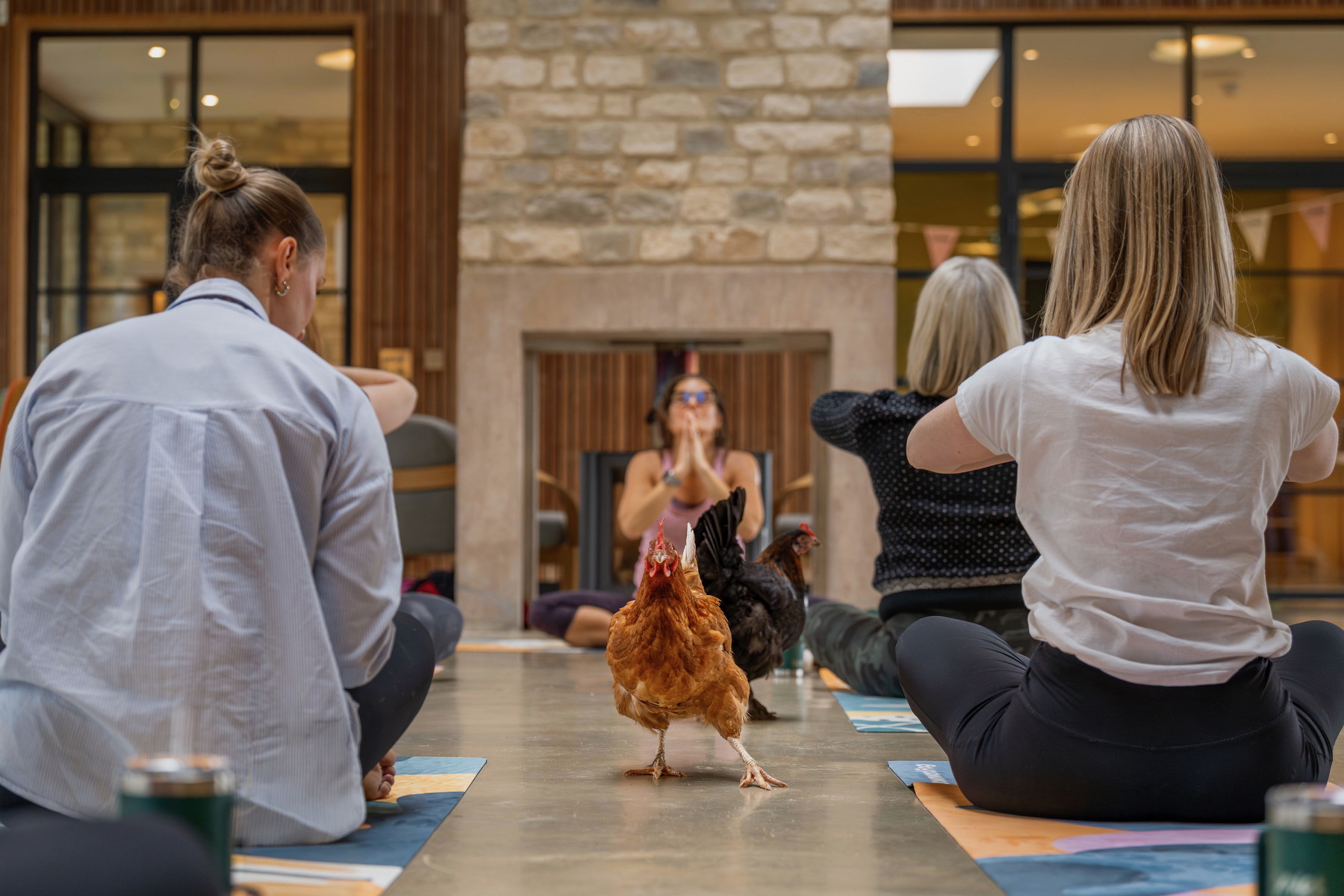
Halfway through a downward dog, red-faced and breathing a little too hard, a hen stops about 18 inches from my face. It squats, and lifts its a tail a fraction. There is a brief, unmistakable pause. Something warm and biological drops onto the mat beside me. It is not an egg.

From the front of the class, the instructor’s voice calls out, instructing us to inhale deeply.
To my side, another chicken wanders into the danger zone just as a pose collapses and someone nearly brings an arm down on it. The bird emits a short, offended squawk.
How have I ended up here? About 20 of us are gathered for what the organisers are calling a ‘Regenerative Roosting’ retreat, a loose collection of farmers, chefs, poultry fanciers, avian influencers of various stripes – and me, a hen keeper with roughly two weeks’ experience.
The session takes place in a purpose built barn at FarmED, a new farming and food education centre outside Chipping Norton, fitted with heated concrete floors and floor-to-ceiling windows offering magnificent views out on to the Cotswold hills beyond.
Chicken yoga is (we are informed) sweeping the nation – or at least sweeping a version of the country that perhaps exists only in the lifestyle pages of the Mail. The pattern is familiar enough: an American import, the whiff of celebrity, and the insistence that a mildly absurd activity has crossed some invisible threshold into inevitability.
Omlet, the company behind the event and best known for its high-end backyard chicken coops, is using the retreat to launch a new smart feeder that can be controlled via your phone and alerts you when feed is running low. The gathered chicken influencers nod appreciatively. We appear to be witnessing Western civilisation’s apotheosis – the dawn of fully automated luxury chicken keeping.
The birds themselves, who have not consented to being cast as the vanguard of civilisational change, or even as adjuncts in the Cotswolds’ new wellness economy, exhibit a heroic indifference to almost everything around them. They behave as if they have always been here.
Life begins to resemble a vast, meaningless experiment, endlessly folding and unfolding
For me, this is newer. Over the past year, my daughter and I have fallen into the habit of watching YouTube videos on rainy evenings. Chickens and their keepers are our favourites: can-do Americans building elaborate backyard coops, homesteaders talking with great seriousness about the virtues of different breeds, the correct pitch of a nesting box, the importance of grit. It is absorbing and oddly calming to watch people care deeply about things that are not abstract. At some point, we started talking about getting some of our own.
I collected the hens on a rainy winter day shortly after New Year, from a small farm outside Bath. The farmer apologised for the mud. He told me it wasn’t really the time of year to be buying chickens and gave me a fiver off. He put them into a cardboard box in the back of my ageing estate. I drove home carefully. I watched them as they settled in. I lost track of time.
Since then, it has become a daily habit. I stand in the garden and watch them scratch at the soil, peck at invisible specks, shelter from the rain under the coop, steal from one another, and finally troop in each night, squabbling over the best spot to roost.
Back in Oxfordshire, our instructor, Nicole, asks us to relax our shoulders. We are told to hold our arms at our sides, hands on hips, to give the impression of being a chicken. We flap them back and forth. We poke our chins out. We salute the sun. The hens remain resolutely uninterested. Phones come out. The chickens are photographed from flattering angles; the people, less so.
An earnest farm tour follows, covering legumes, crop rotation, and a surprising number of questions about polytunnels. There is a workshop on soil. We are invited to sink our hands into a sack of (what we are assured) is deeply superior compost. We are told that contact with the soil has been scientifically proven to make us happier. We are told about the holobiont, the idea that no living thing exists alone, that every person (and chicken) is composed not just of their own cells but of bacteria, fungi, archaea, viruses, and the constant chemical traffic between them, millions of microscopic lives shaping digestion, immunity, appetite, even mood. That around 90 per cent of the cells in a human body are, in fact, not human at all.
I feel a faint pressure building behind my eyes. If we are not individuals but crowded habitats of millions of organisms crowing for attention, is the mind really a single voice, or something closer to a series of echoes? Is free will just a comforting fiction? Life begins to resemble a vast, meaningless experiment, endlessly folding and unfolding, briefly borrowing our outlines before moving on. My sense of self begins to falter.
Somewhere, a chicken clucks. The universe, it turns out, has not dissolved. It requires only warm water, soap and a towel. Driving home, I notice that I feel calmer than I have in months. I am not sure whether this is insight, placebo, or simple fatigue. Possibly it is just chicken yoga.





Comments