
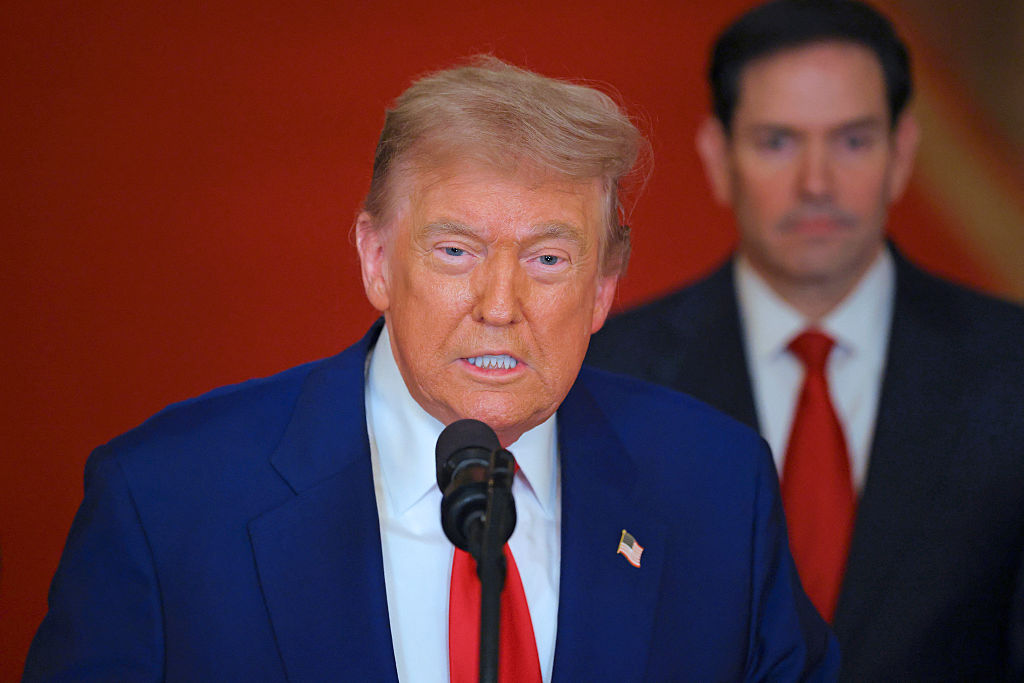
Every Friday, it seems, words spills from Washington that Donald Trump has ordered an imminent strike against Iran. He likes to initiate dramatic military action in the weekend early hours, when markets are closed and the media-consuming public can wake up to big news.
So far, despite the presence of significant US military assets in the region, Trump has resisted the urge to bomb, bomb, bomb, bomb, bomb Iran – preferring instead to pursue a diplomatic settlement with the regime in Tehran.
This weekend could be different. This morning, the US Ambassador to Israel, Mike Huckabee, sent an email to his staff saying those who wanted to leave “should do so TODAY.” The path of diplomacy has, it seems, reached an impasse. Iranian negotiators did make concessions in the Geneva talks this week, offering to reduce uranium stockpiles more than ever, but Tehran remains unwilling to dismantle its nuclear sites and hand over all its fissile materials. There also appear to be outstanding disagreements over ballistic missiles and other issues.
Just because Trump hasn’t yet screwed up a military conflict before doesn’t mean he never will
Trump, for his part, knows that his window for action is closing. He has deployed his “armada” of naval assets into the Arabian seas, as well as a large number of warplanes, and he’ll have to turn them back at some point soon. There have been widespread reports this week of plumbing problems aboard the USS Gerald R. Ford, the world’s largest warship, and lots of whispers of disgruntlement from over-worked American naval officers.
If Trump’s plan was that the mere deployment of such a sizable and menacing force would swiftly bring the Iranians to heel, it appears to have failed.
Yesterday, Vice President J.D. Vance, assured the Washington Post that there was “no chance” America was about to embroil itself in another long war in the Middle East. He did, however, appear to leave open the possibility of a wave of strikes.
“I think we all prefer the diplomatic option,” he said, calling himself a “skeptic of foreign interventions.” “But it really depends on what the Iranians do and what they say.”
Asked if, as a veteran and former sharp critic of the disastrous Iraq adventure, he could ever have foreseen himself supporting another regime change war in the region, Vance laughed and said: “Look, life has all kinds of crazy twists and turns… I do think we have to avoid repeating the mistakes of the past. I also think we have to avoid overlearning the lessons of the past. Just because one president screwed up a military conflict doesn’t mean we can never engage in military conflict again. We’ve got to be careful about it, but I think the president is being careful.”
The Post also asked Vance about his friend Tucker Carlson’s interview with Mike Huckabee, in which the TV host questioned the ambassador about whether America was about to start another war on behalf of Israel. “I guess my takeaway is it’s a really good conversation that’s going to be necessary for the right, not just for the next couple of years but for long into the future.”
Vance insists that “debate and disagreement” on what properly constitutes an America First foreign policy is ‘a good thing’. But when it comes to the next steps in Iran, what best serves America’s interest is a moot point. Stopping Iran having a nuclear weapon appears to be the White House’s priority, but what about Iran’s extensive ballistic missile capabilities, and removing Iran’s implacably anti-American leadership?
If a military campaign in the coming days, in concert with Israeli forces, is launched to decapitate Ayatollah Ali Khamenei’s government, as Team Trump did with Maduro in Venezuela on January 3, what might be the plan to replace it? Secretary of State Marco Rubio conceded recently that regime change in Iran would be “far more complex” than in Venezuela and that required “a lot of careful thinking.”
That word “careful” again. So far, in both his terms, and at least twice with Iran, Trump has pushed America to the brink of a prolonged conflict on several occasions, only to declare victory after swift military action and move on. He may be able to pull that trick off again. As senior military commanders have been warning in recent days, however, a sustained conflict against the Islamic Revolutionary Guard Corps now would be his biggest foreign policy gamble yet.
The risks of a wider war, a shutdown of the Strait of Hormuz, an oil crisis and a global economic panic, are all too real. And any exchange of fire and fury would prompt the question: when it comes to international relations, how careful is the Commander-in-Chief, really? To adapt Vance’s words, just because Trump hasn’t yet screwed up a military conflict before doesn’t mean he never will.



Comments