Much as I love France, who sold us the idea of superior French taste in the first place? Why do we continue to beat ourselves up about their supposedly ultra-cool cinema, peerless fashion sense and exquisite food and drink? Has anyone contemplating the pool of congealing demi-glace set before them at a standard-issue Paris café been able to maintain any delusion of French grandeur?
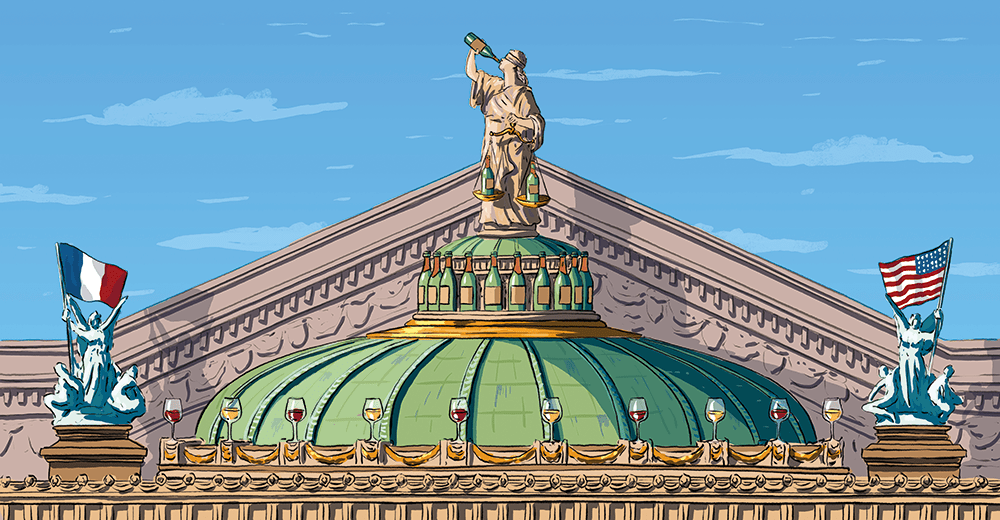
As it happens, a significant blow to French national pride in these matters came almost exactly 50 years ago, at the Paris Intercontinental Hotel, where, in a blind tasting watched over by the world’s media, ten of the host country’s best vintages were set in contest against upstarts from California.
50 years ago there were just two categories: the good stuff (French) and everything else
We should bear in mind that 50 years ago, in the world of wine, there were just two categories: the good stuff (French) and everything else. At the time, the nascent American wine industry occupied a sub-category below even that. One of the few US-based vintners to have brought his product to market was a young Air Force veteran named Charles Shaw, who started a small wine business in 1974. Some of his vintages sold for as little as $1.99 a bottle – and the moniker “Two Buck Chuck” passed into popular shorthand to describe the unpretentious table wines associated with the Napa Valley as a whole.
Steven Spurrier, an Englishman who owned a wine shop in the French capital, organized the 1976 competition, thinking that if nothing else it might “spark an exchange of ideas about evolving production techniques and tastes.” Neither he, nor anyone else present, seriously considered that the event might send shockwaves through the global wine industry.
The competition’s 11 judges included some of the most respected names in French gastronomy, among them sommeliers from three Michelin-starred restaurants; the heads of two highly regarded Bordeaux vineyards; Odette Kahn, the editor of the prestigious Revue du vin de France; and Pierre Brejoux, head of the Appellation d’Origine Controllée. No specific grading framework was given, leaving each judge free to rate the vintages according to his or her own criteria.

As the assembled press photographers snapped away, the climactic moment came when 67-year-old Raymond Oliver, the venerable chef and owner of Le Grand Véfour, one of the French capital’s great dining establishments, sampled a particular white. Some ostentation was involved. First, Monsieur Oliver smelled the proffered vintage, then he inspected it, holding it up to the light to luxuriate in its limpid texture, then he swirled it around his mouth before raising it in salute and, finally, with a deep sigh of satisfaction, said: “Ah, c’est la France!”
Except it was a Napa Valley chardonnay. Of course, M. Oliver didn’t know that – and he was visibly displeased to be informed of his mistake. Nor were his fellow judges happy to be corrected. When the final scores were tallied, the top honors went not to the host nation, but to a California white and red – a 1973 chardonnay from Chateau Montelena, north of San Francisco, and a 1973 cabernet sauvignon from Stag’s Leap Wine Cellars in nearby Napa Valley.
Curiously enough, the winemakers responsible for this unexpected turn of events – a Croatian-American named Mike Grgich, who made the chardonnay, and Warren Winiarski, founder of Stag’s Leap Cellars – were initially unaware of their success. Neither man had been told in advance that his wine had been entered in the contest, and both learned of their coup only by reading the subsequent report by George Taber in TIME magazine. Taber followed up his original story by writing a book on the event, Judgment of Paris: California vs. France and the Historic 1976 Paris Tasting that Revolutionized Wine, published in 2005.
Taber later remarked that, unsurprisingly, the results of the 1976 competition shocked everyone. When it was all over, Kahn unsuccessfully demanded that her scorecard be returned, apparently not wanting anyone from the outside world to know how she had assessed the vintages on offer. “It was meant to be a purely recreational occasion,” she complained. Another judge claimed to be outraged that what he had assumed to be a private event “should be publicly promoted in this way – it was a disgrace.” He was roused to this moral fervor by the belated realization that the journalists and photographers had not been present for their own amusement. Strangely enough, the French media initially chose to completely ignore the results of the competition, although some three months later Le Figaro published a small news item about the event, describing the judges’ verdicts as “laughable” and insisting: “They cannot be taken seriously.”
Unsurprisingly, the results of the 1976 competition shocked everyone
The competition resulted in a significant boost to the prestige and popularity of non-French wine, if not recording a landmark moment in Franco-American relations as a whole. George Taber’s article and book would go on to inspire the 2008 Hollywood feature Bottle Shock, starring Alan Rickman as Spurrier. Barring one or two sour notes, the film was judged to exude a full-bodied robustness that amused even the most discerning critical palates, with an eminently satisfying financial aftertaste.
Taber’s initial story appeared in the July 7, 1976, issue of TIME, which hit American newsstands immediately prior to the coast-to-coast celebrations marking the nation’s 200th birthday. It’s probably a stretch to connect the refined assembly of oenophiles in a Paris hotel to the array of street parades, rodeos, firework shows and hotdog-eating contests taking place across the Atlantic, but it was certainly a happy coincidence. In retrospect, the event – which became known as the Judgment of Paris – was one small part of the continuing culture war between MAGA-style nationalists on one side, and establishment Europhiles on the other.





Comments