The key event in the return of the Artemis II crew was the moment of real drama during what mission controllers call Entry Interface. The capsule is 400,000 feet above the Earth and still traveling at 25,000 miles an hour. They were among the fastest humans even though they did not break the incoming speed of the Apollo 10 mission. It is only fourteen minutes until splashdown in the Pacific, there is no turning back, no second chance, re-entry will happen no matter what.
A few hours earlier the crew donned their orange so-called crew survival suits and lowered their visors. In essence these are personal spacecraft providing everything they need to survive for up to six days. Their water-cooled inner suit was keeping them cool even though the cabin temperature was normal. Outside it was a very different matter.
When you return from the Moon, and they are only the tenth crew to do so, you are traveling very much faster than the velocity required to orbit the Earth, so this is no routine re-entry from the International Space Station. For days they have been making adjustments to their trajectory to align them with a small entry corridor which they must meet with exquisite precision. Failure to do so is unthinkable. To steep and they will burn-up, too shallow and they will bounce off the atmosphere and off into space only returning when all their oxygen is exhausted.
And so, at Entry Interface they begin slowing down from thirty-five times the speed of sound to a 17-mph splashdown just a few minutes later and the only thing that will slow them down is air, and the only thing keeping them alive is a three-inch thick heatshield made of plastic.

Almost imperceptibly at first, they begin to feel the faint tug of gravity as they start deceleration. It grows stronger until it exceeds three times the normal pull of gravity. Pushed back in their seats they know the Earth is reclaiming them.
It’s simple physics. They slow down because of friction with the energy of their movement converted into heat, all 5,252 degrees F of it assaulting their heatshield. It’s designed to burn, then char and then fragment, taking away the heat of re-entry with it. The heat is so intense that a sheath of ionized gas called plasma forms around the capsule cutting off communications for six minutes. When the re-entry is at its max the crew are on their own monitoring the instruments, feeling the excess weight, glancing at each other. This is routine, isn’t it? All but one of the crew have re-entered the atmosphere after previous missions. But this time it’s different.
Twenty-four people have experienced the high-speed return from the Moon, only five of them are alive. All were watching Artemis’ return. Charlie Duke who walked on the Moon with Apollo 16, now aged 90, told the crew they were in for the ride of their lives. When Apollo 11 returned after the first landing, pilot Michael Collins was glued to the window during the blackout when there was nothing to be done but wait and endure. The plasma whisps were dancing around the capsule and he described them as a, “combination of all the colors of the rainbow,” with a central core of orange and yellow.
The capsule does not shake. On liftoff the vibration was intense, but re-entry is smooth but not silent. As the re-entry continues Mission Control waits for the reacquisition of signal. The commander will speak and the computers will squirt a rapid burst of data to ground computers giving the status of the spacecraft.
For days they have been making adjustments to their trajectory to align them with a small entry corridor
The heat shield was a concern but not a problem. On the uncrewed Artemis I it charred and burnt a little more extensively than expected though it still performed very well and protected the capsule. Consequently Artemis II re-entered using a different profile, keeping them away from any problems. The 186 bonded blocks of a Titanium and plastic composite called Avcoat, just a few feet behind their backs, is glowing red. It is threaded with temperature and pressure sensors and this time Mission Control is happy that, as expected, it’s doing its job excellently. Is there a better way to return from the Moon? The Head of NASA, himself a veteran of two re-entries, thinks so, saying the current system, “is not the right way to do things.”
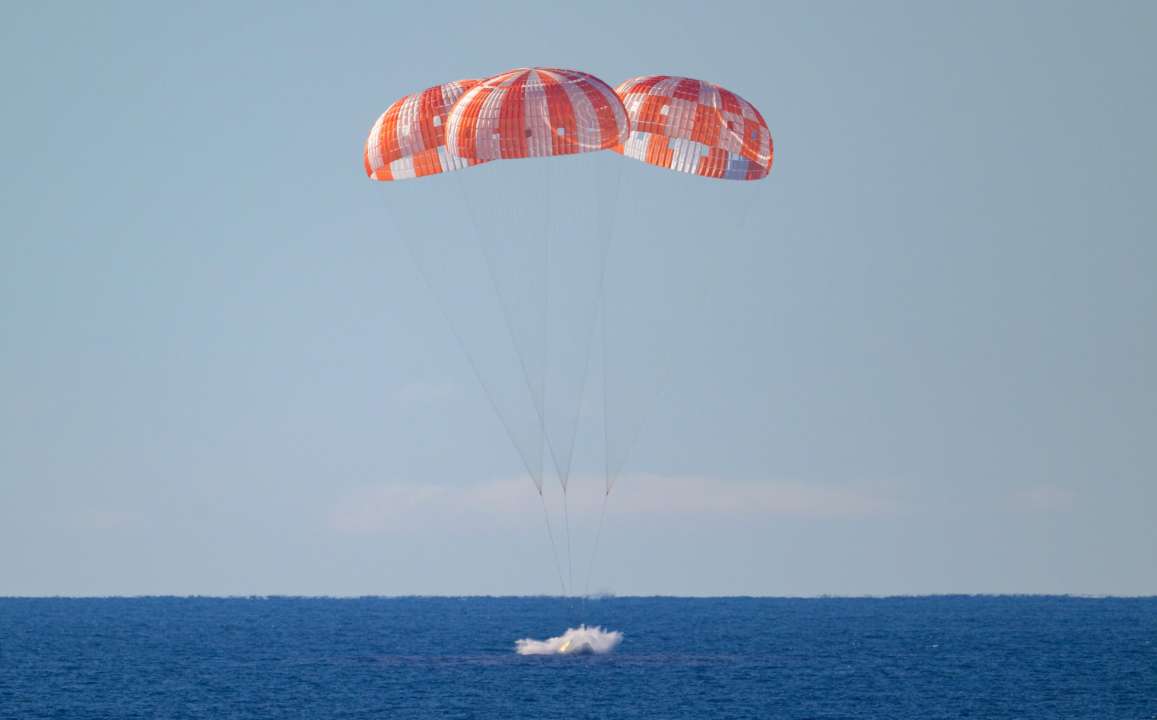
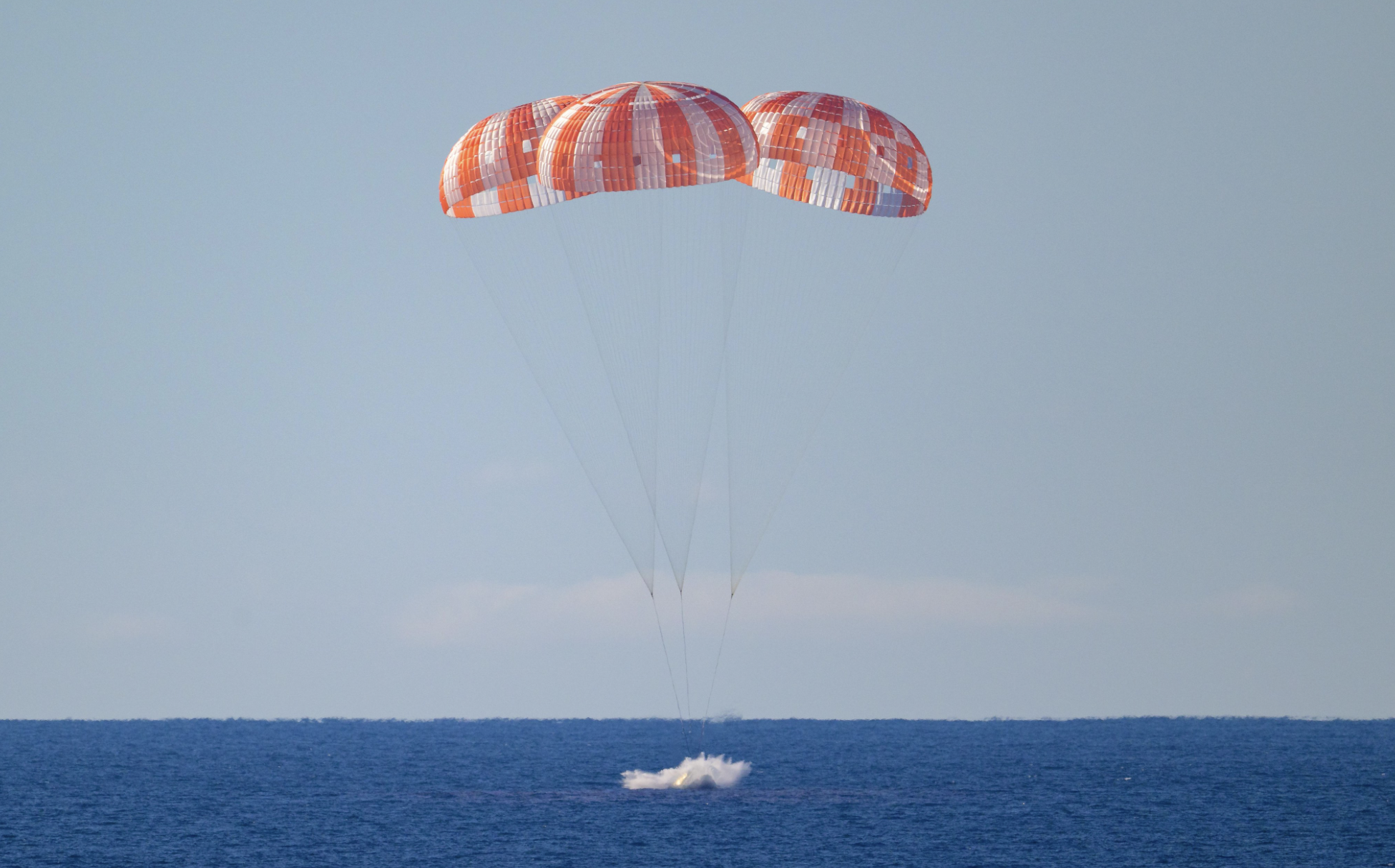
The blackout ends with “Houston, Integrity, we have you loud and clear.” Time for free-fall before the first of a series of parachutes deploy culminating in three main chutes that lowers them into the sea just a mile away from the USS John P Murtha and the circling Sea Hawk helicopters.
Astronauts say that the first taste of sea air after many days of cabin dwelling is an assault on their senses. The crew will take this in when a Navy doctor climbs inside whilst the capsule is still riding the waves to assess the condition of the crew and help them don medical support vests to help them in their first moments of gravity for ten days.
No longer do we live in a world where Moon travel is a thing of the past. The Artemis project moves forward. The components for Artemis III are already being assembled for a flight next year to carry out essential rendezvous tasks in Earth orbit. NASA is to announce that crew after this mission. The task is to put boots on the Moon by 2028 but given the considerable technical hurdles to be overcome this is expected to slip.
As for the Artemis II crew they are reported to be swiftly getting used to gravity again. They face days of medical tests and weeks of debriefs and evaluations and a difficult decision. Do they fly again?
They could if they wished, or they could regard this historic voyage as the pinnacle of their careers. There are certainly many just like them in training for the lunar adventures to come. But something will be different for all of them as they return home, rejoin their families, and carry on. Going to the Moon is no ordinary thing. They have traveled where few have been or could ever follow. From now on people will look at them differently and each will know that in a way they have broken the matrix of ordinary life. They are Moon travelers with thoughts and feelings that we can never truly comprehend. Perhaps like many of the Apollo astronauts they will be forever thrilled by their voyage, and perhaps like others, they will feel the melancholy of all things done.



Comments