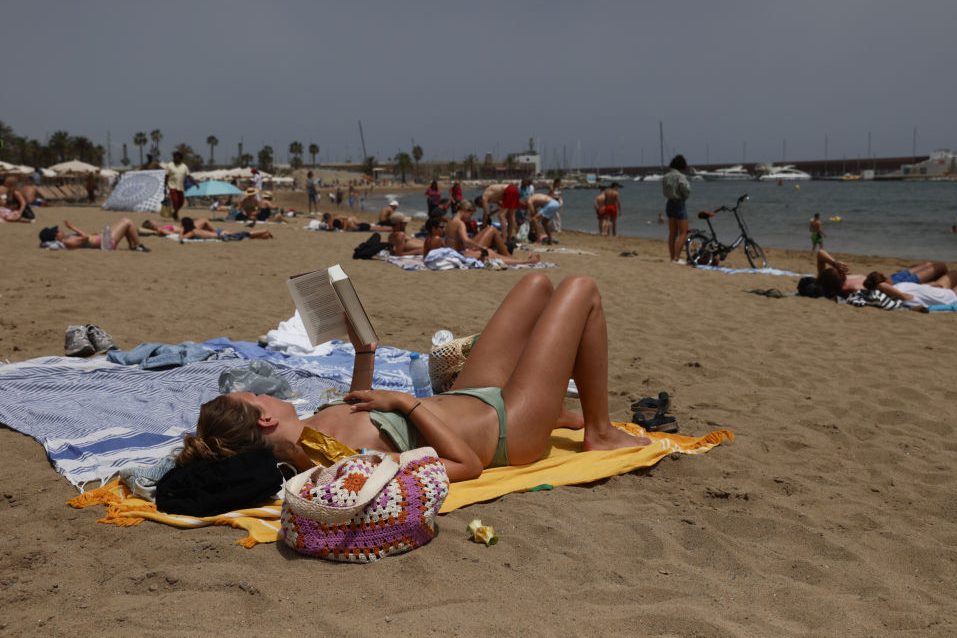
When I go on my hols this summer, I will, as ever, be taking a couple of novels with me. My golden rule for any break is only to take the kind of books that I’m actually likely to read, which not only rules out most of what I write and research, in the form of biographical and historical non-fiction, but also anything that’s going to sit in my suitcase reproachfully unopened, taking up space and leaving me feeling like an intellectual pygmy.
Burying oneself in books should be an enjoyable rather than excruciating experience
Last summer, I raced through an Amanda Craig, several Simon Ravens and a William Boyd. This year, for consistency, I’m hoping to pack the latest Boyd. But I’m also intending to read John le Carré’s A Perfect Spy, which everyone who I respect has routinely described as his masterpiece and which, I hope, will finally make me love le Carré, rather than merely admire him.
I would love to say that I’m also going to be taking The Faerie Queen, Ezra Pound’s The Cantos and some impenetrable modern novel to strain my sun-lashed brain to its limits. But I cannot lie to you, Spectator readers. The idea of doing anything that seems like hard work is so unprepossessing an idea that it makes me shiver, even during these sweaty days. While there is a part of me that would happily spend a week only reading Tom Sharpe and Geoffrey Household, I feel that I should aspire to something above bawdy humour and ripping yarns. But only slightly: hence the presence of two of the most compelling and page-turning British writers of the past few decades on my to-read pile.

When I compare myself both to my peers and the fellow beach-fanciers, I am aware that my intellectual horizons are decidedly limited. Every year, the TLS asks its contributors and friends what they are going to read over their summer holiday; every year, I find myself feeling increasingly out of sync with literary tastes.
Good old Mary Beard, at least, manages to hint that one of her picks might end up remaining largely unread (‘I sometimes find hardcore economic history a bit of a struggle’) but many of the other contributors seem at pains to assure you, and their editors, how clever and how erudite they are, and how jam-packed full of very, very demanding books their knapsacks are going to be.
This is not just reflected in the pages of literary journals, but anecdotally, whether through social media or conversations with friends. Christopher Nolan’s The Odyssey has been the film of the summer, and it has been consequently fashionable in many circles to lambast it for its perceived unfaithfulness to its source material.
Its knocker-in-chief has been Emily Wilson, the tattooed academic and classicist whose translation of the poem in 2017 was not only highly acclaimed but became the basis of Nolan’s screenplay for his film. Wilson might have been expected to nod and smile as the picture’s success elevated sales of her version to giddy heights, but has instead broken ranks to tear it to shreds in the pages of the LRB: a canny decision from an intellectual perspective, and a commercial one, as this has now ensured that those who sneered at Nolan’s perceived populism will be ordering her version of The Odyssey to enjoy as they sun themselves on a Greek island, by a Tuscan villa or in the more far-flung climes of Caribbean shores.
Thus it is with literary snobbery when it’s on holiday. There are books that one is allowed to read – Booker Prize winners current and old, as long as they’re not by the distinctly un-woke Kingsley Amis – and there are titles that are frowned upon. As two white heterosexual Oxford-educated men, Boyd and le Carré would both be seen as passé in many circles, and many of the other books that I have read and enjoyed over the past few months might be looked down on for failing to push literary boundaries, not having fashionable enough authors or simply for being too damn enjoyable.
Sometimes, this literary snobbishness gets into simple self-parody. I am a fully paid-up admirer of James Joyce’s Ulysses, but I am also convinced that it is not exactly light holiday reading. However, for those who would consider The Odyssey, one of the foundational texts of Western literature, somehow too obvious an option, I am sure that they will be packing Joyce’s allusive masterpiece in their hand baggage, to score some imagined points off their fellow travellers. If they’re not getting the attention that they think they merit on the beach, there’s always Instagram, the narcissist’s social media tool of choice to advertise their cleverness and erudition. Look at me, their pictures trill: I’m reading something far more sophisticated than you are. I’m an intellectual; you very much are not.
That’s fine by me. I admire anyone who spends any part of their summer reading, rather than dozing or doom-scrolling. If people seek gratification from the more self-consciously difficult ends of the literary spectrum, then that’s a welcome shift away from sending pouting selfies into the ether. But books, and burying oneself in them, should be an enjoyable rather than excruciating experience. So pack something that you want to spend time with, rather than something that you feel you ought to read. Chances are, it will be the best decision you’ve made since booking your holiday.






Comments