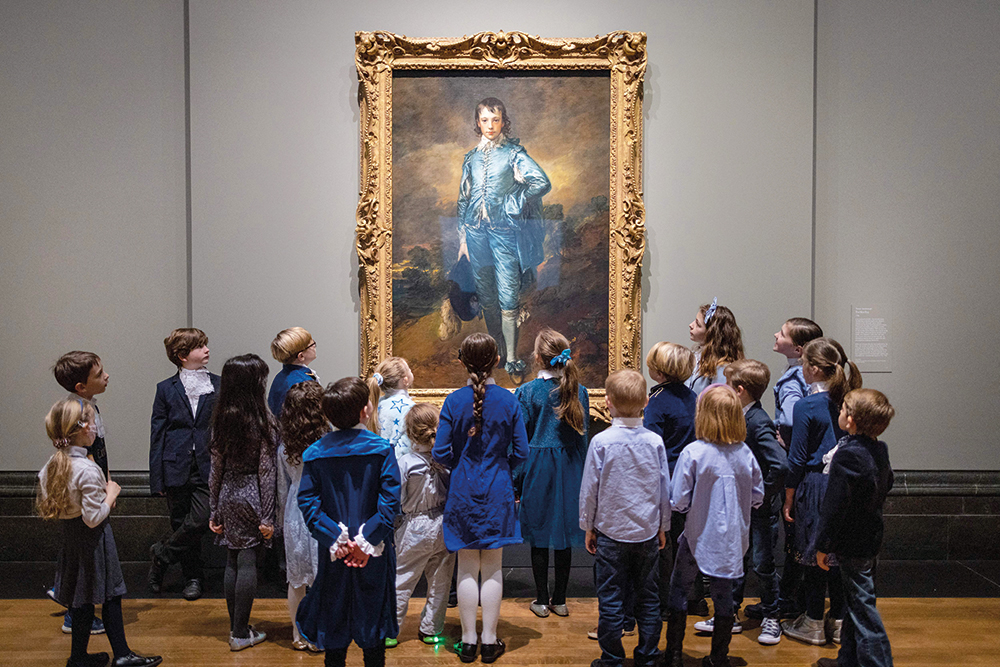
I may be biased because I teach it, but history of art A-level often feels like the greatest, yet most dismally undervalued, subject in the curriculum. It explores history’s most innovative thinkers, enhances visual literacy, teaches history through the prism of creativity and emotion, sharpens critical thinking, and fosters empathy and open-mindedness. Yet it languishes as a minority character in the pantheon of school subjects. It has always been chronically underappreciated by students, teachers, school heads and governments. I worry that its disparagement tells us something rather depressing about our own cultural values and even our sense of what education is for.
Just to scotch a popular misconception from the outset – history of art is not a ‘soft’ subject. Its demands are not dissimilar to those of English literature: it teaches the skills of analysis, interpretation, research and logical argumentation. But history of art tends not to be on most people’s radar as a curriculum subject. Around 35,000 students took English literature A-level last year, compared with 838 for history of art.

What’s going on? How have we become a nation that values Shakespeare, Milton and Austen so much more than Hogarth, Turner and Hepworth? This prejudice in our education system is crazy, particularly since our country is home to some of the world’s greatest artworks, and has its own rich, radical and hugely inventive tradition in the visual arts. By overlooking our artistic heritage and cultural achievements we are neglecting and undervaluing the very areas in which we are a world leader.
A recent study by the Association for Art History throws the demise of A-level history of art into sharp relief. Over the past 15 years, the number of schools offering it has dropped by 34 per cent. You can’t study it at all in Wales, Northern Ireland or Scotland. And because state schools tend to lack the funding to support it, it’s now taught mainly in independent schools.
All this only partially explains why history of art isn’t given the esteem it is due as a subject. Unfortunately, there’s the misapprehension that it’s an easy option, lacking the practical application and skills of its STEM siblings. It’s also tarnished with associations with wealth and privilege. In the news, fine art is often only ever reported in connection with insane prices achieved by artworks at auction, and history of art as an academic subject is usually only mentioned in reference to celebrity poshos like Eddie Redmayne, Loyd Grossman and the Princess of Wales, all of whom studied it at university.
This is a maddening delusion. In history of art A-level, we study architecture and public sculpture as well as painting. This means that students understand the historical resonances of their local, free-to-access parish church or memorials as well as in major international monuments such as Angkor Wat or the Parthenon.
Many of Britain’s greatest museums (such as the National Gallery of Scotland, V&A, the various Tate galleries and the British Museum) offer free entry. Far from being an exclusive and snobby subject, history of artis radically egalitarian. It may cultivate aesthetic pleasure, but its core skills are far more practical.
Key among them is the discipline of close looking and visual literacy, which is intrinsic to the subject and vital for many skilled professions. Whenever I have the opportunity, I enjoy telling people about the American art historian Amy Herman in this context, who has used artwork analysis to sharpen the observational abilities of members of the NYPD, FBI, Interpol and the military and intelligence communities.
How have we become a nation that values Shakespeare and Austen more than Hogarth and Turner?
There is hope on the horizon for the beleaguered subject. A brilliant organisation called Art History Link-Up offers courses to students who wouldn’t otherwise have access to it. Earlier this year, the Courtauld Institute of Art is also announcing its intention to work alongside educational and philanthropic partners to make history of art more accessible as a subject at school level.
Is it worth the fight? I believe so. History of art, like every humanities subject, is essentially an exploration of how to live. It offers students a multitude of opinions about how to discriminate beauty, honesty and decency from cruelty, nihilism and barbarism. And in history of art, the scope of these opinions is enormous, encompassing the time span between the palaeolithic period and the present day. We can’t access the music, religions or stories shared among our ancestors from 10,000 years ago, but we can look at their visual art.
We live in a time when our cultural habits, access to information and even our desires are defined not by other people, but by algorithms. And as the element of human contact is gradually being drained out of these interactions, surely the role of the humanities should be even more central to the education of the young. Only the humanities can explain and augment the experience of being human, to show us its fallibilities and delights, its agonies and glories, to remind us that this experience can – should – be honourable, worthwhile and beautiful. Now is the time to rally around the humanities, to make them more prominent in the curriculum, to spread and popularise them, especially the history of art – relentlessly underappreciated and overlooked as it is.





Comments