
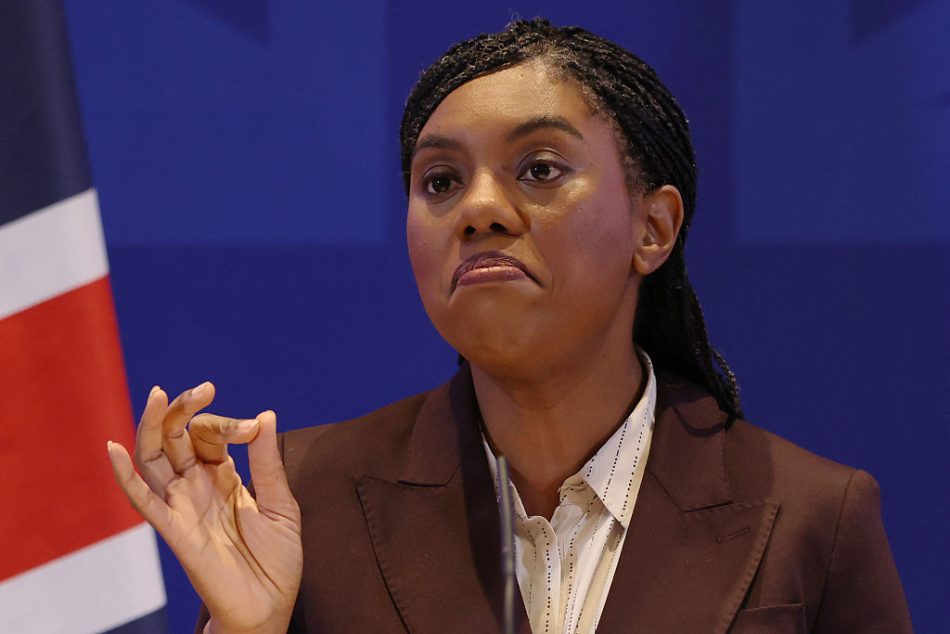
Much like Alan Partridge, Kemi Badenoch hopes to have bounced back. After an unsure start to her first year as Tory leader – hopeless interviews and PMQs showings, and a local election shellacking – she now seems to be on a roll. Her two recent set piece speeches at conference and responding to the Budget were successes, her parliamentary performances have been more assured, and she can now get through an interview without declaring war on her ethic enemies. The Conservatives are no longer spiralling towards fourth; her personal ratings have ticked up to the dizzying heights of -14.
For the first time since Badenoch became leader, I feel a faint twig of optimism
For those of us of a Kemi-sceptic disposition, this is quite distressing. When you have become used to someone falling flat on their face again and again, their failure to continue doing so astonishes. I had expected her to flop at a wake-like party conference, to continue missing open goals at PMQs and to build up sufficient resentment that – either before or after May’s locals, set to be as disastrous as 2025’s but on a wider scale – she would either be junked by her MPs or resign out of shame. But I was wrong. The rot appears to have stopped.
Mea culpa, mea maxima culpa. I had allowed my vision to be clouded by several things: a low estimation of Badenoch’s abilities, my zest for Robert Jenrick and my deep and all-consuming pessimism about my party’s prospects. I have spent too many afternoons with the London Zoo penguins. Consider this an apology. Having set the bar for Badenoch so low, I must be honest when she has surmounted it. Before anyone asks about my health, I haven’t been drugged, abducted and chained to a CCHQ desk by the Movement, even if I do keep having visions of Henry the Great.

Badenoch has been saved by a combination of personnel changes – in the Shadow Cabinet, and in the backroom – and by finding a political purpose. The electorate’s memories seem short enough to trust us Tories over Labour on the economy. Badenoch has made a return to prudence central to the Conservative offer, just as swing voters have soured on Labour’s tax rises for splurges on their public sector chums, EU boondoggles and welfare largesse. Badenoch finally has something to say that doesn’t sound ludicrous and which meets voters where their concerns are.
And yet. Just as Partridge’s frantic assertions that he had bounced back were contradicted by his hawking his autobiography at Norwich Station, one must check the increasingly virulent outbursts of Kemimania by pointing out how difficult the Tory position remains. Our ratings are no longer in free-fall. But that is as much because of the Labour’s ongoing experiments with new depths of unpopularity amid the success of prominent boob-whisperer Zach Polanski – no Tory he. We remain loathed by da yoof, irrelevant to vast swathes of the electoral map and with a brand only marginally less toxic than Huw Edwards’s.
With internal numbers suggesting that the Tories on track for 14 seats at the next election, our hopes of returning to government in 2029 are slim. May’s elections still look set to see us ended as a national force – kicked into fourth or fifth in Wales and Scotland and beaten back across England. The cause of this is plain, and painful: Reform UK. Nigel Farage’s momentum may have been checked by a bad by-election, media gaffes and schoolboy errors. But Reform’s lead remains healthy and their ceiling high. Badenoch is the leader who took her party from first place to third by going AWOL for months and leaving the space open to Farage.
Badenoch has realised that twiddling her thumbs for two years before announcing policies was a ludicrous idea; the addition of Neil O’Brien to her top team has brought not only much-needed heft but a parliamentary aggressiveness that reaped dividends over the China spy scandal. But it is Reform that is making the running on developing a policy and strategy for a future right-wing government. That such bright sparks as James Orr and Danny Kruger see more hope from a Reform ministry than a Conservative one set alarm bells ringing amongst thinking Tories (both of us).
It may be that Badenoch’s historic role is merely to steady the ship: to keep the party financially viable, to absorb the blows of a rocky first couple of years in opposition, to put in place the fundamentals of a strategy and policy prospectus for a future right-wing government and to bolster the Tory position sufficiently that the inevitable negotiations with Reform can be conducted from a position of less-than-total supplication. If Badenoch did that, fell on her sword and handed over to a fresher face by 2029, she would be a model servant of the party that she has long claimed to love.
After Kruger’s defection, I had an overwhelming sense that the Conservatives were toast. If the Last Tory had decided the party was not worth fighting for, why should I? Rather than go to Reform, I had bucolic visions of fleeing to the countryside, blissfully decoupling from the appalling realities of an SW1 that I had once sought my fortune in. But for the first time since Badenoch became leader, I feel a faint twig of optimism. The hour is late, the situation grave and the wicket sticky. But all is not quite lost. At least I’ll have some semblance of a party to inherit from my safe seat in 2029.


Comments