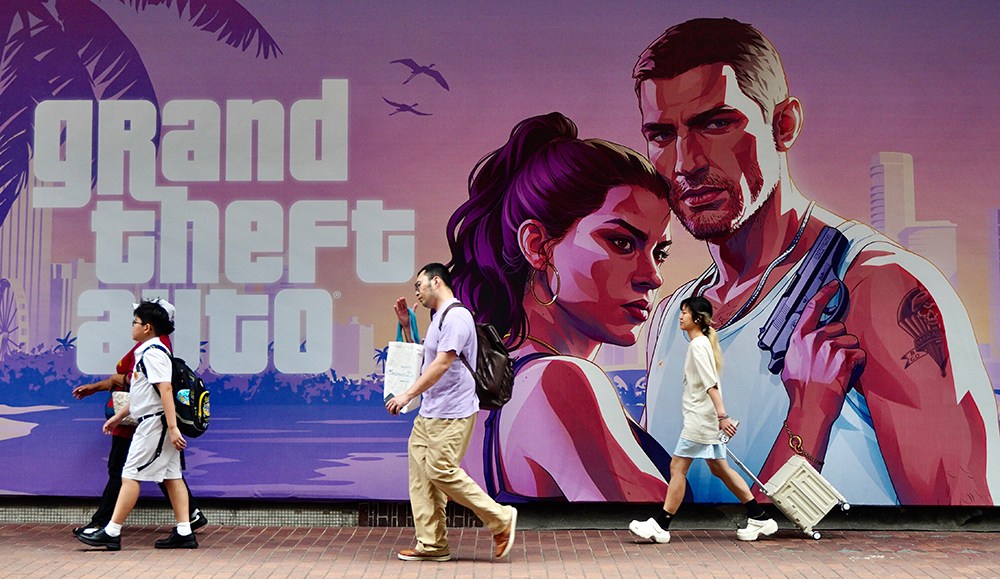


Grand Theft Auto has gone woke. Murdering prostitutes, once a staple in-game activity, has been replaced by painting your bedroom in preparation for your girlfriend’s arrival home from prison. Committing actual grand theft auto has been curtailed. Instead you can work as a roofer replacing tiles on your damaged shack.
But something even stranger has happened in GTA: it now reflects our dark economic times. In its last iteration – GTA V – it was impossible to play without your character being rewarded with millions of GTA dollars. Now you really have to grind. In GTA VI the American dream has been replaced by a version of modern Britain: working all hours with very little to show for it.
Economists and analysts at the Adam Smith Institute spent last Friday marauding around the game. ‘It’s really expensive,’ the ASI’s Maxwell Marlow complains – not referring to the game’s £89.99 price tag. He means the virtual economy within the game. A bit like being an employee in Britain, ‘you constantly find yourself without money no matter how much work you do’.
It was a deliberate game design: this time the in-game economy would be at the forefront. ‘We have made money matter more in this story than I think it has in previous GTA games,’ the lead developer said recently. They have achieved this by making it easier to lose in-game cash and made life within the game more expensive. ‘It is an economically responsible game in that sense,’ says Marlow. ‘Some lessons for the government there.’

GTA designer Rockstar Games is right to think about economics. When it launched GTA Online – the multiplayer version of GTA V – it quickly ran into in-game inflation which made the currency lose any meaning and the game less enjoyable.
Economists have looked into how games reflect the real world. Future Greek finance minister Yanis Varoufakis was one of them. Gabe Newell, owner of the American video game developer Valve, whose game Team Fortress 2’s economy had spiralled out of control, asked Varoufakis for help.
The game had no virtual currency, but players had started using virtual hats, originally intended for aesthetics, as a form of money. These hats could be sold on eBay for real cash and then used in-game to trade for other items. It’s a bit like cigarettes being used as currency in prisons. Newell became concerned when one pixelated pilot’s cap sold for $6,000 – real ones. ‘I was surprised when Gabe contacted me,’ says Varoufakis. Newell had seen a blog in which Varoufakis had criticised the eurozone’s single currency and thought there would be no one better to stop the growth of the hat-based single currency that Valve had accidentally created.
Newell was obsessed with a ridiculous-sounding question: ‘What happens if one of these items emerges spontaneously as a common currency? Then are we going to have the problems that Germany, Greece, Ireland and Portugal had?’
Varoufakis accepted the job as Valve’s ‘economist-in-residence’ and helped develop some of the in-game inflation-busting mechanisms which most massively multiplayer online role-playing games (MMORPGs) use.
His innovations were necessary to stop these games emulating real-world economics too much. World of Warcraft, for example – an MMORPG that happens to have a level-51 ‘Gnome Warlock’ allegedly played by Kemi Badenoch – has just been through a cost-of-living crisis of its own.
When players complete in-game quests – slaying monsters or farming cabbages – the laws of the game grant them virtual currency or gold. As new players join these fantasy worlds, more opportunities for printing virtual cash arise. For years this was balanced out by teenage boys discovering girls, or wives issuing ultimatums; accounts went dormant and their gold left the economy with them.
Then virtual gold acquired a real-world value. Some developers established official ways to exchange real money for virtual currency, while unofficial markets sprang up even in games that tried to ban such trading. Players who didn’t want to spend hours grinding to get to higher levels started paying with real-world cash, agreeing a price via eBay or PayPal, then meeting inside the game to exchange the goods.
With a new real-world financial incentive, players (often based in China) began to ‘gold farm’, ‘dungeon raid’ or ‘cabbage grind’– which just means doing some in-game gold-generating task again and again, at a vast scale, to produce enough gold to sell for real cash to wealthier players who want to level up quickly. There ends up being far more virtual currency in these fantasy worlds than their creators ever intended. The result is an inflationary crisis and virtual cost-of-living pressures not dissimilar to our own.
World of Warcraft, for example, has just been through a cost-of-living crisis of its own
In another game, RuneScape – a bargain-basement version of World of Warcraft – for example, the most effective orc–killing weapon in the game would have cost a player one million coins two decades ago. Today, the equivalent weapon costs 240 million coins, as demand outstrips supply. Rune-Scape has become a pretty good simulation of a hyperinflated Zimbabwe.
Designers have to act to keep their games fun. RuneScape now has a 2 per cent tax on all gold transactions and earlier this month World of Warcraft announced it was taking steps to stop players abusing the game’s rules in pursuit of easy gold generation through ‘the misuse of dungeons’. GTA VI’s more Protestant-style economy will keep a lid on things when an online version is released.
But the lessons go both ways. Varoufakis learnt how online games could help him improve his understanding of economics in the real world. His time at Valve strengthened his conviction that humans ‘don’t understand money – especially economists at the Bank of England’. And so observing how an economy functions in an ‘environment designed by people who didn’t have an inkling that a monetary system would emerge within it’ was like ‘having a laboratory’. Since he had access to every transaction, trade and population member, he became ‘like God’.
Indeed, Varoufakis is not interested in the games themselves. ‘I never got into them. That’s one of the reasons I couldn’t stay longer at the company. They were all mad gamers and I could never really get into killing zombies and all that.’
‘The lessons we tend to get from virtual economies tend to be the lessons we get from real economies,’ says Matt McCaffrey, an economics professor at Manchester University. ‘The laws of economics are universal. They don’t disappear in fantasy worlds, and the same economic problems always pop up.’
When it comes to abiding by the world’s oldest economic lessons, it’s increasingly politicians and bankers, not video-game players and designers, who are living in a fantasy.




Comments