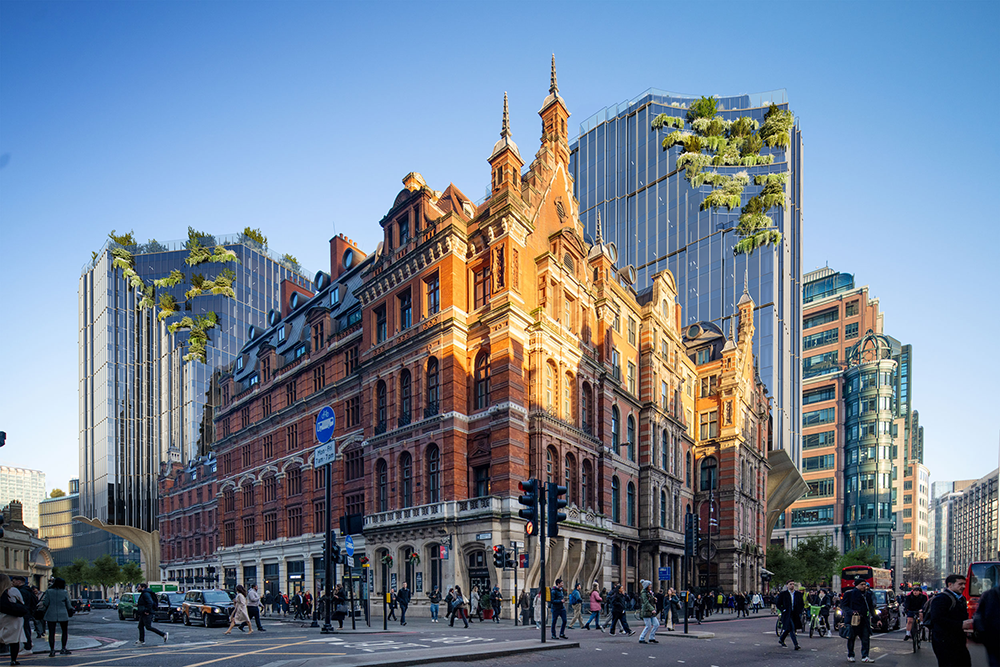
The City of London is not noted for its beauty. Most great European cities expect their historic streets to retain visual integrity, their modern buildings to show some respect for their old. London’s planners, such as they are, have little use for such concepts. A few ancient churches cling to life in the footings of skyscrapers. The odd pub slinks nervously down a back alley. Anyone seeking historic London should look elsewhere.
Meanwhile, competition for the ugliest City building is intense, but an outright winner is in the offing. Permission has just been given for a true monster to sit over Liverpool Street Station. The speculative development, backed by Network Rail, is for a 19-storey L-shaped cliff to tower over the Great Eastern hotel on Bishopsgate. It will demolish part of a listed building, disregard a conservation area and glare out over the City’s last neighbourhood of urban dignity, Spitalfields. Its facades will be topped by bizarre moustaches of vegetation to make them look ‘green’.

The guardianship of Britain’s historic buildings is unmistakably in retreat. The City recently swept aside the Fleet Street conservation area to give itself permission for the redevelopment of Salisbury Square. Westminster council allowed a giant glass box to destroy what used to be the Paddington conservation area. Emboldened by Sir Keir Starmer’s attacks on conservationists as nimbys and wimps, planning permissions are becoming ever more reckless. The Victorian masterpiece that was central Manchester is starting to mimic London’s Canary Wharf.
If Notre-Dame had burned down in London it would still be a gutted ruin
The £1.2 billion Liverpool Street Station scheme designed by a firm called ACME is a mystery. Figures in Network Rail’s own viability report admit that it shows a £220 million shortfall, rendering it ‘not technically viable’. The figure also disregards millions in compensation payable to rail operators and others for at least eight years of building disruption round Bishopsgate. This suggests that, as with the aborted ‘Helter Skelter’ at nearby 22 Bishopsgate, ACME’s project might simply fail. There the planners took pity on the developers and allowed the highest tower in the City to rise instead.
Liverpool Street Station is a London gem. Network Rail’s predecessor, British Rail, tried to demolish it in the 1970s, but this produced a campaign similar to that which failed to save Euston but did rescue St Pancras. A public inquiry was entertained by Sir John Betjeman and Spike Milligan. The station survived and an extension by the British Rail architects department produced a masterpiece of neo-gothic revivalism. It was later listed for preservation and yet is now under sentence of death.
The new plan has evoked 2,400 letters of protest and a coalition of champions, including the 20th Century Society, the Victorian Society, Georgian Group and SAVE Britain’s Heritage. They have commissioned an alternative scheme by John McAslan and Partners, designers of the revitalised King’s Cross. This preserves the existing concourse and train shed, while locating 700,000 square feet of offices in a block floating above the northern end of the shed. Much of this can be built off-site and need not disrupt train movements. The cost is just half that of the present scheme, or £600-700 million.
Both schemes were presented to a packed City planning committee in February in a session that was a caricature of the bad old days of London property development. The committee was clearly going to approve the ACME slab. Its backers were given 45 minutes to state their case. The alternative Mc-Aslan scheme was given a mere ten. When McAslan then tried to answer questions put to him, he was told that he had had his ten minutes and should shut up. The ACME plan was passed on the nod.
Sir Sadiq Khan, London’s mayor, and Steve Reed, the Planning Secretary, have the power to overrule the City. The project blatantly disregards listed building and conservation controls. It ignores the government’s new 2024 national planning framework in its disrespect for historic environment. Ignored too is the City’s aim for new developments to contribute to carbon neutrality. A report by the sustainability expert Simon Sturgis dismisses the project as so defective as ‘to date from the 1990s’ and be effectively ‘redundant’. Its budget even offers a sheepish £1 million in carbon offsetting.
The viability of the McAslan alternative has been challenged by ACME in the Architects’ Journal, but at the very least it merits consideration, while the present project should be paused. It cannot simply be ignored. If Network Rail’s board had any guts it would withdraw a plan that appears against its operational and financial interests as well as facing serious public opposition.
So many such projects in Britain’s public sector acquire a scale and an extravagance that clearly overwhelms those supposedly in charge of them. Contracts for new ships and tanks go out of control. So does work on HS2, Hinkley Point and the repair of the Palace of Westminster. Everything seems to cost two, three or four times what similar projects cost abroad. HS2 is now running at an estimated eight times what similar rail lines cost in France and Spain. If Notre-Dame had burned down in London it would still be a gutted ruin.

The reason is simple. Poorly led public bodies live in awe of Britain’s most powerful professional lobby, accounting consultancies. They profit by pumping cost inflation into the construction industry, with no incentive for economy. Liverpool Street is the victim of another hard-pressed nationalised industry, Network Rail, finding itself adrift in the Wild West of London’s property industry. It clearly does not know where to turn, and needs ministers to put it out of its misery. The alternative is another grim memorial to Britain’s public-sector philistinism – paid for in yet more swingeing rail fares.
As for the City, it is clearly as much a political as a planning anachronism. Its constitutional independence, dating from the Norman Conquest, leaves it like the Church of England and the House of Lords, validated merely by antiquity. Each time local government reform is mooted, as it is now, the City is thought too insignificant to merit change. Nothing should ever be that.






Comments