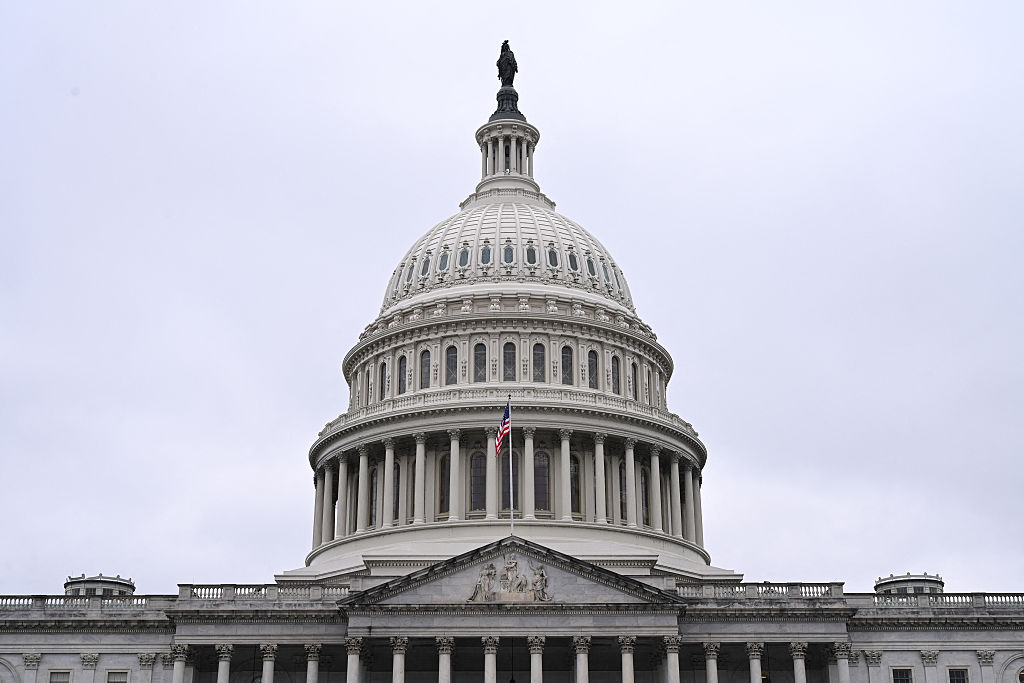
America needs Donald Trump, badly. He is the bull in the china shop that every nation needs from time to time. He is testing his country’s constitution to destruction as well as its relations with the outside world. Such tests hasten the necessity of reform. The only question is how long will it take for reform to catch up and overcome him, as it surely will.
Constitutional chaos may then break loose after midterms. This is America’s great opportunity
In January alone Trump toppled the leader of Venezuela, mooted the conquest of Greenland and a 100 percent tariffs on Canada, insulted the British army and killed Americans protesting his immigration policy. He has shown himself immune to constitutional checks by virtue of his congressional majority and past Supreme Court patronage.
Nothing Trump has done so far is unprecedented. The White House is papered with past presidential bids for untrammeled power. Andrew Jackson ordered “a second declaration of independence” and constantly vetoed Congress, though he was vetoed in return. James Polk conquered Mexico and sought to colonize the Caribbean. Andrew Johnson substantively reversed the result of the Civil War by suspending Reconstruction.
At the start of the 20th century Teddy Roosevelt went further. He saw America taking up Kipling’s “white man’s burden” and becoming an imperial power. He invaded Cuba and Panama and occupied the Philippines, defying a fiercely skeptical Congress. He sent a “great white fleet” round the world and ensured himself a place on Mount Rushmore.
Woodrow Wilson was a foretaste of Trump’s Board of Peace in inventing the League of Nations, but Congress prevented America from becoming a member. Franklin Roosevelt massively abused “emergency” executive orders to erect the beginnings of a welfare state. He then defied the two-term protocol by running four times for president.
America’s Congress supposedly has power to curb an autocratic president, but that assumes it is prepared to use it. Trump’s reliance so far on Congressional support seems certain to end with the Republicans losing their majority later this year. Constitutional chaos may then break loose. This is America’s great opportunity.
When FDR defied the two-term protocol, Congress did not hesitate. In 1951 it passed the 22nd Amendment entrenching the two-term limit. When Trump last year mooted defying it, he knew he could not. Reversing the FDR amendment would need the approval of two thirds of Congress and of the states. As de Tocqueville noted, American democracy is regularly accountable, even if it “defaults to the mob.”
Trump may yet prove vulnerable to a more recent 25th Amendment to the Constitution, passed after Kennedy’s assassination. This laid down a procedure should the president not die but be unfit to govern. Trump’s rambling speeches have indicated early dementia or, more critically, narcissistic personality disorder (NPD). The clinical definition is when a patient is self-obsessed, craves attention, interprets every contact egotistically, is mendacious and careless of others.
There were frequent “25th Amendment moments” in Trump’s first term, when White House “grown-ups” discussed whether he was actually ill. They also occurred in the presidencies of Ronald Reagan and Joe Biden. There would appear to be more such moments now, though fewer grown-ups. A Democratic Congress would also render Trump more vulnerable to impeachment.
Even if Trump sees out his full term, one thing is for sure. When he departs reformers galore will descend on the constitutional china shop to see what needs mending. A prime candidate could well be the presidential electoral college. It assumes all states (other than Maine and Nebraska) give all their votes to their state’s majority candidate. This leaves losing votes uncounted. The system gave the White House to George W. Bush in 2000 and Trump in 2016, when both had lost the popular vote. One result is that presidential elections are largely fought only in a minority of “swing states.”
Another candidate for reform is the Supreme Court, a gerontocracy reduced to rubber-stamp status by political appointees. Yet another is state sovereignty, after Trump’s brazen invasion of Minnesota with what amounts to a presidential private army. Every constitution needs an occasional spring clean. But it takes a crisis to secure it.
On a different level will be the operation to rectify some of the wilder consequences of Trump’s posturing on the international stage. Recovering from his much-touted “bullying hegemony” should not be difficult for a successor, though it may take a king-sized love-in to soothe many bruised and sensitive western nations. Harder but equally necessary will be to respond to Mark Carney’s Davos call to replace Trump’s “rupture with transition,” which received a standing ovation.
Nowhere has Trump so thoroughly smashed the china as in America’s role as head of NATO. The accusation that Britain was “not fighting in the front line” of what was America’s vengeance war against Afghanistan showed an alliance that had lost its bearings, or at least was a sign of acute NPD.
Trump was refreshingly realistic last year in telling the Arab world there would be “no more nation building.” His controversial National Security Strategy document rejected America’s role as an “indispensible nation” with a duty to police the world. But he then did what every president since the Cold War has done. Sensing the guns of military glory, he did the precise opposite, in Iran and Venezuela.
America’s backing for NATO has long been shrouded in rhetoric and bluff. Trump reasonably banged his fist on the table and asked what was really being expected of America’s taxpayers and its armed forces. It was a good question, but one that has yet to receive an answer. His successor will need one if deterrence is to have any meaning. Sometimes diplomacy needs a wake-up call from exasperation.
The calendar will call time on Trumpism and its wayward madness. With time it is certain there will be some reform. The historian Arthur Schlesinger held that America’s Constitution had guided it through frequent critical cycles. They had often gone to the brink of disaster. But the Constitution had always hauled Americans back to their roots and taught them a lesson. This happened most recently during McCarthyism and briefly under Nixon.
For 250 years the United States has not fallen apart as South America did. It has suffered just one internal war, while Europe has seen too many to count. The evidence is on Schlesinger’s side. Americans have achieved a political union whose robustness remains an example to every country on earth. It enabled 13 tiny colonies to become, for all their faults, the richest, strongest, most enterprising and open-minded of great powers. The present world would be unimaginable without America.
It is currently enduring a moment of trial, from which it will emerge strengthened by the Trump experience. We should all be thankful.






Comments