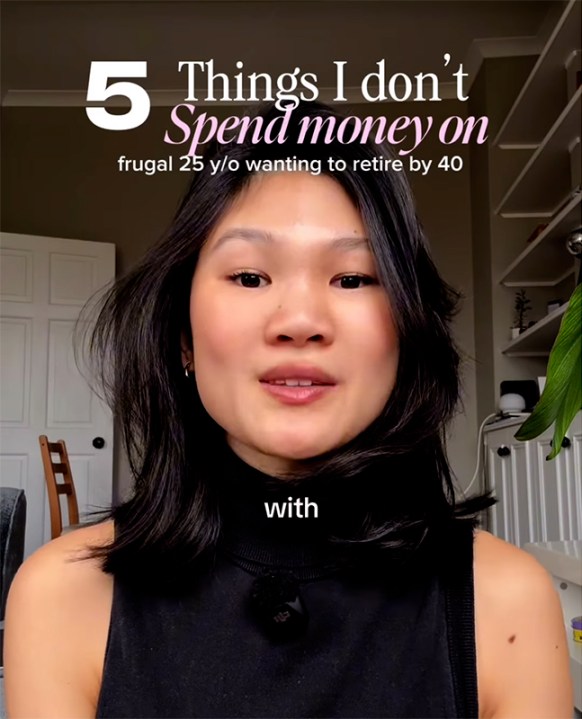


It is, apparently, a novel concept in our age of overconsumption, that life can still be enjoyable even if you don’t have stupid money. ‘Frugal chic’ is the new lifestyle trend summed up by the 25-year-old influencer Mia McGrath, who coined and trademarked the term, as ‘living luxuriously while spending intentionally’.
Frugal chic supposedly teaches young women – whose financial literacy typically lags behind young men’s – how to make their money go further with practical advice on investing and saving. This type of frugality is not about doing everything on the cheap, but rather emphasises what McGrath calls ‘value-based spending’ – for example, buying the £120 pair of shoes that will last several years, rather than the £8 pair that will need replacing after a few months.
It’s not so much what the frugal chic girl doesn’t buy, but the ‘investment pieces’ she does spend her money on
Beyond the hard financial advice, the lesson here is that you can build a more fulfilling life without making yourself miserable by pinching pennies. It’s not so much what the frugal chic girl doesn’t buy that makes her frugal, but the natural fibres and ‘investment pieces’ she does spend her money on. (Some of McGrath’s favourite purchases of last year were, she admits, from H&M.) Miss Frugality can also attain a spiritually richer life through cultivating ‘hot girl hobbies’, such as walking outside and doing puzzles.
While frugal chic strikes me as a way for materialistic young women (I include myself in this category) to cope with a cost-of–living crisis, McGrath rejects the notion that it’s a ‘recession indicator’ or merely reactive. ‘It’s not a trend to me; it’s a philosophy,’ she writes on her Substack, where she has more than 24,000 subscribers. One article features an image of a ‘frugal but rich’ moodboard, including a Cartier Tank watch, an overflowing Birkin bag and a bar of Hermès soap. She writes that saving money and repairing items instead of replacing them ‘are not radical behaviours; they only appear so in an era obsessed with excess’.

Every so often, a new trend crops up which veils an excuse to consume – not necessarily to consume more, but to consume better, more wholesome things – behind an ethos of anti-consumerism. Before frugal chic, there was ‘quiet luxury’: think Jil Sander, cashmere jumpers from The Row, beige, beige, beige. And before quiet luxury, there was the health-conscious ‘clean girl’ (Pilates, slicked-back hair, expensive skincare, more beige). And before that the quest for a ‘capsule wardrobe’ to release us from the burden of too much stuff. Each was as much a rejection of overconsumption as it was an excuse to ‘curate’ a collection of supposedly elegant, joy-sparking and wholesome possessions.
Carolyn Bessette Kennedy recently emerged as the It girl – despite the fact she died more than 25 years ago – of our frugal chic moment. This is partially thanks to the new FX biopic series Love Story, but more down to her minimalist, uniform-like style. The CBK look appeals at a time when women are trying to console themselves that there’s more to life than having lots of those shiny, colourful things we can’t afford. Maybe if we have a few nice pieces in our wardrobe, if we can pass for a Calvin Klein publicist – or better yet a Kennedy – we’ll be content enough with what we have to stop fussing about clothes and focus on things besides money. Like puzzles.
I’m sympathetic to this feeling. I am, as many young women are, abstractly aware that fast fashion and overconsumption are social and environmental ills, not to mention scourges on my wallet and peace of mind. But, as Dave Chapelle said, women be shoppin’. We still want to buy things. The idea of having a ‘shopping ethos’ makes me want to gouge my eyeballs out, but it’s more realistic than abstaining from shopping, and morally more laudable than simply not caring. Whether it’s possible to disguise this as frugality, though, I’m not convinced.
But McGrath’s schtick – helping women save money by convincing them that frugality is a chic, aspirational lifestyle, while offering entry-level information about bonds, Isas and banking apps – is a refreshing break from the deliberately opaque advice offered by other non-professional finance influencers, many of whom are flogging snake-oil ‘wealth strategies’. However, much of her credibility is grounded in her status as a content creator who was able to make £100,000 in a year and a half by monetising her brand of frugality, and she often offers advice on how to make content creation your nine-to-five. There’s a bizarre circular logic to it all: the key to financial freedom is making short-form videos on how making short-form videos is the key to finding financial freedom.
Given the independence and the potential earnings of the job (McGrath has had months where she’s made as much as £50,000) it’s no wonder 57 per cent of Gen Z say they would like to be influencers, while being a content creator is the most desired career for Gen Alpha. Not only does it pay well to be an influencer if you’re able to land paid brand deals and monetise views, but you often get stuff for free, whether it’s a spa holiday or lip gloss. (In a video laying out her outgoings last month, McGrath says she only had to spend £6.99 on make-up – with the caveat that a brand sent her some for free.)

For the rest of us, it’s not so easy to be frugal, especially when our social media is filled with influencers showing off their freebies. There have been countless times where I’ve suddenly discovered a gaping hole in my life, which could only be filled by some little thing I’d had no idea existed until I opened the Instagram app on my phone.
Lifestyle influencers might like to believe they’re helping their followers change their habits for the better, but more often they tempt us to buy into their image of happiness and success (even when that’s by buying less). McGrath’s advice is to choose between ‘scrolling for entertainment and showing up with intent’ – to ‘log off completely, or build something’. It’s probably a good rule for those of us not aspiring to become full-time content creators. After all, it’s not really chic to take financial advice from influencers.






Comments