Around 350 pages into Simon Sebag Montefiore’s exhilarating and accomplished history of the modern Middle East, we reach the present – or at least times that are so close to us that they are very much part of our recent lived experience. We have, to be fair, left long ago the realm of archives and yellowing press cuttings, black-and-white photographs and oft-cited quotes, and have been traversing for some time the years of all-too-bloody recent memory: 9/11 and its consequences, the Iraq War, the rise of ‘neo-Ottoman’ Turkey, the Arab Spring and much else.
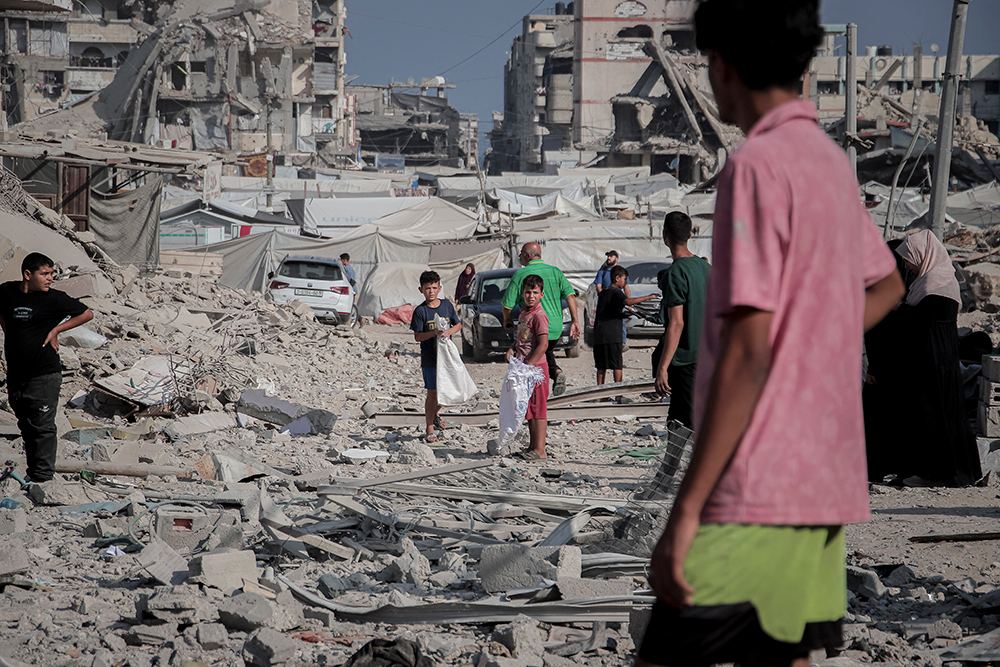
But suddenly here we are. There is Donald Trump in the White House; the carefully negotiated 2015 nuclear agreement with Iran shredded; MBS the new crown prince of Saudi Arabia; and the Islamic State defeated in Iraq and Syria. Rushing towards us like an out-of-control freight train on a steep downhill track is an appalling conflict that has torn Sudan apart; Hamas’s bloody surprise attack on Israel on 7 October 2023; Israel’s relentless retaliation on Gaza; the rounds of new conflict in Lebanon; the fall of the Assad regime in Syria; the consequent coming to power of a former al-Qaeda jihadist in Damascus; and the current war in the Gulf, which may have ended by the time you read this, but don’t hold your breath.
At this point, the aim of Montefiore’s ambitious effort to retell the entire history of the Middle East since around 1900 becomes clear. The Cauldron attempts to provide us with the necessary background to formulate our own views. After all, we can only understand what is happening today in the Middle East if we know what went before. This should be a truism, but isn’t. The past 30 months or so have made amply clear quite how many people, despite having only the most superficial knowledge of the extremely complex history of the region, can hold very strong and exclusive views on events there. If just some of them read this book, Montefiore can count a big win.
When Yitzak Shamir became Israel’s prime minister, Abba Eban called the event ‘the tunnel at the end of the light’
His effort is a brave one. A problem that confronts reporters in the Middle East is that you are frequently exposed to individual narratives that are themselves entirely coherent, convincing and, at least in terms of the individual facts that compose them, accurate. Yet they are often entirely irreconcilable with other ones that are similarly coherent, convincing and, in the same selective way, true. This is bad enough for those dealing with breaking news. But when it comes to venturing into history, it is the stuff of nightmares.
What is also clear is that arguments about the Middle East that take place outside the region are often more about the preoccupations, concerns and identities of participants than anything actually happening there. The rhetorical violence of such confrontations is partly made possible by the knowledge that in the US, the UK and France, such disagreements are unlikely to lead to real violence. This is not the case in the Middle East, of course, and when outrage is no longer a localised phenomenon, polarisation in one place can fuel new confrontations thousands of miles away, setting up an appalling feedback loop of increasing extremism.
The extent of The Cauldron’s narrative is vast, ranging from Morocco to Afghanistan and from southern Sudan to Azerbaijan. Iran features heavily, which is useful and distinguishes the book from other more Arab-centric accounts. There are hundreds of rapid sketches of major actors: the Islamist ideologue Syed Qutb and Ayatollah Ruohollah Khomeini rub shoulders with King Hussein of Jordan, Golda Meir, King Farouk of Egypt and Colonel Muammar Gaddafi, to name but a handful. This is a work aimed at a general audience, and if some scholars sniff at the broad brushstrokes of the portraits, most readers will be grateful for them. The same applies to the lively descriptions of episodes that are familiar to the specialists.
Montefiore also has an eye for telling details and quotes. Field Marshal Montgomery says he will be ‘sorry to leave Palestine’, where he has been crushing a revolt by its Arab population, because he has been ‘enjoying’ the war out there. Little more needs to be said about how most of the upper ranks of the British political and military establishment viewed the fortunes of both Arabs and Jews in its quasi-colony. Anwar Sadat describes joining radical organisations of all ideological types in Cairo as a young man ‘out of curiosity or hope’. Paul Bremer, George W. Bush’s plenipotentiary in Iraq, sees a captured and condemned Saddam Hussein as ‘after all a human, even if a monster’. British allies are ‘the snake in the grass’, he muses.
When Yitzak Shamir, the dour, implacable, right-wing former terrorist, became prime minister of Israel in 1986, the urbane and cultivated Abba Eban, a former Israeli foreign minister, called the event ‘the tunnel at the end of the light’, nicely capturing both the extinction of the optimism of Israel’s earlier decades and the not unconnected rise of Israel’s right. Just a decade later, Bill Clinton met Benjamin Netanyahu, the recently elected prime minister, and received a lengthy lecture. The US president walked away incensed, asking aides: ‘Who the fuck does he think he is? Who’s the fucking superpower here?’ Earlier this year, another US president, equally enraged by the veteran Israeli politician’s presumption, would use such profanities directly to Netanyahu – again a useful moment, when the reader can see the contours of current confrontations in earlier ones.
An advantage of Montefiore’s long view is that it allows him to tease out some important shifts. One is the extraordinary transformation of certain Middle Eastern states from victims of intervention by other powers to ones that now project influence far overseas. Gulf monarchies fund proxies in East Africa, Libya and elsewhere in ways that would have been all too familiar to former colonial overlords. The concept and definition of the Middle East needs to be expanded, Montefiore argues, to include more countries, more territory, more variety and more ambition.
Occasionally some nuances get lost. Do we know for certain that the Pakistani intelligence services protected Osama bin Laden in the years before his death at the hands of US special forces in 2011? There’s no solid evidence. Was President Sadat really the best ruler Egypt had in the 20th century? Possibly, though the competition is weak. Was the revolution in Iran a key motor of Sunni jihadist violence in recent years? Many scholars would argue otherwise. Do the Gulf monarchies offer the most hopeful current model of an authentically Islamic governmental system to the region, and indeed the world? Montefiore suggests so; others may justifiably differ. But amid the current tsunami of overheated commentary on the Middle East, this reasonable and genuine effort to present a careful, fact-based and sensitive account of such contentious topics is very valuable indeed and deserves to be widely read.
‘Ignorance is the father of righteous certainty, hatred and slaughter; knowledge is the mother of respect for others, alliance, sharing and tolerance. Knowledge is an elixir, the antidote to the poisons of supremacy, bigotry and ignorance. Peace is only possible when a majority in any society hears and accepts the narrative of others,’ Montefiore writes, and he is right, of course.



Comments