
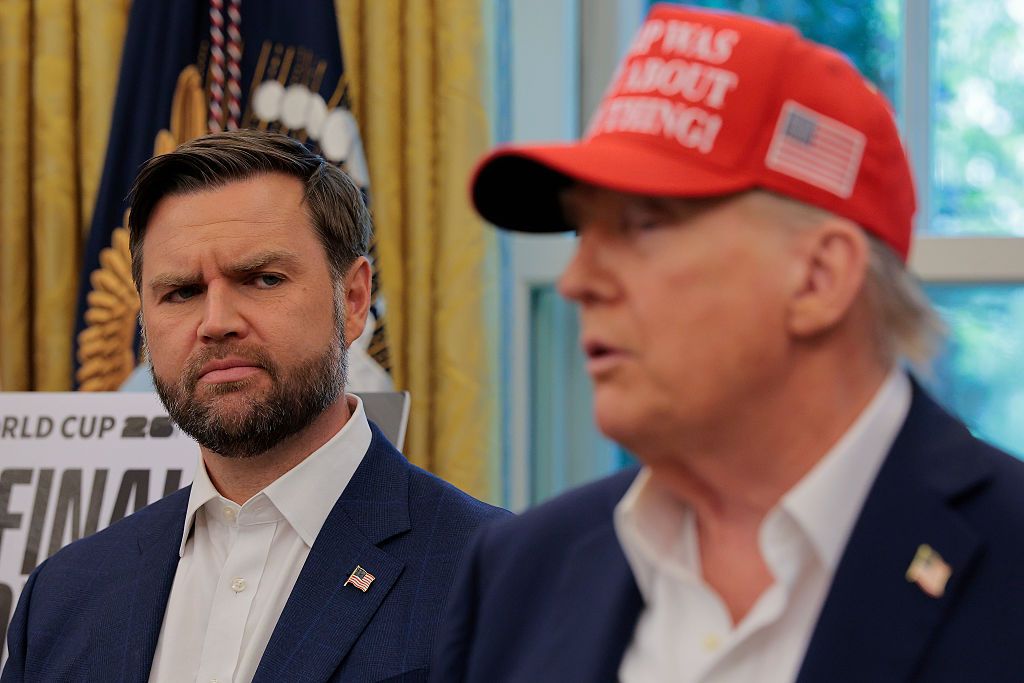
There’s a wonderful old gospel song called “Ain’t Nobody’s Fault But Mine.” That phrase has never passed the lips of Donald Trump, and he’s not about to start uttering it now.
But a lot of other Republicans are at least whispering it, and a few are singing openly from the hymnal. They point to President Trump’s over-promising and under-delivering on the pledges he made in 2024. They also note that he told voters this year to think of him as being “on the ballot,” at least in spirit.
The spirit was willing but the ballot box was weak. The Republicans didn’t just lose. They drowned in a tsunami, often by 60-40 margins in red states that Trump had won easily two years before. When South Carolina elects a Democratic Senator, when Texas turns blue at every level, you are witnessing something more than a few bad candidates – you are witnessing voters’ wholesale rejection of Republican performance since 2024. They did not vote for a positive Democratic platform, but voted to reject what the Republicans had done.
Of all the losers’ finger pointing, the most stunning came from Vice President J.D. Vance. Although he didn’t blame his boss directly, he effectively blamed the midterm results on Trump’s bad decisions, particularly his choice to fight an unpopular war against Iran.
Trump made two fundamental mistakes in the Iran War. He never convinced voters that it was necessary, that removing a nuclear threat to the United States was possible or that the short-term costs were worth paying. His other fateful mistake was pausing major combat operations to negotiate with Iran before the US had eliminated its key military and political targets.
Iran played Trump for a sucker, to put it bluntly. They refused to make major concessions, despite the US pause, and they managed to halt petroleum and chemical deliveries through the Strait of Hormuz before the US could reopen the flows. The result was a spike in energy prices and a slowing of US growth (though still far short of a recession). Oil flows are finally getting through, but prices are still high and the war remains unfinished, with no clear path to the goal line. Voters showed they were none too pleased with this half-finished outcome, the high energy prices and the confused rationale for the whole operation.
The unspoken – but obvious – subtext of Vance’s position is “I disagree with the President on the war.” The other message is “I’m positioning myself to run for president in 2028, and I can’t win unless I distance myself from an unpopular incumbent.” How Trump will respond to that distancing – will he see it as disloyalty? – is one of the big questions about the impending battle for the Republican nomination.
Each party faces fundamental questions about its future
Vance is also underscoring his credentials as a populist. His election post-mortem also pointed to Trump’s decision to provide strong, continuing support to Israel as a reason for Republican losses in the midterms. Blaming Israel (and, all too often, Jews in general) is an enduring feature of populism, both in the US and Europe. What is striking is how long that vile sentiment has remained silent on America’s populist right. That silence is ending now, and Trump’s own impulsive decision to cut off US aid to Israel reflects those changes.
What we can see plainly now are enduring themes of populist politics. It is always framed as supporting the “little, powerless guy” against some “big, malicious minority.” That minority is always blamed for our nation’s troubles, and they must be made to pay dearly for their sins.
The targeted group always includes corporations, Wall Street and the rich. In the 1890s, it was the Robber Barons and the railroads. Today, it is Palm Beach Billionaires, Big Tech and data centers. Other minorities vary over the years as prime targets. For decades, it was African-Americans – the fulcrum of Southern populism for a century after the Civil War, from the KKK to George Wallace.
Today, the target has shifted to Israel, and frequently to American Jews. This kind of scapegoating is now rising among isolationist Republicans, especially younger ones. Meanwhile, the socialist left has been launching those attacks for over a decade, making common cause with a growing population of Muslim immigrants. Sometimes the venom is open; sometimes it is coded. But it is there.
Indeed, this hatred has become a core feature of the socialist left’s rhetoric. Just listen to the newly-elected Senator from Michigan, Abdul El-Sayed, who puts it in stark terms. Iran, he says, is no more evil or dangerous than Israel. He’s not shy about broadcasting those views. The day before Michigan’s Democratic primary, he shared the stage with the notorious Hassan Piker. Democrats still elected him. In the past week, he was aided by an advertisement, paid for by an independent group, blaming Israel for Michigan’s high grocery prices. He was asked repeatedly to condemn the ad, and refused.
Now that the blue tsunami has demolished the old political landscape, each party faces fundamental questions about its future. For Democrats, the biggest question is how to divide their energies between attacking the Trump administration and putting forward a positive agenda, which can serve as a platform for 2028. They will try to do both, of course, but they still face choices about priorities.
They will almost certainly try to impeach the President and have a large enough majority to get it through the House on a party-line vote. The open question is whether the public considers that a diversion from their kitchen-table concerns.
In pursuing their legislative agenda, Democrats have a huge, under-appreciated asset. The party’s victory in the House is large enough that the Democratic Socialist wing cannot wield an effective veto over the center-left’s agenda. But they will surely try. Hakeem Jeffries will keep throwing them bones, hoping to appease the activists and ideologues. The trick is to do it without alienating voters and undermining the party’s chances in 2028.
One thing will unite Democrats on Capitol Hill and across the country: blocking Trump’s nominees
One thing will unite Democrats on Capitol Hill and across the country: blocking all Trump’s nominees for the Cabinet and the Courts. Trump knows that, so he will have to reform his Cabinet before January and, after that, appoint only interim secretaries. If any judicial nominees are confirmed after January, there won’t be many and they will trickle through only after major concessions from the White House.
Passing anything other than an interim federal budget is probably a lost cause. The only question is whether there will be prolonged shutdowns. Facing that nasty stasis, Trump will govern by executive order. It’s not exactly the constitutional structure the Founders imagined.
For Republicans, the crucial question is whether Trump, who transformed the old Republican party, has lost control of his creation. The answer depends on his popularity with the base, the people who showed up for his rallies by the thousands. Will those voters back away after he led the party to such devastating losses? Will the base treat him as a spent force?
The answers matter for every Republican running for president in 2028. Can they risk crossing Trump to build a wider appeal, first among Republican primary voters and then among Independents? They will need that wider appeal to take the Oval Office, but first they have to win the primary battle.
The candidates will spend a lot of time trying to solve that puzzle. And they have to do it while Democrats are trying to lash all of them to Trump, hoping another tsunami will return to drown them all.






Comments