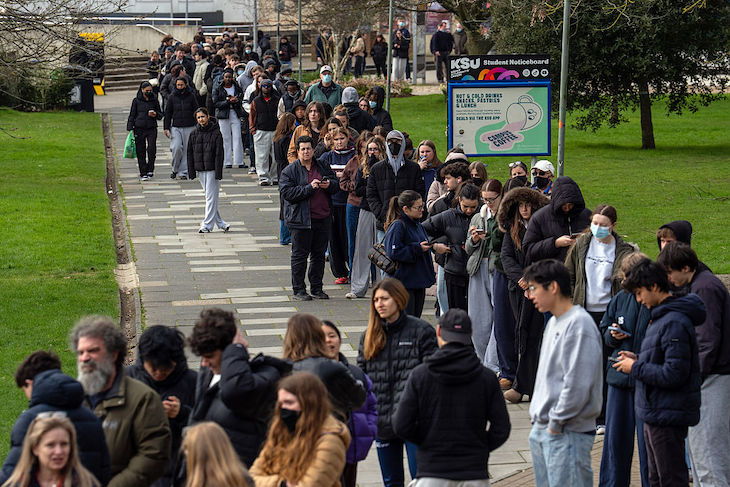
Bacterial meningitis has left two young people dead and another fifteen seriously ill following an outbreak linked to a night club in Canterbury. Whenever there’s a photo of a pretty non-celeb teenager in the paper the heart sinks. So rarely is it good news. This time it was Juliette, 18, a sixth form pupil, smiling out at us with a pink flower in her hair. She died from the illness on Sunday. Her father said the family had ‘no words to express their loss’.
Her father said the family had ‘no words to express their loss’
By the time our children reach adolescence, meningitis – which we were all terrified of when they were babies – has slipped down our worry lists; it’s way below drugs, alcohol, pregnancy, rape, accidents and murder. It’s this – and the devastating speed with which the infection takes hold – that makes it so deadly.
The problem is that meningitis is difficult to diagnose. A rash, one of the symptoms, is easy to spot but sometimes by the time it actually appears it’s too late. Septicaemia can kill quickly, in hours. A baby can’t tell us their neck is sore or stiff, but an older child or adult can. A stiff neck with a headache is not cause for alarm but add fever, joint pain, nausea or eye sensitivity – even before a rash develops – and it can be a red flag. A balance needs to be sought between awareness and provoking unnecessary fear, but health education has suffered in Britain because of finite resources. Might greater awareness of meningitis – or a greater uptake of the Meningitis B vaccine – have saved lives in this latest outbreak? It seems almost certain it would have done.
Despite being an ex-nurse, when I caught a severe, but much less serious, viral meningitis in my late twenties, I failed to spot the signs. Money was tight in those days. I had then two very young children, a toddler and a ten month old baby, and, for a spell, three jobs. Five mornings a week I was a district nurse and after the shift would rush back to feed the baby who steadfastly refused bottles, sippy cups and hardly ate any solids. Two afternoons I ran health education classes for mothers in one of the poorest primary schools in Scotland; one on women’s health and the other on AIDS.
All this working and running about began to take its toll. One day, when my then husband was away for a week on a work trip, I began to feel unwell. I had a fever and headache but the district nursing job was new and I didn’t want to let the team down. Half way through the morning, driving between patients, I had to pull over. The headache and fever became intense and were not helped by medication. I felt sick and couldn’t turn my head. My neck felt hot inside. Back at the surgery the kind and handsome, James Bond lookalike, senior GP examined me. He asked me to bring my chin down to my chest which I could, but he didn’t think the fact I couldn’t turn my head from side to side was significant. He sent me home telling me to go to my own GP if I got worse.
An hour later, I begged my childminder to stay with the babies and drove at 15 mph, hardly able to open my eyes because they were by now so sore, to my GP surgery. The receptionist told me I couldn’t be seen and should come back later, but I slumped down on the seating anyway and was seen quickly. Half way through the examination I lost consciousness and an ambulance was called.
I was lucky that it was viral and not bacterial meningitis. If it had been the latter, I’d perhaps be dead or missing limbs. But even so, it still took two months to recover properly. Meningitis is a cruel, and devastating illness that takes hold with devastating speed. If any good can come from the horror of this deadly outbreak, it’s that greater awareness of this illness might save lives in the future. That, of course, will offer little comfort to those who have lost their loved ones.




Comments